We offer FREE SHIPPPING on all orders!
We offer FREE SHIPPPING on all orders!
| THIS PRODUCT IS INTENDED AS A RESEARCH CHEMICAL ONLY. This designation allows the use of research chemicals strictly for invitro testing and laboratory experimentation only. All product information available on this website is for educational purposes only. Bodily introduction of any kind into humans or animals is strictly prohibited by law. This product should only be handled by licensed, qualified professionals. This product is not a drug, food, or cosmetic and may not be misbranded, misused or mislabeled as a drug, food, or cosmetic. |
GHK-Cu is a naturally occurring copper-binding peptide that has attracted substantial interest for skin repair, collagen production, wound healing, hair growth, tissue regeneration, and anti-aging applications.
It is quite different from peptides such as BPC-157 and TB-500. GHK-Cu has been studied for decades, particularly in dermatology and wound-healing research, and copper-peptide ingredients are already widely used in topical cosmetic products. However, that does not mean injectable GHK-Cu has the same level of evidence or an established medical dosing protocol.
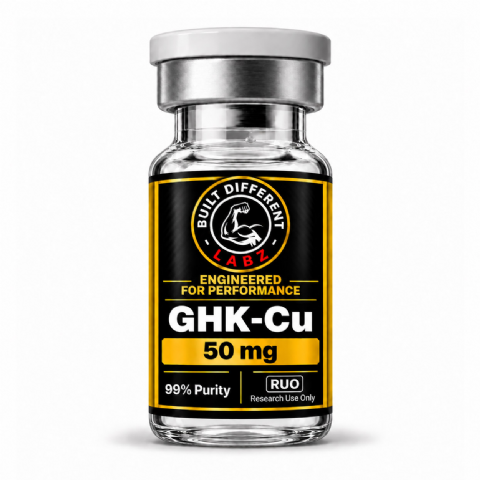
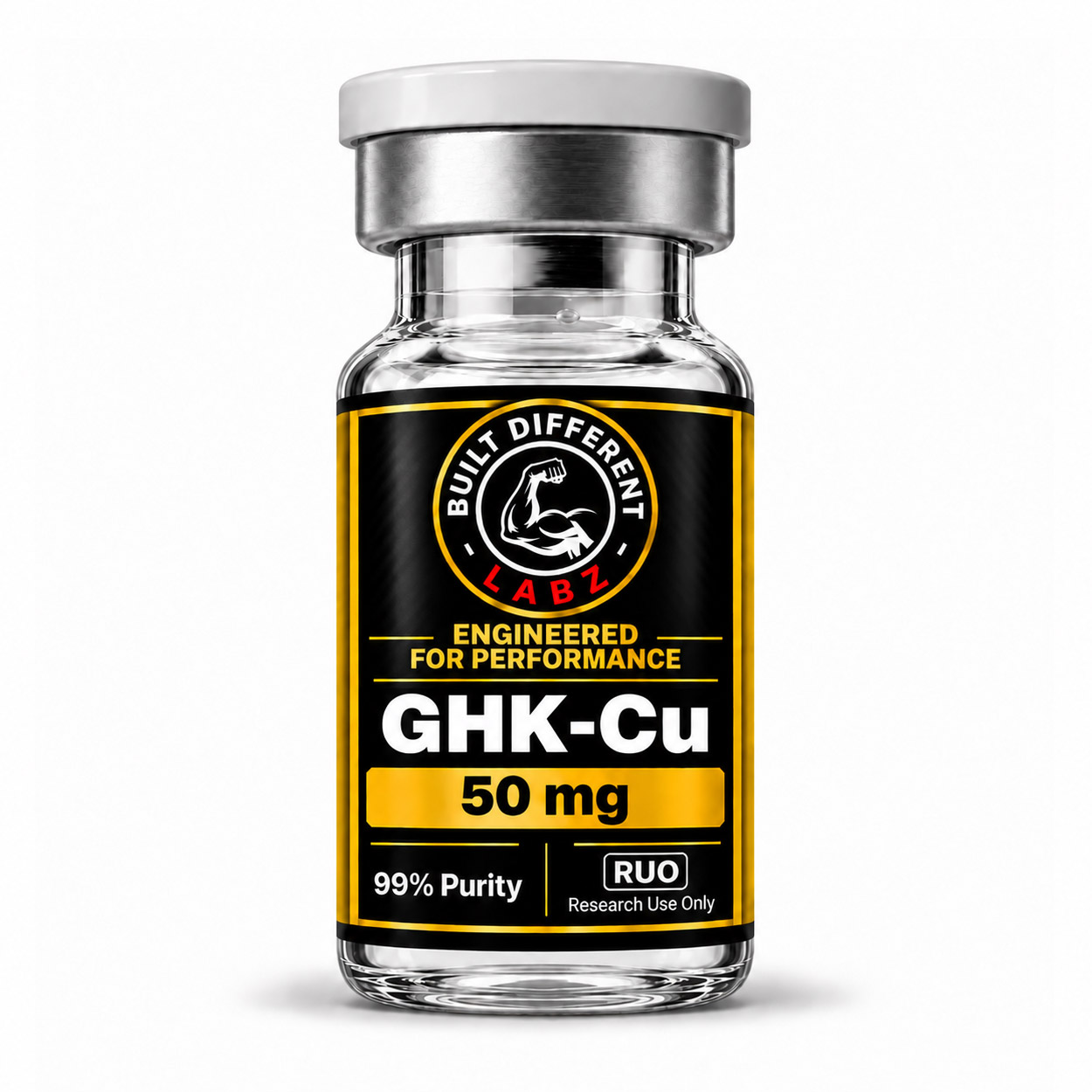
The "50mg" designation simply refers to the amount of GHK-Cu represented as being contained in a particular vial or product. It is not an established recommended human dose.
GHK-Cu stands for:
Glycyl-L-Histidyl-L-Lysine Copper
GHK is a naturally occurring tripeptide composed of three amino acids:
Glycine - Histidine - Lysine
The histidine portion allows GHK to bind copper ions very strongly.
Once bound to copper, the complex is called GHK-Cu.
GHK was originally identified in human plasma. It is also found in biological fluids such as saliva and urine.
The amount circulating naturally in the body appears to decrease with age, which contributed to interest in GHK-Cu as a potential regenerative and anti-aging compound.
GHK-Cu appears to function partly as a biological signaling molecule and copper-delivery system.
Research has associated it with processes involving:
Collagen production
Elastin production
Skin regeneration
Wound healing
Blood-vessel formation
Hair-follicle biology
Inflammation
Antioxidant activity
Tissue remodeling
Fibroblast activity
Gene expression
Extracellular matrix repair
Unlike a steroid or growth hormone, GHK-Cu isn't primarily trying to force tissue into an anabolic state.
Its effects appear to be more closely related to regulating repair and remodeling processes.
Copper is an essential trace mineral.
The body needs copper for numerous enzymes involved in:
Connective-tissue formation
Iron metabolism
Energy production
Antioxidant defense
Nervous-system function
Pigmentation
Blood-vessel development
One particularly important copper-dependent enzyme is lysyl oxidase.
Lysyl oxidase helps cross-link collagen and elastin.
Those proteins provide structural strength and elasticity to:
Skin
Tendons
Ligaments
Blood vessels
Connective tissue
GHK can bind copper and potentially help regulate its availability to biological processes.
Collagen production is probably one of the best-known properties associated with GHK-Cu.
Fibroblasts produce much of the collagen found in skin and connective tissue.
Research suggests GHK-Cu can stimulate fibroblast activity and influence production of extracellular-matrix components.
These include:
Collagen
Elastin
Glycosaminoglycans
Proteoglycans
This is one reason GHK-Cu became popular in cosmetic and anti-aging products.
Skin rejuvenation is probably the most established commercial application of copper peptides.
GHK-Cu has been investigated for its potential to improve:
Skin firmness
Skin elasticity
Fine lines
Wrinkles
Skin texture
Skin thickness
Hydration
Sun-damaged skin
Wound repair
Copper peptides are consequently found in many topical anti-aging products.
Topical GHK-Cu is considerably different from injecting a 50mg research vial.
Evidence supporting topical cosmetic use cannot automatically establish the safety or effectiveness of systemic injectable use.
GHK-Cu may influence several processes associated with aging skin.
These include collagen synthesis, elastin production, antioxidant activity and tissue remodeling.
Rather than acting as a temporary moisturizer, the theoretical advantage is that GHK-Cu could influence the underlying extracellular matrix.
This has made copper peptides particularly interesting for long-term skin-care formulations.
However, cosmetic improvements tend to be gradual rather than immediate.
Wound healing is another major area of GHK-Cu research.
Normal wound healing involves several stages:
Blood clotting
Inflammation
Cell migration
Formation of new blood vessels
Fibroblast activity
Collagen production
Tissue remodeling
GHK-Cu appears capable of influencing several of these processes.
This is why researchers have investigated copper peptides for damaged skin and wound repair.
Fibroblasts are extremely important cells for connective-tissue repair.
They produce structural materials such as:
Collagen
Elastin
Extracellular matrix
GHK-Cu appears to influence fibroblast activity.
This could help explain many of its proposed effects involving:
Skin
Wounds
Connective tissue
Scars
Tissue remodeling
Hair growth is another major reason GHK-Cu has become popular.
Copper peptides have been investigated for effects involving:
Hair follicles
Follicle size
Hair-growth signaling
Blood supply around follicles
Inflammation around follicles
GHK-Cu is therefore frequently included in topical scalp formulations.
It is sometimes compared with minoxidil, although they are very different compounds and shouldn't be considered interchangeable.
There is biological evidence supporting copper peptides' effects on hair-follicle biology, but evidence for GHK-Cu as a stand-alone treatment for common male or female pattern hair loss is much less established than treatments such as minoxidil.
Hair loss can also have numerous causes:
Androgenetic alopecia
DHT sensitivity
Nutritional deficiencies
Thyroid problems
Stress
Autoimmune disease
Medication
Scalp inflammation
GHK-Cu would not necessarily address all of them.
Copper plays an important role in melanin production.
Melanin determines much of the pigmentation in:
Hair
Skin
Eyes
This has generated speculation that copper peptides might influence hair pigmentation or premature graying.
There isn't enough evidence to say that GHK-Cu reliably reverses gray hair in humans.
GHK-Cu appears to have anti-inflammatory properties.
Rather than simply blocking inflammation like a conventional NSAID, it appears to influence signaling pathways associated with inflammation and tissue repair.
That distinction is potentially important because some degree of inflammation is necessary for proper healing.
The objective isn't necessarily to eliminate inflammation but to regulate it appropriately.
Copper participates in antioxidant systems within the body.
For example, copper is required for copper/zinc superoxide dismutase.
Superoxide dismutase helps neutralize reactive oxygen species.
Oxidative stress contributes to:
Cellular damage
Skin aging
Inflammation
DNA damage
Tissue degeneration
GHK-Cu has therefore attracted attention for possible antioxidant and protective effects.
GHK-Cu has also been associated with angiogenesis.
Angiogenesis means the formation of new blood vessels.
This is important during healing because newly repairing tissue needs:
Oxygen
Nutrients
Growth factors
Immune cells
Repair cells
Improved vascularization can potentially create a better environment for tissue repair.
One of the more interesting areas of GHK research concerns gene expression.
Laboratory research suggests GHK can influence the expression of numerous genes involved in:
Tissue repair
Inflammation
Antioxidant defense
Extracellular matrix
Cellular stress
DNA repair
This has led some researchers to propose that GHK acts partly as a biological signaling molecule that helps shift damaged tissue toward a repair-oriented state.
This area is interesting but frequently exaggerated in online marketing.
Changing gene expression does not automatically mean that a peptide reverses aging.
GHK-Cu is frequently marketed as an anti-aging peptide.
There is legitimate scientific reasoning behind this description, particularly for skin.
Potential mechanisms include:
Increased collagen
Increased elastin
Improved tissue remodeling
Antioxidant activity
Reduced inflammatory signaling
Improved wound healing
Effects on gene expression
However, "anti-aging" is an extremely broad term.
Evidence that a compound improves skin quality does not establish that it increases lifespan or reverses systemic human aging.
There is no convincing evidence demonstrating that GHK-Cu increases human lifespan.
Claims that GHK-Cu is a longevity drug should therefore be treated cautiously.
Its potential regenerative effects are scientifically interesting, but longevity is a much larger claim.
GHK-Cu is not generally considered a muscle-building peptide.
It does not work like:
Testosterone
Anabolic steroids
SARMs
Growth hormone
IGF-1
There is interest in its effects on tissue repair, inflammation, and connective tissue, but there is little evidence that GHK-Cu directly causes substantial skeletal-muscle hypertrophy.
For bodybuilders, the theoretical interest is more related to recovery than direct muscle growth.
Potential areas of interest include:
Skin quality
Connective-tissue health
Wound healing
Inflammation
Tissue repair
Hair health
GHK-Cu should not be considered an anabolic compound.
Because collagen is a major component of tendons, GHK-Cu's effects on collagen and fibroblast biology have generated interest in connective-tissue recovery.
However, evidence for treating human tendon injuries with GHK-Cu is much less established than the general laboratory evidence involving collagen and wound healing.
It should not be assumed that increased collagen signaling automatically repairs a torn tendon.
GHK-Cu's effects on collagen remodeling and wound healing make scars another area of interest.
Scar formation involves a balance between:
Collagen production
Collagen breakdown
Fibroblast activity
Inflammation
Tissue remodeling
Importantly, successful wound healing isn't simply about producing as much collagen as possible.
The collagen needs to be organized and remodeled correctly.
Copper peptides may influence this remodeling process.
Topical copper peptides are sometimes used in skin-care routines aimed at improving post-acne skin.
Potential benefits could theoretically involve:
Collagen remodeling
Skin texture
Tissue repair
Inflammatory regulation
Deep atrophic acne scars are structurally different and frequently require dermatological procedures to produce substantial improvement.
Because copper participates in melanin synthesis, there is theoretical potential for copper-related compounds to influence pigmentation.
However, GHK-Cu should not be considered a predictable tanning or pigmentation treatment.
Topical application is one of the most established ways copper peptides are used.
GHK-Cu can be incorporated into:
Serums
Creams
Lotions
Scalp products
Cosmetic formulations
Topical use makes particular sense when the intended target is skin.
It also avoids systemic exposure associated with injection.
GHK-Cu is also sold as lyophilized powder in research vials, commonly in amounts such as:
10mg
20mg
50mg
100mg
A vial labeled "GHK-Cu 50mg" means that the vial is represented as containing 50 milligrams of GHK-Cu.
It does not mean that 50mg is an appropriate single dose.
There is no FDA-established injectable GHK-Cu protocol specifying:
Dose
Frequency
Treatment duration
Injection location
Maximum cumulative exposure
Long-term safety
Protocols found on peptide websites or bodybuilding forums should therefore not be presented as established medical dosing guidelines.
This is a distinctive feature of GHK-Cu.
GHK-Cu commonly has a blue or blue-green appearance because of the copper ion bound to the peptide.
The copper-peptide complex absorbs visible light in a way that gives it its characteristic coloration.
This distinguishes it visually from many lyophilized peptides that appear completely white.
Color alone, however, cannot verify purity or identity.
These compounds have quite different areas of emphasis.
| Characteristic | GHK-Cu | BPC-157 |
|---|---|---|
| Naturally occurring component | GHK occurs naturally | Synthetic peptide |
| Copper binding | Yes | No |
| Skin research | Major area | Less prominent |
| Collagen | Major area | Potential involvement |
| Hair research | Major interest | Limited |
| Wound healing | Major area | Major research interest |
| Tendon research | Less established | Major preclinical interest |
| Gut research | Limited | Major area |
| Anti-aging skin care | Major use | Not primary use |
| Direct muscle building | Not established | Not established |
In very simplified terms:
GHK-Cu is more strongly associated with skin, collagen, hair, wound healing, and tissue remodeling.
BPC-157 is more strongly associated with gastrointestinal protection and experimental musculoskeletal tissue repair.
There is some overlap, particularly around tissue repair.
TB-500 and thymosin beta-4 related research focuses heavily on:
Cell migration
Actin regulation
Angiogenesis
Wound healing
Tissue repair
GHK-Cu research focuses more heavily on:
Collagen
Fibroblasts
Skin
Extracellular matrix
Hair follicles
Wound healing
Copper-dependent biological processes
Both have regenerative research associated with them, but they operate through substantially different mechanisms.
These three peptides are sometimes grouped together because they're all marketed as regenerative peptides.
However, they should not be treated as interchangeable.
A simplified comparison is:
BPC-157:
Primarily associated with experimental tendon, ligament, gastrointestinal, and tissue-repair research.
TB-500:
Primarily associated with cell migration, angiogenesis, actin regulation, and broader tissue repair.
GHK-Cu:
Primarily associated with collagen, skin regeneration, wound healing, hair, fibroblasts, and extracellular-matrix remodeling.
Claims that combining all three creates a scientifically proven "healing stack" go beyond the available clinical evidence.
The safety profile depends heavily on the route of exposure.
Topical cosmetic exposure is very different from systemic injection.
Potential problems associated with GHK-Cu products can include:
Skin irritation
Redness
Itching
Local sensitivity
Injection-site reactions with injectable products
Allergic reactions
Unknown systemic effects
Systemic administration also raises questions about copper exposure.
Copper is essential for human health, but excessive copper can be harmful.
Excessive systemic copper exposure can potentially affect:
Liver
Gastrointestinal system
Nervous system
Oxidative balance
This doesn't establish that GHK-Cu at a particular experimental dose causes copper toxicity.
Rather, it is one reason that assuming "more is better" with a copper-containing peptide would be inappropriate.
Product quality is especially important when dealing with research peptides.
Potential problems include:
Incorrect concentration
Incorrect peptide identity
Chemical impurities
Residual synthesis products
Degradation
Endotoxins
Bacterial contamination
Sterility problems
Incorrect copper-to-peptide ratio
A vial saying:
"GHK-Cu 50mg, 99 percent purity"
does not independently prove that it actually contains 50mg or has 99 percent purity.
Those claims require appropriate analytical testing.
When legitimately established through analytical testing, a 99 percent purity claim generally means that approximately 99 percent of the measured peptide material corresponds to the intended compound under the particular analytical method used.
High-performance liquid chromatography, commonly called HPLC, is frequently used to assess peptide purity.
Mass spectrometry can help confirm molecular identity.
However, a purity result does not automatically establish:
Sterility
Endotoxin levels
Exact vial quantity
Safety for human injection
Those are separate measurements.
Research Use Only, frequently abbreviated RUO, indicates that a product is being marketed for laboratory or research purposes rather than as an approved medication for human treatment.
RUO should not be interpreted as an FDA-approved indication for injection or other human use.
GHK-Cu is not an FDA-approved injectable drug for systemic anti-aging, bodybuilding, injury recovery, or hair restoration.
Copper peptides can be found in cosmetic products, but that is a different regulatory situation from an approved injectable medication.
Skin and collagen:
One of the strongest areas of GHK-Cu research.
Wound healing:
Substantial scientific interest and supportive experimental evidence.
Fibroblast activity:
Good biological evidence.
Extracellular-matrix remodeling:
Strong research interest.
Hair growth:
Promising biological evidence but less established as a stand-alone clinical hair-loss therapy.
Tendon repair:
Biologically plausible but insufficient clinical evidence.
Muscle growth:
Not established.
Fat loss:
Not established.
Systemic anti-aging:
Not established.
Human lifespan extension:
Not established.
Injectable GHK-Cu:
Much less established than topical/cosmetic use.
Long-term systemic safety:
Insufficiently characterized.
GHK-Cu is interesting because it isn't simply associated with one biological pathway.
It appears to influence multiple components of tissue repair, including:
Collagen production
Fibroblast activity
Extracellular-matrix remodeling
Inflammatory signaling
Antioxidant defense
Angiogenesis
Wound healing
Gene expression
That combination makes GHK-Cu particularly interesting for dermatology, wound healing, and regenerative research.
There is a major difference between saying:
"GHK-Cu has decades of interesting biological and dermatological research."
and:
"Injecting GHK-Cu 50mg has been proven safe and effective."
The first statement has considerable scientific support.
The second does not.
Much of the evidence commonly used to promote injectable GHK-Cu comes from laboratory studies, topical applications, animal experiments, or research involving naturally occurring GHK.
These findings cannot automatically establish the safety or effectiveness of systemic injectable GHK-Cu.
GHK-Cu is a naturally occurring copper-binding tripeptide associated with:
Collagen production
Elastin production
Fibroblast activity
Skin regeneration
Wound healing
Hair-follicle biology
Angiogenesis
Inflammatory regulation
Antioxidant activity
Extracellular-matrix remodeling
Tissue repair
Of BPC-157, TB-500, and GHK-Cu, GHK-Cu has a particularly long history of research surrounding skin biology, wound healing, and collagen.
However, the evidence supporting topical copper-peptide applications should not be confused with evidence supporting systemic injection.
A product labeled "GHK-Cu 50mg" describes the represented amount of peptide in the vial. It does not establish a 50mg human dose, and there is no FDA-approved injectable GHK-Cu dosing protocol for anti-aging, bodybuilding, hair restoration, or injury recovery.
The most accurate description is:
GHK-Cu is a biologically active copper-binding peptide with substantial research supporting roles in tissue remodeling, collagen biology, skin repair, and wound healing, but injectable use remains experimental and lacks established human dosing and long-term safety data.
We do not accept returns or issue refunds for any reason, beside manufacturing defects.
Feel free to contact us if you have any questions or concerns about our Return Policy.