We offer FREE SHIPPPING on all orders!
We offer FREE SHIPPPING on all orders!
| THIS PRODUCT IS INTENDED AS A RESEARCH CHEMICAL ONLY. This designation allows the use of research chemicals strictly for invitro testing and laboratory experimentation only. All product information available on this website is for educational purposes only. Bodily introduction of any kind into humans or animals is strictly prohibited by law. This product should only be handled by licensed, qualified professionals. This product is not a drug, food, or cosmetic and may not be misbranded, misused or mislabeled as a drug, food, or cosmetic. |
PT-141, also known as bremelanotide, is a synthetic peptide best known for its effects on sexual desire and arousal. It is substantially different from BPC-157, TB-500, and GHK-Cu because PT-141 is not primarily a tissue-repair peptide. It acts on the central nervous system through melanocortin receptors.
Unlike many research peptides, bremelanotide has undergone significant human clinical research, and a specific formulation is FDA-approved as a prescription medication for certain women with hypoactive sexual desire disorder.
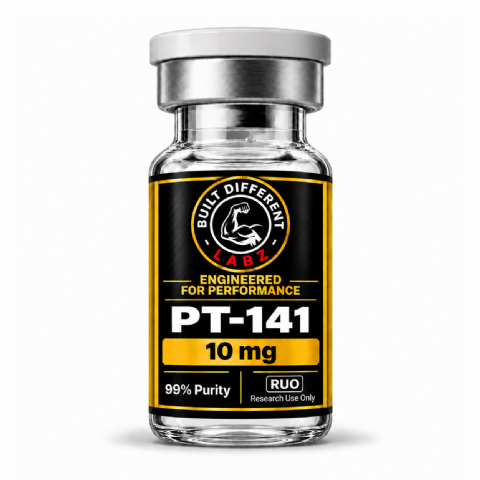
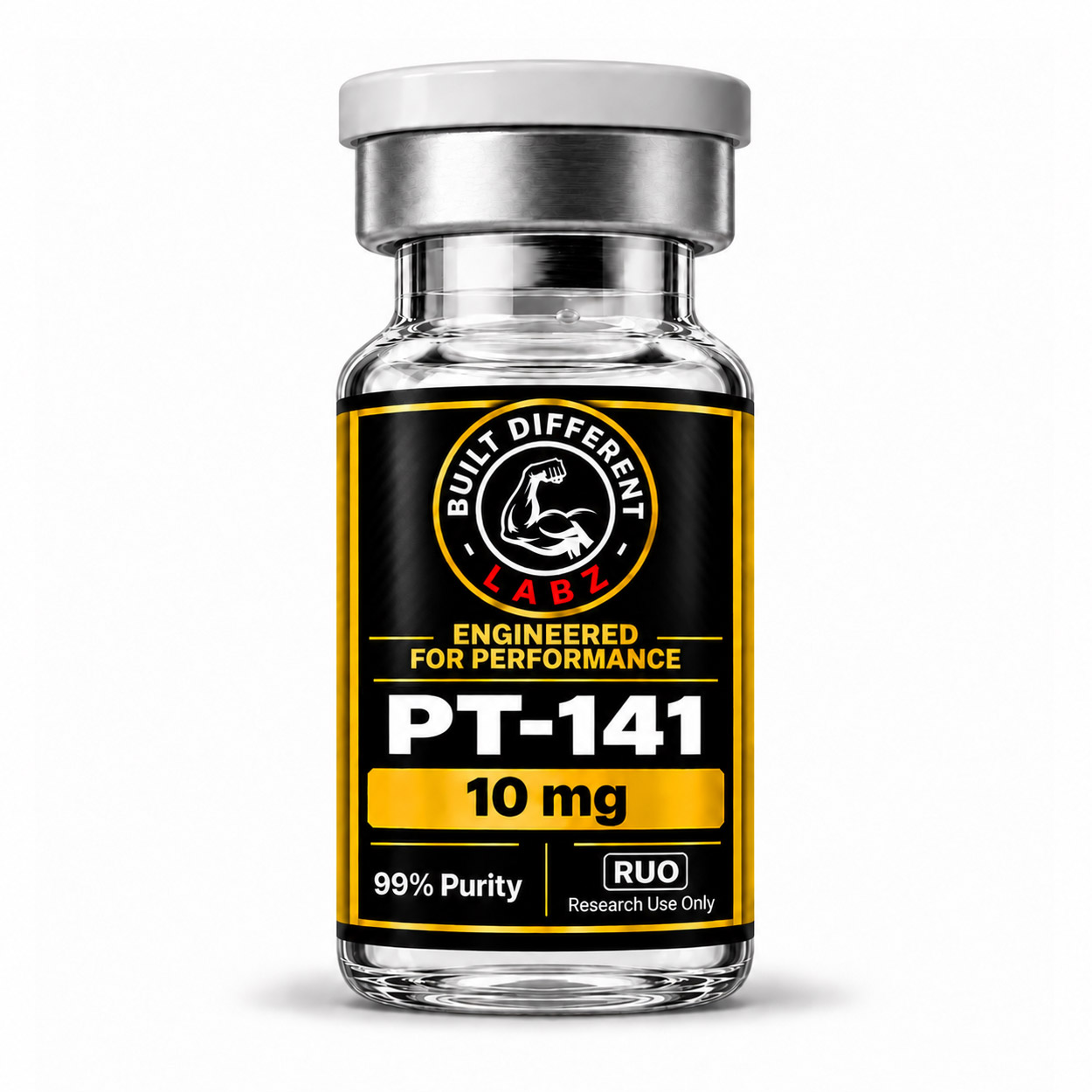
A vial labeled "PT-141 10mg" represents 10 milligrams of peptide in the vial. It does not mean that 10mg is an appropriate single dose.
PT-141 is the research name commonly used for bremelanotide.
It is a synthetic cyclic peptide derived from research involving melanocortin peptides.
PT-141 was ultimately developed from melanotan-II research. During early studies of melanotan-II, researchers observed an unexpected effect: subjects experienced increased sexual arousal and spontaneous erections.
This led researchers to investigate melanocortin signaling specifically for sexual function, eventually resulting in PT-141.
PT-141 primarily influences sexual desire and arousal through the brain.
Potential effects can include:
Increased sexual desire
Increased sexual arousal
Increased sexual responsiveness
Increased genital arousal
Increased likelihood of erections in men
Increased sexual interest in some women
Unlike drugs such as sildenafil, PT-141 does not primarily work by directly increasing blood flow to the genitals.
Its mechanism begins primarily within the central nervous system.
PT-141 is a melanocortin receptor agonist.
The melanocortin system contains several receptor types:
MC1R
MC2R
MC3R
MC4R
MC5R
PT-141's sexual effects are believed to involve primarily central MC4 receptors, with MC3 receptor activity potentially contributing as well.
These receptors participate in neural pathways associated with:
Sexual behavior
Sexual motivation
Arousal
Appetite
Energy regulation
Autonomic nervous-system activity
This makes PT-141 fundamentally different from conventional erectile-dysfunction drugs.
PT-141 and Viagra work very differently.
Viagra, or sildenafil, inhibits PDE5.
This increases nitric-oxide-mediated blood flow into erectile tissue.
PT-141 acts primarily through melanocortin receptors in the brain.
A simplified comparison is:
| Characteristic | PT-141 | Sildenafil |
|---|---|---|
| Primary target | Brain/CNS | Blood vessels |
| Main pathway | Melanocortin receptors | PDE5 inhibition |
| Sexual desire | May increase | Usually little direct effect |
| Erectile response | May improve | Improves blood-flow response |
| Requires sexual stimulation | Effects still depend on context | Generally yes |
| Approved use | Certain women with HSDD | Erectile dysfunction |
| Blood-pressure effects | Can temporarily increase BP | Can lower BP |
This difference is important.
Someone can have perfectly adequate genital blood flow but little sexual desire. A PDE5 inhibitor may not solve that problem.
PT-141 is interesting because it targets sexual motivation and arousal much further upstream.
Increasing libido is PT-141's most notable effect.
PT-141 appears capable of activating neural pathways associated with sexual motivation.
People sometimes describe its effects as:
Greater interest in sex
More frequent sexual thoughts
Increased sensitivity to sexual stimulation
Stronger sexual response
Greater spontaneous arousal
However, responses vary considerably between individuals.
It is not guaranteed to produce intense libido in everyone.
Women represent the population for which prescription bremelanotide has an FDA-approved indication.
The approved medication is intended for certain premenopausal women with acquired, generalized hypoactive sexual desire disorder, commonly called HSDD.
HSDD involves persistently reduced sexual desire that causes significant distress and isn't better explained by another medical condition, medication, relationship issue, or similar cause.
Bremelanotide can increase sexual desire in some women with this condition.
PT-141 has also been investigated in men, particularly for erectile dysfunction and sexual arousal.
Studies have demonstrated that melanocortin stimulation can produce erectile responses.
However, PT-141 is not FDA-approved for treating male erectile dysfunction.
Men nevertheless represent a significant portion of experimental PT-141 use outside its approved indication.
PT-141 can potentially facilitate erections through central nervous-system pathways.
This is particularly interesting because it does not depend entirely on the nitric-oxide/PDE5 pathway.
That means PT-141 and sildenafil are pharmacologically very different approaches.
PT-141 essentially influences the brain's signaling related to sexual arousal.
Sildenafil improves the physical vascular response once the sexual response has been initiated.
Some men report spontaneous erections following PT-141 exposure.
This isn't surprising given the history of melanocortin research.
Unexpected erections during melanotan-II research were one of the observations that helped generate interest in developing PT-141.
However, prolonged erections can become medically dangerous.
An erection lasting approximately four hours or longer requires urgent medical evaluation because prolonged priapism can permanently damage erectile tissue.
Some users report:
Stronger orgasms
Easier orgasm
Increased sexual sensitivity
Multiple sexual encounters
Increased sexual interest
These effects aren't as reliably established as the effects on sexual desire.
PT-141 shouldn't be considered a guaranteed orgasm-enhancing drug.
PT-141 is not a testosterone booster.
Its primary mechanism doesn't involve substantially increasing:
Testosterone
LH
FSH
DHT
Someone can potentially experience increased sexual desire from PT-141 without any meaningful increase in testosterone.
This illustrates how libido involves considerably more than testosterone alone.
PT-141 isn't an anabolic steroid and isn't generally associated with suppression of natural testosterone production.
It doesn't operate through the androgen receptor in the manner of testosterone or anabolic steroids.
Traditional steroid-style testosterone suppression isn't considered its primary concern.
PT-141 isn't generally associated with post-cycle therapy.
PCT is primarily used after compounds that suppress the hypothalamic-pituitary-gonadal axis.
PT-141 does not normally fit into that category.
No meaningful evidence establishes PT-141 as a muscle-building peptide.
It is not comparable to:
Testosterone
Anabolic steroids
Growth hormone
IGF-1
SARMs
Its principal effects concern melanocortin signaling and sexual function.
PT-141's relationship with melanocortin receptors makes appetite and metabolism scientifically interesting, but PT-141 isn't an established weight-loss medication.
It should not be treated as a conventional fat-loss peptide.
The melanocortin system participates heavily in appetite regulation.
Consequently, some people experience:
Reduced appetite
Nausea
Less interest in food
Nausea is particularly important because it is one of bremelanotide's most recognized adverse effects.
Reduced food intake caused by nausea should not be confused with a desirable fat-burning mechanism.
PT-141 is unusual compared with drugs such as sildenafil because its effects aren't necessarily immediate.
With the FDA-approved bremelanotide formulation, administration is intended before anticipated sexual activity rather than immediately at the moment sexual activity begins.
Individual response can vary considerably.
Some people may notice effects within hours, while the overall experience can persist considerably longer than the short window associated with some conventional ED medications.
Effects may persist for many hours, and some users describe sexual effects extending into the following day.
The exact duration varies between people.
Duration can depend on factors such as:
Individual metabolism
Sensitivity to melanocortin stimulation
Dose
Other medications
Cardiovascular status
Sexual stimulation
Psychological factors
More drug does not necessarily produce proportionally better effects.
Adverse effects can increase as exposure increases.
Research suppliers commonly sell PT-141 in lyophilized vials labeled:
5mg
10mg
20mg
A vial marked:
"PT-141 10mg"
means the manufacturer represents the vial as containing a total of 10 milligrams of PT-141.
It does not mean the entire vial represents a single administration.
This distinction is especially important with PT-141 because clinically studied bremelanotide exposure is substantially lower than 10mg at one time.
Bremelanotide is commercially available by prescription under the brand name Vyleesi.
The approved product is a prefilled autoinjector.
Its FDA-approved indication is specifically for certain premenopausal women with acquired, generalized HSDD.
That approval is important because PT-141 differs from many peptides sold online.
There is legitimate human clinical-trial evidence for pharmaceutical bremelanotide.
However, that approval does not automatically extend to research-grade PT-141 powder purchased from a peptide supplier.
This is an extremely important distinction.
Pharmaceutical bremelanotide is manufactured under regulated pharmaceutical standards.
A research vial labeled:
"PT-141 10mg - 99 percent purity - Research Use Only"
is not automatically equivalent to the approved pharmaceutical product.
Potential differences include:
Manufacturing controls
Sterility
Endotoxin levels
Peptide identity
Concentration accuracy
Impurities
Storage
Stability
A purity claim alone does not establish pharmaceutical equivalence.
PT-141 has a considerably better characterized adverse-effect profile than many experimental peptides because bremelanotide has actually undergone clinical trials.
Important adverse effects include:
Nausea
Flushing
Headache
Vomiting
Injection-site reactions
Fatigue
Dizziness
Temporary increases in blood pressure
Temporary decreases in heart rate
Nausea is particularly common.
For some people it can be substantial.
Nausea is probably the side effect most strongly associated with bremelanotide.
This likely relates partly to melanocortin signaling in the central nervous system.
Some people experience relatively little nausea.
Others may experience:
Significant nausea
Loss of appetite
Stomach discomfort
Vomiting
Sensitivity varies substantially.
This is one of the most important safety considerations.
Bremelanotide can temporarily increase blood pressure and decrease heart rate.
Because of this cardiovascular effect, the approved medication isn't appropriate for everyone.
People with uncontrolled hypertension or known cardiovascular disease require particular caution and should discuss it with a clinician.
This is also why PT-141 shouldn't be thought of as simply a harmless libido peptide.
Melanocortin peptides have an interesting relationship with pigmentation.
Remember that PT-141 originated from melanotan research.
Repeated bremelanotide exposure can potentially cause focal hyperpigmentation or darkening of areas such as:
Face
Gums
Breasts
Some pigmentation changes may not completely disappear after stopping treatment.
This risk becomes more important with repeated exposure.
The two compounds are related but aren't identical.
Melanotan II is primarily known for:
Skin tanning
Increased pigmentation
Appetite effects
Sexual effects
PT-141 was developed to emphasize the sexual effects associated with melanocortin stimulation while reducing emphasis on tanning.
PT-141 can still affect pigmentation because the melanocortin pathways overlap.
These peptides have almost completely different purposes.
| Characteristic | PT-141 | BPC-157 |
|---|---|---|
| Primary interest | Sexual desire/arousal | Tissue repair |
| Brain/CNS activity | Major | Not primary |
| Melanocortin receptors | Yes | No |
| Libido | Major effect | Not established |
| Erections | Potential effect | Not established |
| Tendon repair | Not primary | Major research interest |
| Gut research | Not primary | Major research interest |
| Human clinical evidence | Significant for bremelanotide | Very limited |
| FDA-approved formulation | Yes | No |
TB-500 is primarily discussed in relation to:
Tissue repair
Cell migration
Angiogenesis
Wound healing
PT-141 primarily involves:
Sexual desire
Sexual arousal
Melanocortin signaling
Central nervous-system activity
They have very little in common pharmacologically despite both being described as peptides.
GHK-Cu is primarily associated with:
Collagen
Skin
Hair
Wound healing
Tissue remodeling
PT-141 is primarily associated with:
Libido
Sexual arousal
Erectile response
Melanocortin receptors
Again, they're fundamentally different compounds.
Combining substances that can cause nausea, dizziness, flushing, or cardiovascular changes can make side effects more difficult to predict.
Alcohol can also impair sexual performance despite temporarily lowering inhibition.
Someone using prescription bremelanotide should follow the medication guidance provided by their prescriber rather than assuming alcohol has no interaction relevance.
Because PT-141 and PDE5 inhibitors work through different pathways, researchers have been interested in whether melanocortin agonists could complement conventional erectile-dysfunction treatments.
However, combining medications affecting sexual and cardiovascular function should be discussed with a clinician, particularly in people with:
Hypertension
Cardiovascular disease
Other cardiovascular medications
Previous adverse reactions to ED medications
Any drug capable of facilitating erections raises concern about prolonged erections.
An erection lasting four hours or longer is a medical emergency.
Untreated priapism can cause:
Oxygen deprivation in erectile tissue
Tissue damage
Fibrosis
Permanent erectile dysfunction
This is one adverse effect that should never simply be "waited out" indefinitely.
There is an important distinction.
Bremelanotide itself has an FDA-approved prescription formulation.
However, a generic research vial labeled "PT-141 10mg" is not thereby an FDA-approved drug product.
The FDA approval applies to the specific pharmaceutical formulation and indication.
It doesn't make every PT-141 product sold online an approved medication.
Research peptide quality remains a significant consideration.
Potential problems with an unregulated 10mg PT-141 vial include:
Incorrect quantity
Incorrect peptide
Chemical impurities
Degradation
Bacterial contamination
Endotoxin contamination
Poor sterility
Improper storage
A label stating "99 percent purity" doesn't prove sterility or confirm that exactly 10mg is present.
Sexual desire in certain women with HSDD:
Established enough for a specific FDA-approved bremelanotide indication.
Female sexual arousal:
Supported by human clinical research.
Male erectile response:
Human research exists, but PT-141 isn't FDA-approved for male ED.
Male libido:
Biologically plausible with human evidence of sexual effects, but not an approved indication.
Muscle growth:
Not established.
Tendon healing:
Not established.
Fat loss:
Not an established treatment.
Long-term frequent use outside the approved regimen:
Much less certain.
This is an important distinction.
BPC-157 has extensive animal research but very little human clinical evidence.
TB-500 is complicated by much of the literature actually involving thymosin beta-4.
GHK-Cu has substantial research surrounding skin, collagen, and wound healing, while systemic injection remains poorly established.
PT-141 is different.
The active pharmaceutical compound, bremelanotide, has undergone controlled human clinical trials and resulted in an FDA-approved prescription medication.
Therefore, PT-141 has substantially stronger direct human evidence for its intended sexual effects than BPC-157 or TB-500 have for injury healing.
That doesn't mean an unregulated research vial is equivalent to the approved medication or that experimental use is automatically safe.
PT-141, or bremelanotide, is a melanocortin peptide primarily associated with:
Increased sexual desire
Increased sexual arousal
Female HSDD treatment
Erectile response
Central nervous-system sexual signaling
It works fundamentally differently from Viagra and similar ED medications because its primary action occurs through melanocortin receptors in the brain rather than directly increasing genital blood flow.
Unlike many peptides, bremelanotide has meaningful human clinical evidence and an FDA-approved pharmaceutical formulation for a specific indication in certain premenopausal women.
Its most important potential adverse effects include nausea, flushing, headache, vomiting, injection-site reactions, temporary increases in blood pressure, decreases in heart rate, and hyperpigmentation with repeated exposure.
Finally, "PT-141 10mg" describes the represented total amount in a vial. It should not be interpreted as a recommended 10mg dose. A research-use vial also should not be assumed to have the same purity, sterility, concentration accuracy, or safety profile as pharmaceutical bremelanotide.
We do not accept returns or issue refunds for any reason, beside manufacturing defects.
Feel free to contact us if you have any questions or concerns about our Return Policy.