We offer FREE SHIPPPING on all orders!
We offer FREE SHIPPPING on all orders!
| THIS PRODUCT IS INTENDED AS A RESEARCH CHEMICAL ONLY. This designation allows the use of research chemicals strictly for invitro testing and laboratory experimentation only. All product information available on this website is for educational purposes only. Bodily introduction of any kind into humans or animals is strictly prohibited by law. This product should only be handled by licensed, qualified professionals. This product is not a drug, food, or cosmetic and may not be misbranded, misused or mislabeled as a drug, food, or cosmetic. |
IGF-1 LR3, short for Insulin-Like Growth Factor-1 Long R3, is a synthetic modified analogue of human IGF-1 designed to have altered binding characteristics and substantially prolonged biological activity compared with naturally occurring IGF-1.
Unlike CJC-1295, GHRP-2, GHRP-6, Ipamorelin, or Sermorelin, IGF-1 LR3 does not primarily stimulate the pituitary gland to release growth hormone.
Instead, it acts much farther downstream in the growth hormone axis by directly activating IGF-1 signaling.
Its major research interests include:
IGF-1 receptor signaling
Cellular growth
Protein synthesis
Skeletal-muscle biology
Glucose metabolism
Cell survival
Tissue growth and repair
Bone biology
Metabolic signaling
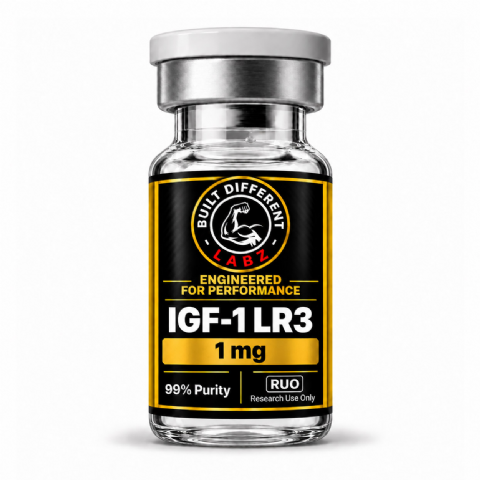
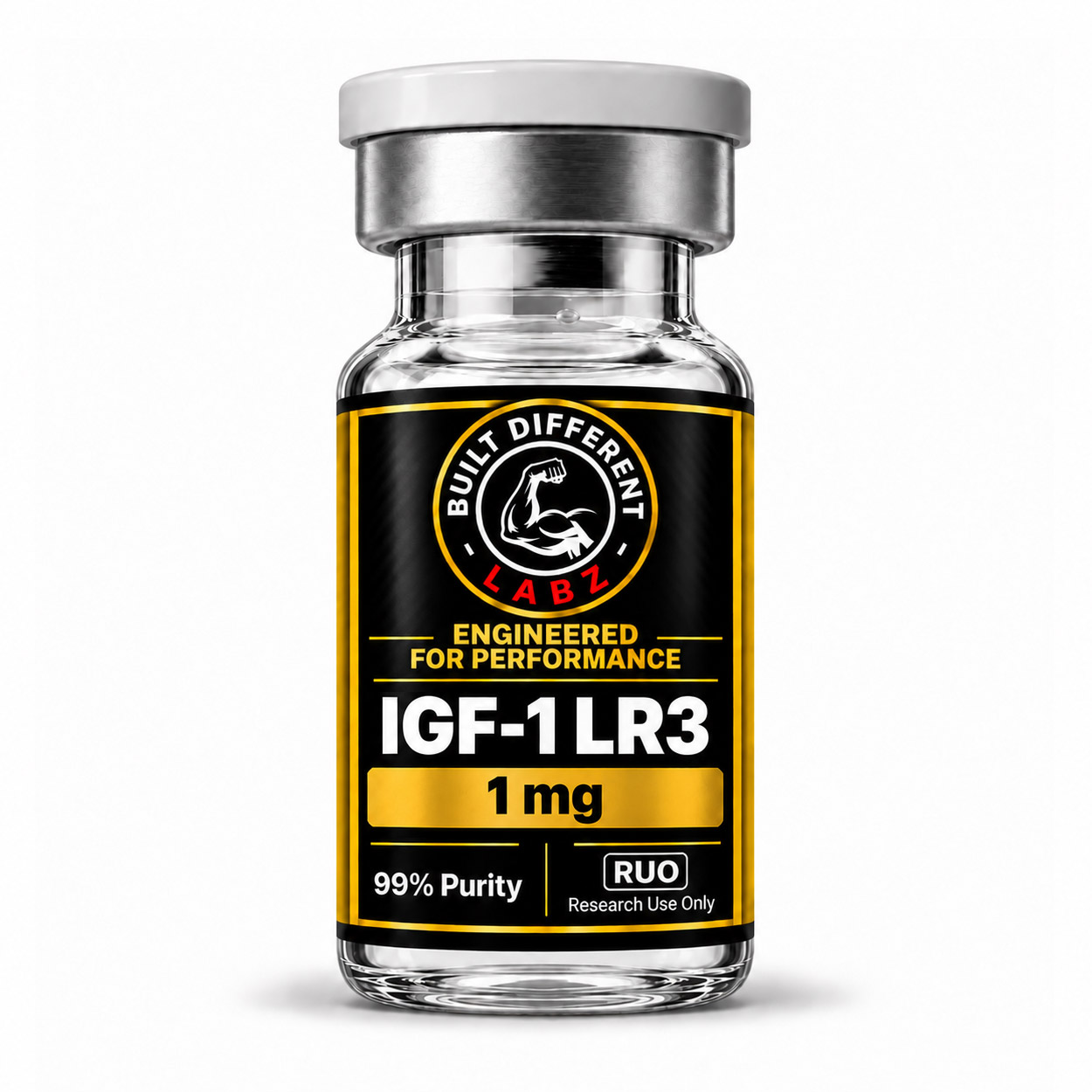
A vial labeled "IGF-1 LR3 1mg" represents a total of 1 milligram, or 1,000 micrograms, of represented IGF-1 LR3 material in the vial. This is the total vial quantity, not an established or recommended single human dose.
IGF-1 stands for:
Insulin-Like Growth Factor 1
Natural IGF-1 is a peptide hormone consisting of 70 amino acids.
It is produced throughout the body, with the liver serving as a major source of circulating IGF-1.
Growth hormone is one of the primary regulators of hepatic IGF-1 production.
The simplified physiological pathway is:
Hypothalamus
GHRH
Pituitary gland
Growth hormone
Liver and other tissues
IGF-1
Growth and metabolic signaling
IGF-1 LR3 bypasses much of this upstream pathway.
LR3 stands for:
Long R3.
IGF-1 LR3 differs structurally from native human IGF-1 in two major ways.
First, an arginine is substituted at position 3.
This is the "R3" portion of the name.
Second, an additional 13-amino-acid extension is attached to the N-terminus.
These modifications create a molecule containing 83 amino acids rather than the 70 amino acids found in native IGF-1.
Natural IGF-1 activity is heavily influenced by a family of proteins called:
IGF-binding proteins
or:
IGFBPs.
These proteins regulate:
IGF-1 distribution
Circulating availability
Tissue exposure
Receptor access
Biological activity
IGF-1 LR3 was engineered to have substantially reduced affinity for several IGF-binding proteins.
The result is greater availability for interaction with IGF-1 receptors and prolonged biological activity in experimental systems.
Natural IGF-1:
70 amino acids
Strongly regulated by IGF-binding proteins
Normal physiological hormone
Part of the endogenous GH/IGF-1 axis
IGF-1 LR3:
83 amino acids
Modified at position 3
Contains a 13-amino-acid extension
Reduced IGF-binding-protein affinity
Longer biological activity
Experimental analogue
They should not be treated as interchangeable molecules.
IGF-1 LR3 primarily activates the:
IGF-1 receptor
or:
IGF-1R.
IGF-1R is a receptor tyrosine kinase found throughout numerous tissues.
When activated, it can stimulate major intracellular pathways including:
PI3K
Akt
mTOR
and:
RAS
RAF
MAPK
These signaling networks participate in:
Protein synthesis
Cellular growth
Cell survival
Glucose metabolism
Cellular proliferation
Differentiation
The PI3K-Akt pathway is one of the major intracellular pathways activated by IGF-1R.
The simplified pathway is:
IGF-1 LR3
IGF-1 receptor
PI3K
Akt
mTOR-related signaling
Protein synthesis and cellular growth
This pathway is one major reason IGF-1 is closely associated with anabolic biology.
mTOR is a central regulator of cellular growth and protein synthesis.
It responds to numerous signals including:
Amino acids
Insulin
IGF-1
Cellular energy
Mechanical loading
IGF-1 receptor signaling can activate pathways leading toward mTOR activity.
This creates a legitimate biological connection between IGF-1 and muscle protein synthesis.
IGF-1 receptor activation can also influence MAPK signaling.
MAPK pathways participate in:
Cell proliferation
Differentiation
Growth
Gene expression
This demonstrates why IGF-1 signaling extends far beyond skeletal muscle.
Muscle biology is one of the primary reasons IGF-1 LR3 attracts performance-related interest.
IGF-1 participates in:
Protein synthesis
Muscle-cell signaling
Satellite-cell biology
Tissue growth
Recovery
However, the fact that IGF-1 is anabolic at the cellular level does not establish a safe or effective IGF-1 LR3 bodybuilding regimen in humans.
Controlled human evidence specifically supporting IGF-1 LR3 for bodybuilding is extremely limited.
Satellite cells are muscle-associated stem cells involved in:
Muscle repair
Adaptation
Growth
Regeneration
IGF-1 signaling can influence satellite-cell activation and differentiation.
This is one reason the IGF system is important in skeletal-muscle research.
It has a much more direct relationship with anabolic cellular signaling than GH secretagogues.
However, "activates anabolic pathways" and "has been proven to safely produce major muscle growth in healthy humans" are different statements.
The first has strong biological support.
The second is not established for IGF-1 LR3.
HGH works upstream.
HGH can stimulate:
Hepatic IGF-1 production
Local tissue IGF-1 signaling
Lipolysis
Numerous GH-receptor-mediated effects
IGF-1 LR3 works downstream by directly activating IGF-1 receptors.
Therefore:
HGH
GH receptor
IGF-1 production and GH effects
versus:
IGF-1 LR3
IGF-1 receptor
Direct IGF-related signaling.
CJC-1295:
GHRH analogue
Stimulates pituitary GH
GH then increases IGF-1
IGF-1 LR3:
Does not require GHRH stimulation
Does not primarily require pituitary GH release
Directly targets IGF-1 signaling
The pathway difference is:
CJC-1295 -> GH -> IGF-1
versus:
IGF-1 LR3 -> IGF-1 receptor.
GHRP-2 and GHRP-6 activate the ghrelin receptor and stimulate endogenous GH.
IGF-1 LR3 acts downstream.
Therefore:
GHRP -> pituitary -> GH -> IGF-1
IGF-1 LR3 -> IGF-1 receptor.
This makes IGF-1 LR3 fundamentally different from a GH secretagogue.
Ipamorelin:
GHS-R1a agonist
Stimulates endogenous GH
Relatively selective GH secretagogue
IGF-1 LR3:
Modified IGF-1 analogue
Directly activates IGF-1R
Does not primarily rely on pituitary GH secretion
Tesamorelin stimulates endogenous GH through the GHRH receptor.
It has a specific FDA-approved pharmaceutical indication involving excess abdominal visceral fat in adults with HIV-associated lipodystrophy.
IGF-1 LR3 is an experimental modified growth factor and does not have an equivalent FDA-approved indication.
This distinction is especially important.
Mecasermin is recombinant human IGF-1 used pharmaceutically for a specific pediatric growth disorder involving severe primary IGF-1 deficiency.
Mecasermin is essentially human IGF-1.
IGF-1 LR3 is a modified experimental analogue.
The existence of an FDA-approved IGF-1 medication does not mean IGF-1 LR3 is FDA approved.
IGF-1 is called "insulin-like" because IGF-1 and insulin share structural and signaling similarities.
Their receptors are related.
IGF-1 can produce insulin-like metabolic effects, including increasing glucose uptake in some tissues.
This makes blood-glucose effects particularly important.
Hypoglycemia is one of the most important potential risks associated with significant IGF-1 activity.
Hypoglycemia means:
Abnormally low blood glucose.
Potential symptoms can include:
Shaking
Sweating
Hunger
Dizziness
Weakness
Confusion
Palpitations
Irritability
Blurred vision
Severe hypoglycemia can cause:
Seizures
Loss of consciousness
Neurological injury
This is not simply a theoretical issue. Clinically used IGF-1 drugs carry significant hypoglycemia warnings.
IGF-1 can promote glucose uptake and has insulin-like metabolic activity.
The simplified concept is:
Increased IGF-1 signaling
Increased cellular glucose utilization
Potential reduction in circulating glucose
This is one reason IGF-1-related compounds have a substantially different acute risk profile from many ordinary research peptides.
IGF-1 signaling interacts closely with:
Insulin signaling
Glucose uptake
Hepatic metabolism
Nutrient signaling
The relationship is complex and cannot simply be described as "improves insulin sensitivity."
Excessive pharmacological activity can produce clinically significant glucose disturbances.
IGF-1 LR3 should not be considered primarily a fat-loss compound.
GH is much more strongly associated with direct lipolytic signaling.
IGF-1 has complex metabolic effects involving:
Glucose
Amino acids
Cellular growth
Insulin-like signaling
Claims that IGF-1 LR3 is a powerful direct fat burner are therefore oversimplified.
The term "nutrient partitioning" is frequently used in bodybuilding discussions.
The concept refers to how nutrients are directed toward different tissues and metabolic pathways.
Because IGF-1 influences:
Glucose uptake
Amino-acid metabolism
Protein synthesis
Cellular growth
there is a biological basis for studying its effects on nutrient metabolism.
However, claims of predictable muscle-specific nutrient partitioning from IGF-1 LR3 have not been established in controlled human trials.
A common claim is that administering IGF-1 LR3 near a particular muscle causes that muscle to grow preferentially.
This is not established.
IGF-1 LR3 is capable of systemic biological activity.
There is insufficient evidence demonstrating reliable "spot growth" of a selected human muscle.
IGF-1 participates in:
Cellular repair
Protein synthesis
Muscle adaptation
Connective-tissue biology
This makes recovery an important research area.
However, IGF-1 LR3 has not been established as a treatment for sports injuries.
IGF-1 participates in connective-tissue metabolism and can influence collagen-related processes.
However, IGF-1 LR3 has not been demonstrated to reconnect or reliably regenerate severely torn human tendons.
The same limitation applies to ligaments.
Cellular growth signaling should not be confused with proven structural regeneration of major injuries.
IGF-1 plays an important role in cartilage biology.
Chondrocytes respond to IGF-related signaling.
This creates interest in:
Cartilage matrix production
Proteoglycan synthesis
Tissue maintenance
However, IGF-1 LR3 is not an established treatment for osteoarthritis or cartilage regeneration.
IGF-1 is extremely important for skeletal development and bone metabolism.
It participates in:
Osteoblast activity
Bone formation
Growth-plate biology
Skeletal development
This is part of the reason severe IGF-1 deficiency can cause significant growth failure.
IGF-1 receptors exist throughout the body.
IGF-1 signaling is therefore not restricted to skeletal muscle.
This is extremely important.
Potential growth signaling can involve numerous tissues.
The idea that IGF-1 LR3 only acts on desired muscles is biologically unrealistic.
IGF signaling participates in gastrointestinal growth and cellular turnover.
Pharmacological IGF-related activity can therefore affect tissues outside the musculoskeletal system.
Again, IGF-1 is a systemic growth factor.
IGF-1 signaling participates in cardiac biology.
Normal IGF-1 has physiological roles involving:
Cardiomyocyte function
Cellular survival
Growth signaling
However, excessive growth signaling is not automatically beneficial.
Long-term cardiovascular safety of IGF-1 LR3 use in healthy individuals is not established.
IGF-1 participates in nervous-system development and function.
Research areas include:
Neuronal survival
Neuroplasticity
Brain development
Metabolism
However, IGF-1 LR3 is not an established cognitive-enhancement or neurodegenerative-disease treatment.
IGF-1 LR3 does not primarily stimulate:
GnRH
LH
FSH
Testosterone
It is not an androgen.
IGF-1 LR3 does not have the classic androgen-receptor-mediated suppression associated with anabolic steroids.
However, the endocrine system is interconnected, and long-term experimental exposure has not been sufficiently studied to characterize every hormonal effect.
Traditional steroid-style post-cycle therapy is not inherently associated with IGF-1 LR3 because it is not an androgenic steroid or SARM.
The GH/IGF-1 axis contains negative feedback loops.
Elevated IGF-1 can influence:
Hypothalamic GHRH
Somatostatin
Pituitary GH secretion
Therefore, directly increasing IGF-related signaling does not occur independently of the body's endocrine feedback system.
Bodybuilding interest generally focuses on:
Protein synthesis
Satellite cells
Muscle growth
Recovery
Nutrient metabolism
The biological rationale is stronger than it is for many compounds marketed as muscle-building peptides because IGF-1 genuinely is an important anabolic growth factor.
The problem is that potent growth-factor activity also creates significant safety concerns.
There is insufficient controlled evidence demonstrating that IGF-1 LR3 safely and reliably improves:
Strength
Speed
Power
Endurance
Competitive athletic performance
in healthy athletes.
Its use in sport also raises anti-doping concerns.
This is one of the most important long-term concerns.
IGF-1 signaling participates in:
Cell proliferation
Cell survival
Anti-apoptotic signaling
Growth pathways
Many cancers can exploit the IGF signaling system.
This does not mean IGF-1 LR3 has been proven to create cancer in healthy people.
However, stimulating a potent growth and survival pathway is particularly concerning when:
An existing malignancy is present
Abnormal cells already exist
Long-term exposure is involved
IGF-1 LR3 should therefore never be simplistically described as a muscle-specific growth factor.
Because IGF-1 receptors exist throughout the body, excessive signaling could theoretically influence unwanted tissues as well as desired tissues.
Potential concerns with excessive growth-factor signaling include:
Soft-tissue growth
Organ effects
Abnormal cellular proliferation
Long-term human safety data specific to IGF-1 LR3 are inadequate.
Acromegaly is caused by chronic excessive growth hormone signaling, usually from a pituitary tumor, with elevated IGF-1 as an important downstream mediator.
Features can include:
Soft-tissue enlargement
Enlarged hands and feet
Facial changes
Joint problems
Cardiovascular complications
Glucose abnormalities
Sleep apnea
Organ enlargement
Experimental IGF-1 LR3 exposure is not the same as acromegaly.
However, acromegaly demonstrates why chronically excessive growth-factor signaling is not harmless.
Claims that IGF-1 LR3 will immediately produce acromegaly-like facial changes are exaggerated.
However, long-term excessive growth-factor exposure raises legitimate concerns about unwanted tissue growth.
The absence of robust long-term human IGF-1 LR3 safety studies makes precise risk estimates impossible.
A vial labeled:
"IGF-1 LR3 1mg"
means the supplier represents the vial as containing:
1 milligram
which equals:
1,000 micrograms
of IGF-1 LR3.
This describes total represented vial content.
It should not be interpreted as an established single administration amount.
There is no FDA-approved IGF-1 LR3 dosing regimen for bodybuilding, muscle growth, recovery, anti-aging, or athletic performance.
With highly biologically active growth factors, the total vial quantity and an experimental exposure amount are completely different concepts.
The label:
1mg
describes how much material is represented as being contained in the entire vial.
It does not establish how that material should be administered to a person.
Research suppliers commonly sell IGF-1 LR3 as lyophilized material.
An injectable-style vial does not establish that it is an approved injectable medication.
Product quality is particularly important with a potent growth factor.
Important considerations include:
Correct molecular identity
Correct amino-acid sequence
Correct LR3 modification
Chemical purity
Exact vial quantity
Sterility
Endotoxin levels
Stability
Aggregation
Manufacturing quality
IGF-1 LR3 was specifically engineered to have prolonged biological activity compared with native IGF-1.
Reduced binding to IGF-binding proteins changes its pharmacological behavior.
However, precise claims about a fixed human half-life for research-market IGF-1 LR3 should be treated cautiously because robust modern human pharmacokinetic data are lacking.
"Long acting" is more defensible than presenting an exact universal number.
Most circulating endogenous IGF-1 does not simply float freely through the bloodstream.
It interacts extensively with:
IGFBP-1
IGFBP-2
IGFBP-3
Other IGF-binding proteins
These proteins regulate IGF availability.
IGF-1 LR3's reduced binding affinity changes this natural regulatory system.
That is central to both its research interest and its potential risk.
Potential adverse effects related to significant IGF-1 activity can include:
Hypoglycemia
Headache
Dizziness
Sweating
Tremor
Hunger
Weakness
Nausea
Fluid retention
Swelling
Joint discomfort
Injection-site reactions
Potential effects associated with stronger or prolonged growth-factor exposure may also involve:
Soft-tissue growth
Glucose disturbances
Organ effects
Abnormal cellular growth
The actual frequency of these effects with research-market IGF-1 LR3 is not well characterized.
Among the risks associated with IGF-related compounds, hypoglycemia is particularly important because it can become acutely dangerous.
Severe symptoms such as:
Confusion
Loss of coordination
Seizure
Loss of consciousness
require immediate medical attention.
Long-term human safety of IGF-1 LR3 has not been adequately established.
Important unanswered questions include:
Chronic glucose effects
Cardiovascular effects
Organ growth
Soft-tissue changes
Cancer-related implications
Neurological effects
Endocrine feedback
Reproductive effects
Long-term receptor signaling
This uncertainty is substantially more important for a potent growth factor than for a compound with only weak biological activity.
Research-market IGF-1 LR3 quality can vary.
Potential problems include:
Incorrect protein or peptide
Incorrect sequence
Incorrect LR3 modification
Incorrect vial quantity
Degradation
Aggregation
Chemical impurities
Endotoxins
Microbial contamination
HPLC or related analytical methods can provide information about chemical purity.
Mass spectrometry can help verify molecular identity.
However, "99 percent purity" does not automatically establish:
Sterility
Endotoxin levels
Exact quantity
Correct biological activity
Correct folding or structural integrity
Pharmaceutical manufacturing quality
Human safety
These are separate characteristics.
Research Use Only, or RUO, means the particular product is marketed for laboratory or analytical research rather than as an approved medication for human treatment.
An RUO IGF-1 LR3 vial should not be treated as pharmaceutical IGF-1.
No.
IGF-1 LR3 is not FDA approved for:
Bodybuilding
Muscle growth
Fat loss
Athletic performance
Recovery
Injury healing
Anti-aging
Growth hormone optimization
General wellness
There is no FDA-approved human dosing protocol for IGF-1 LR3.
This should not be confused with mecasermin, an FDA-approved recombinant human IGF-1 pharmaceutical used for a specific medical indication.
IGF-1 receptor biology:
Very strong.
IGF-1 involvement in growth:
Very strong.
IGF-1 involvement in protein synthesis:
Very strong.
PI3K-Akt signaling:
Very strong.
IGF-1 and muscle biology:
Very strong.
IGF-1 and bone biology:
Very strong.
IGF-1 and glucose metabolism:
Very strong.
IGF-1-related hypoglycemia risk:
Well established.
IGF-1 LR3 reduced binding to IGF-binding proteins:
Well established experimentally.
IGF-1 LR3 bodybuilding effectiveness:
Not established in robust human trials.
IGF-1 LR3 localized muscle growth:
Not established.
IGF-1 LR3 injury healing:
Not established clinically.
IGF-1 LR3 anti-aging:
Not established.
Long-term IGF-1 LR3 safety in healthy humans:
Insufficiently characterized.
IGF-1 LR3 is interesting because it acts directly on one of the body's major anabolic growth-factor pathways.
The basic model is:
IGF-1 LR3
Reduced IGF-binding-protein interaction
Greater biological availability
IGF-1 receptor activation
PI3K-Akt and MAPK signaling
Protein synthesis, cellular growth and survival signaling
Unlike a GH secretagogue, it does not need to stimulate multiple upstream endocrine steps before reaching IGF-related signaling.
Its greatest potential strength is also its greatest concern.
IGF-1 is not a muscle-specific signal.
IGF-1 receptors exist throughout the body.
The same signaling pathways associated with:
Muscle-cell growth
Protein synthesis
Cell survival
also participate in:
Glucose metabolism
Organ growth
Soft-tissue growth
Cellular proliferation
Cancer biology
Reducing the normal binding-protein regulation of IGF-1 makes LR3 scientifically interesting, but it also means the compound should not be viewed as simply "more effective IGF-1."
Long-term human safety is poorly characterized.
IGF-1 LR3 is an experimental 83-amino-acid modified analogue of human IGF-1 designed to have reduced IGF-binding-protein affinity and prolonged biological activity.
Its major research areas include:
IGF-1 receptor signaling
Protein synthesis
Muscle biology
Cellular growth
Satellite cells
Bone biology
Tissue repair
Glucose metabolism
Cell survival
"IGF-1 LR3 1mg" describes a represented total vial content of 1 milligram, equivalent to 1,000 micrograms. It should not be interpreted as a recommended 1mg dose.
The most accurate description is:
IGF-1 LR3 is a potent experimental long-acting IGF-1 analogue that directly activates IGF-1 receptor signaling rather than stimulating growth hormone release like CJC-1295, GHRP-6, or Ipamorelin. Its modification reduces normal IGF-binding-protein interactions, creating prolonged biological activity and making it valuable for laboratory research involving growth, protein synthesis, muscle cells, metabolism, and cellular survival. However, direct growth-factor activity also introduces significant concerns, particularly hypoglycemia, systemic tissue growth, glucose disturbances and the theoretical implications of stimulating pathways involved in abnormal cell proliferation. Human bodybuilding benefits, localized muscle growth, anti-aging effects and long-term safety have not been adequately established, and IGF-1 LR3 is not equivalent to FDA-approved pharmaceutical IGF-1.
We do not accept returns or issue refunds for any reason, beside manufacturing defects.
Feel free to contact us if you have any questions or concerns about our Return Policy.