We offer FREE SHIPPPING on all orders!
We offer FREE SHIPPPING on all orders!
| THIS PRODUCT IS INTENDED AS A RESEARCH CHEMICAL ONLY. This designation allows the use of research chemicals strictly for invitro testing and laboratory experimentation only. All product information available on this website is for educational purposes only. Bodily introduction of any kind into humans or animals is strictly prohibited by law. This product should only be handled by licensed, qualified professionals. This product is not a drug, food, or cosmetic and may not be misbranded, misused or mislabeled as a drug, food, or cosmetic. |
Selank is a synthetic peptide primarily researched for its potential effects on anxiety, stress regulation, mood, cognition, memory, and nervous-system function.
It is very different from peptides such as BPC-157, TB-500, GHK-Cu, PT-141, Ipamorelin, DSIP, or Sermorelin. Selank is generally discussed as a nootropic and anxiolytic peptide rather than as a tissue-repair, growth-hormone, metabolic, or sexual-function peptide.
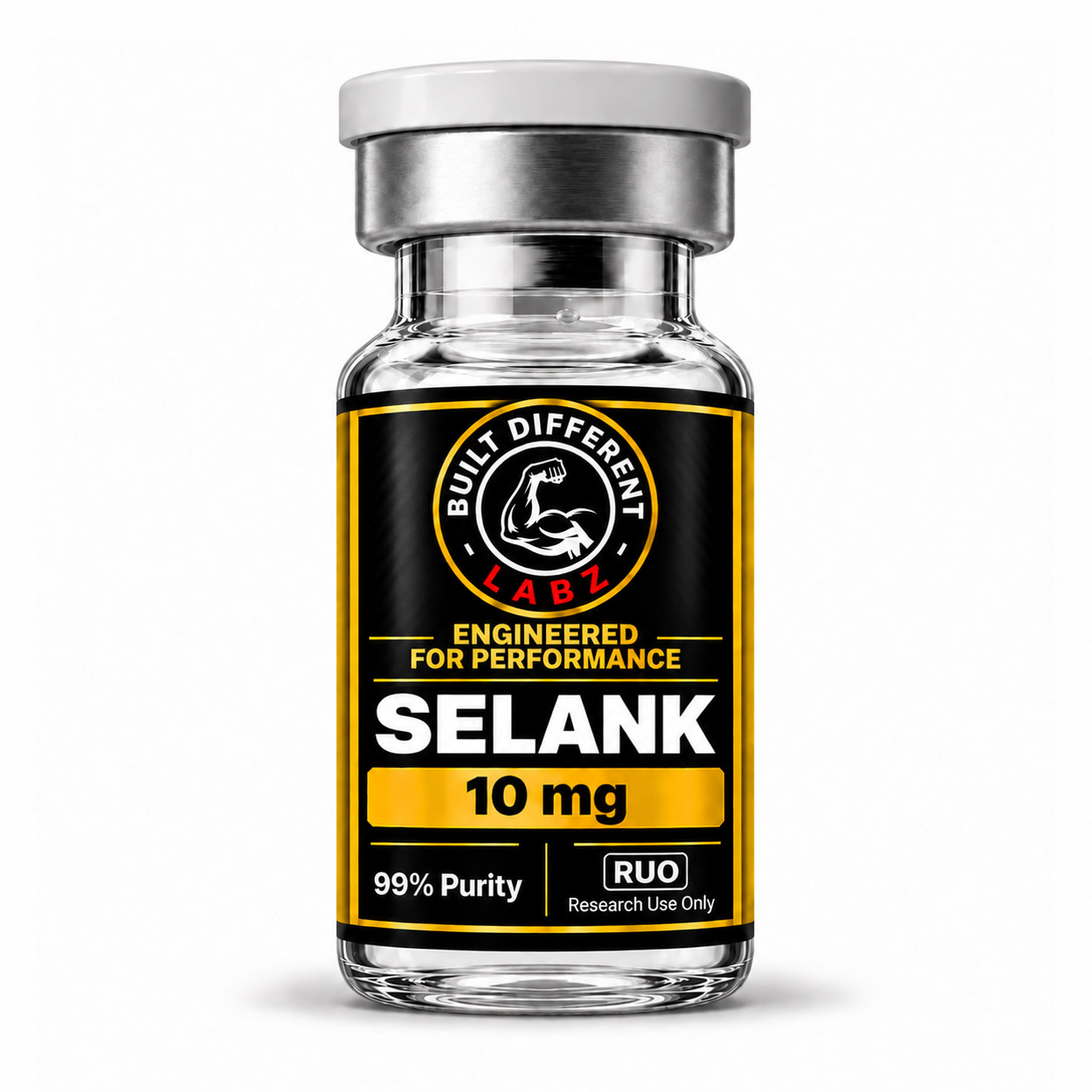
A vial labeled "Selank 10mg" represents a total of 10 milligrams of Selank in the vial. It does not mean that 10mg is an established or appropriate single human dose.
Selank is a synthetic peptide derived from tuftsin, a naturally occurring immune-related tetrapeptide.
Selank contains seven amino acids.
It was developed primarily in Russia for research involving:
Anxiety
Stress
Cognitive performance
Memory
Learning
Mood
Nervous-system regulation
Selank is often categorized as a peptide-based anxiolytic and nootropic.
Selank has been investigated for possible effects involving:
Reduced anxiety
Reduced stress
Improved mood
Improved memory
Improved learning
Improved concentration
Improved emotional stability
Neurotransmitter regulation
Immune signaling
Neuroplasticity
The most common reason people become interested in Selank is its potential anxiolytic effect.
An anxiolytic is a compound that reduces anxiety.
Selank does not appear to operate through one single receptor.
Research has suggested that it may influence several systems, including:
GABA signaling
Serotonin signaling
Dopamine-related pathways
BDNF
Neurotrophic signaling
Gene expression
Immune regulation
Its exact mechanism remains incompletely understood.
GABA is the brain's primary inhibitory neurotransmitter.
It helps reduce excessive neuronal activity.
GABA signaling is associated with:
Calmness
Reduced anxiety
Sleep
Muscle relaxation
Emotional regulation
Some research suggests Selank may influence GABAergic signaling.
This may help explain its proposed anti-anxiety effects.
Selank is sometimes compared with benzodiazepines because both are discussed for anxiety.
They are not equivalent.
Benzodiazepines such as alprazolam or diazepam directly enhance GABA-A receptor signaling.
Selank appears to affect GABA-related systems more indirectly.
A simplified comparison:
| Characteristic | Selank | Benzodiazepines |
|---|---|---|
| Anxiety reduction | Experimental | Established |
| Direct GABA-A activity | No | Yes |
| Sedation | Usually less | Often significant |
| Dependence potential | Not well established | Significant |
| Withdrawal risk | Not established like benzodiazepines | Can be substantial |
| FDA approved | No | Several are |
One of Selank's proposed advantages is that it may reduce anxiety without producing heavy sedation.
Selank is generally described as having less sedating potential than conventional anti-anxiety drugs.
Some users report feeling:
Calm
Relaxed
Mentally clearer
Less reactive to stress
Others may experience:
Fatigue
Drowsiness
Headache
Responses can vary considerably.
Anxiety reduction is Selank's primary research interest.
Potential effects described in experimental work include:
Reduced generalized anxiety
Lower stress response
Reduced emotional tension
Improved stress tolerance
Improved behavioral stability
However, Selank should not be described as a proven replacement for established anxiety treatments.
Human research exists, but much of it comes from relatively small or regional studies.
Selank is sometimes promoted online for panic attacks.
There is not enough high-quality evidence to establish Selank as a proven treatment for panic disorder.
Panic attacks can have serious psychiatric or medical causes and should not be self-diagnosed solely as something a peptide can correct.
Stress regulation is another important area of interest.
Selank may influence systems involved in:
Cortisol response
Neurotransmitter balance
Emotional reactivity
Stress adaptation
Its theoretical role is more about normalizing stress responses than producing strong sedation.
Some experimental research has examined Selank's effect on stress-related endocrine signaling.
However, it is not established as a reliable cortisol-lowering drug.
Any effect appears to be indirect through nervous-system regulation rather than direct blockade of cortisol production.
Selank has also been investigated as a nootropic.
Potential cognitive effects include:
Improved memory formation
Better memory retention
Improved learning
Better attention
Improved mental performance under stress
These effects may partly result from reducing anxiety, because severe anxiety itself can impair memory and concentration.
Experimental studies have suggested that Selank may improve certain forms of learning.
Possible mechanisms include:
Neurotransmitter modulation
BDNF-related signaling
Reduced stress interference
Improved neuroplasticity
However, strong claims about major intelligence enhancement are not supported.
Some users report improved focus or concentration.
This may be related to:
Reduced anxiety
Reduced distracting thoughts
Improved emotional regulation
Possible neurotransmitter effects
Selank is not a conventional stimulant.
It should not be compared directly with amphetamine or methylphenidate.
Selank may indirectly influence dopamine-related systems.
Dopamine is involved in:
Motivation
Reward
Attention
Movement
Learning
However, Selank is not generally considered a direct dopamine agonist.
Its effects appear more regulatory than strongly stimulatory.
Research has also suggested that Selank may influence serotonin-related pathways.
Serotonin participates in:
Mood
Anxiety
Sleep
Appetite
Emotional regulation
This could contribute to Selank's proposed anxiolytic and mood effects.
BDNF stands for brain-derived neurotrophic factor.
BDNF is involved in:
Neuronal survival
Neuroplasticity
Learning
Memory
Synaptic function
Some peptide research suggests Selank may influence BDNF expression or related neurotrophic pathways.
This is one reason it is discussed as a nootropic.
However, increasing BDNF-related signaling does not automatically translate into dramatic cognitive enhancement.
Neuroplasticity refers to the brain's ability to change and reorganize neural connections.
Selank's potential effects on neurotrophic signaling and gene expression have generated interest in whether it could support neuroplasticity.
This remains an experimental area.
Selank is occasionally discussed for depression.
There is not enough evidence to establish it as an antidepressant treatment.
Any mood benefit may be secondary to reduced anxiety or stress.
It should not be considered a replacement for established treatment for major depressive disorder.
Selank is not primarily a sleep peptide.
Some people report better sleep because reduced anxiety makes it easier to relax.
Others report little effect on sleep.
It should not be confused with DSIP.
DSIP is primarily associated with:
Sleep
Deep sleep
Neuroendocrine regulation
Selank is primarily associated with:
Anxiety
Stress
Cognition
Memory
Emotional regulation
Both involve nervous-system research but have different primary research profiles.
Selank is frequently compared with Semax.
Both are Russian-developed neuropeptides.
Selank is generally associated more strongly with:
Anxiety reduction
Calmness
Stress regulation
Semax is generally associated more strongly with:
Cognitive stimulation
Attention
Neuroprotection
Mental performance
Simplified comparison:
| Characteristic | Selank | Semax |
|---|---|---|
| Anxiety | Major interest | Secondary |
| Stress | Major interest | Secondary |
| Cognition | Yes | Major interest |
| Mental stimulation | Usually mild | More prominent |
| Neuroprotection | Possible | Major research area |
| Sedation | Usually low | Usually low |
The two are sometimes used together experimentally, but combination protocols are not established medical treatment.
Selank may influence mood through:
Anxiety reduction
Stress regulation
Serotonin pathways
GABA-related signaling
It is generally described as calming rather than euphoric.
Strong recreational effects are not typically associated with Selank.
Selank is not generally considered intoxicating.
It is not known to produce a conventional recreational "high."
Reported effects are more often described as:
Calm
Focused
Clear-headed
Less anxious
Selank is not known to have the same dependence profile as benzodiazepines or opioids.
However, there is insufficient long-term human research to say that chronic unrestricted use carries no dependence-related concerns.
Lack of evidence of addiction does not equal proof of zero risk.
Because Selank was derived from tuftsin, an immune-related peptide, researchers have also investigated potential immunomodulatory effects.
Possible areas include:
Cytokine regulation
Immune signaling
Stress-related immune changes
This is a secondary research area compared with anxiety and cognition.
Some experimental studies suggest Selank may influence inflammatory signaling.
However, it should not be considered an established anti-inflammatory medication.
Selank is not a bodybuilding peptide in the traditional sense.
It does not directly:
Increase testosterone
Increase growth hormone
Increase IGF-1
Build muscle
Burn fat
Its potential appeal to athletes is more indirect.
Reduced anxiety and better stress regulation may theoretically support:
Sleep
Training consistency
Recovery
Competition focus
These effects are not the same as direct performance enhancement.
No strong evidence shows that Selank directly builds muscle.
It does not function as an anabolic compound.
No.
Selank is not considered a fat-loss peptide.
Any changes in body composition would be indirect.
Selank is not known to directly increase testosterone.
It does not primarily target the reproductive endocrine system.
Selank is not generally associated with testosterone suppression.
It does not act like anabolic steroids.
No traditional steroid-style post-cycle therapy is associated with Selank.
It is not known to suppress the hypothalamic-pituitary-gonadal axis.
Research suppliers commonly sell Selank in lyophilized vials labeled:
5mg
10mg
A vial labeled:
"Selank 10mg"
means the supplier represents the vial as containing a total of 10 milligrams of Selank.
It does not mean that 10mg is an appropriate single administration.
There is no FDA-approved Selank dosing protocol.
Selank is frequently discussed as an intranasal peptide.
This route became popular because the compound is intended to affect the nervous system.
Intranasal administration has been used in research and in regional pharmaceutical formulations.
However, products sold online as research chemicals should not automatically be assumed to match regulated pharmaceutical formulations.
Some suppliers also sell Selank as lyophilized powder intended for research.
Injectable use is much less established than the better-known intranasal route.
There is no FDA-approved injectable Selank protocol.
Anecdotal reports vary substantially.
Some people describe calming effects relatively quickly.
Others report that effects are subtle or only noticeable after repeated exposure.
There is no universally established onset time.
Human pharmacokinetic data are limited.
Peptides can have short circulating half-lives while still producing longer downstream biological effects.
Precise duration can vary depending on:
Route of administration
Individual metabolism
Exposure
Nervous-system sensitivity
Human safety data are limited compared with established psychiatric medications.
Potentially reported effects include:
Headache
Fatigue
Dizziness
Nasal irritation with intranasal use
Nausea
Temporary drowsiness
Changes in mood
Changes in sleep
The actual frequency of these effects is not well established.
Intranasal products may cause:
Burning
Dryness
Irritation
Congestion
Unpleasant taste
These effects may be related to the formulation rather than the peptide itself.
Long-term human safety remains insufficiently characterized.
There are not large modern clinical trials following healthy people using Selank continuously for years.
Important unanswered questions include possible effects on:
Neurotransmitter regulation
Mood
Hormonal systems
Immune function
Nervous-system adaptation
Research-grade peptide quality is an important concern.
Potential problems include:
Incorrect peptide identity
Incorrect amount
Chemical impurities
Peptide degradation
Bacterial contamination
Endotoxins
Poor sterility
Improper storage
A vial labeled:
"Selank 10mg - 99 percent purity"
does not independently prove that it contains exactly 10mg of correctly synthesized Selank.
When properly tested, peptide purity can be evaluated using techniques such as HPLC.
Mass spectrometry can help confirm molecular identity.
However, high analytical purity does not automatically establish:
Sterility
Correct vial quantity
Endotoxin safety
Pharmaceutical quality
Safety for human administration
These are separate issues.
Research Use Only, or RUO, means a product is marketed for laboratory or analytical research rather than as an approved medication for human treatment.
RUO labeling should not be interpreted as approval for human administration.
No.
Selank is not an FDA-approved medication in the United States for:
Anxiety
Stress
Depression
Cognitive enhancement
Memory improvement
Sleep
ADHD
Neuroprotection
There is no FDA-approved Selank dosing protocol.
Anxiety reduction:
Promising experimental and limited human evidence.
Stress regulation:
Promising but not firmly established.
Memory:
Interesting experimental evidence.
Learning:
Possible benefit in experimental research.
Cognition:
Promising but not proven as a general nootropic.
Depression:
Not established.
ADHD:
Not established.
Sleep:
Secondary potential benefit only.
Muscle growth:
Not established.
Fat loss:
Not established.
Long-term safety:
Insufficiently characterized.
FDA-approved treatment:
No.
Selank's most interesting feature is the possibility of reducing anxiety without causing the degree of sedation and cognitive impairment associated with some conventional anxiolytic medications.
The theoretical profile is:
Less anxiety
Better stress tolerance
Preserved mental clarity
Potential improvement in memory and concentration
That combination explains its popularity in nootropic communities.
The biggest limitation is evidence quality.
Selank has interesting pharmacological and clinical research, but it lacks the large modern randomized trials that would normally be required to establish a medication as a mainstream anxiety treatment.
Many online claims go far beyond what has actually been demonstrated.
Claims that Selank:
Eliminates anxiety
Dramatically increases intelligence
Permanently rewires the brain
Replaces psychiatric medication
are not scientifically established.
Selank is a synthetic seven-amino-acid neuropeptide primarily associated with research involving:
Anxiety reduction
Stress regulation
GABA-related signaling
Serotonin pathways
Memory
Learning
Concentration
Neuroplasticity
BDNF-related signaling
Immune regulation
Its most distinctive potential benefit is anxiolysis without strong sedation.
However, Selank is not FDA approved in the United States, long-term human safety is not well characterized, and evidence supporting its use for anxiety or cognitive enhancement is much more limited than the evidence for established medications.
"Selank 10mg" describes the represented total amount contained in a vial. It should not be interpreted as a recommended 10mg dose.
The most accurate description is:
Selank is an experimental anxiolytic and nootropic peptide with promising research involving anxiety, stress regulation, and cognition, but insufficient large-scale modern clinical evidence to establish its effectiveness, optimal dosing, or long-term safety.
We do not accept returns or issue refunds for any reason, beside manufacturing defects.
Feel free to contact us if you have any questions or concerns about our Return Policy.