We offer FREE SHIPPPING on all orders!
We offer FREE SHIPPPING on all orders!
| THIS PRODUCT IS INTENDED AS A RESEARCH CHEMICAL ONLY. This designation allows the use of research chemicals strictly for invitro testing and laboratory experimentation only. All product information available on this website is for educational purposes only. Bodily introduction of any kind into humans or animals is strictly prohibited by law. This product should only be handled by licensed, qualified professionals. This product is not a drug, food, or cosmetic and may not be misbranded, misused or mislabeled as a drug, food, or cosmetic. |
Bacteriostatic Water is sterile water containing a small amount of bacteriostatic preservative, most commonly benzyl alcohol.
Unlike the peptides discussed above, Bacteriostatic Water is not a peptide, hormone, performance-enhancing compound, or active therapeutic ingredient. It is a sterile diluent designed for use with compatible medications when the applicable product instructions call for it.
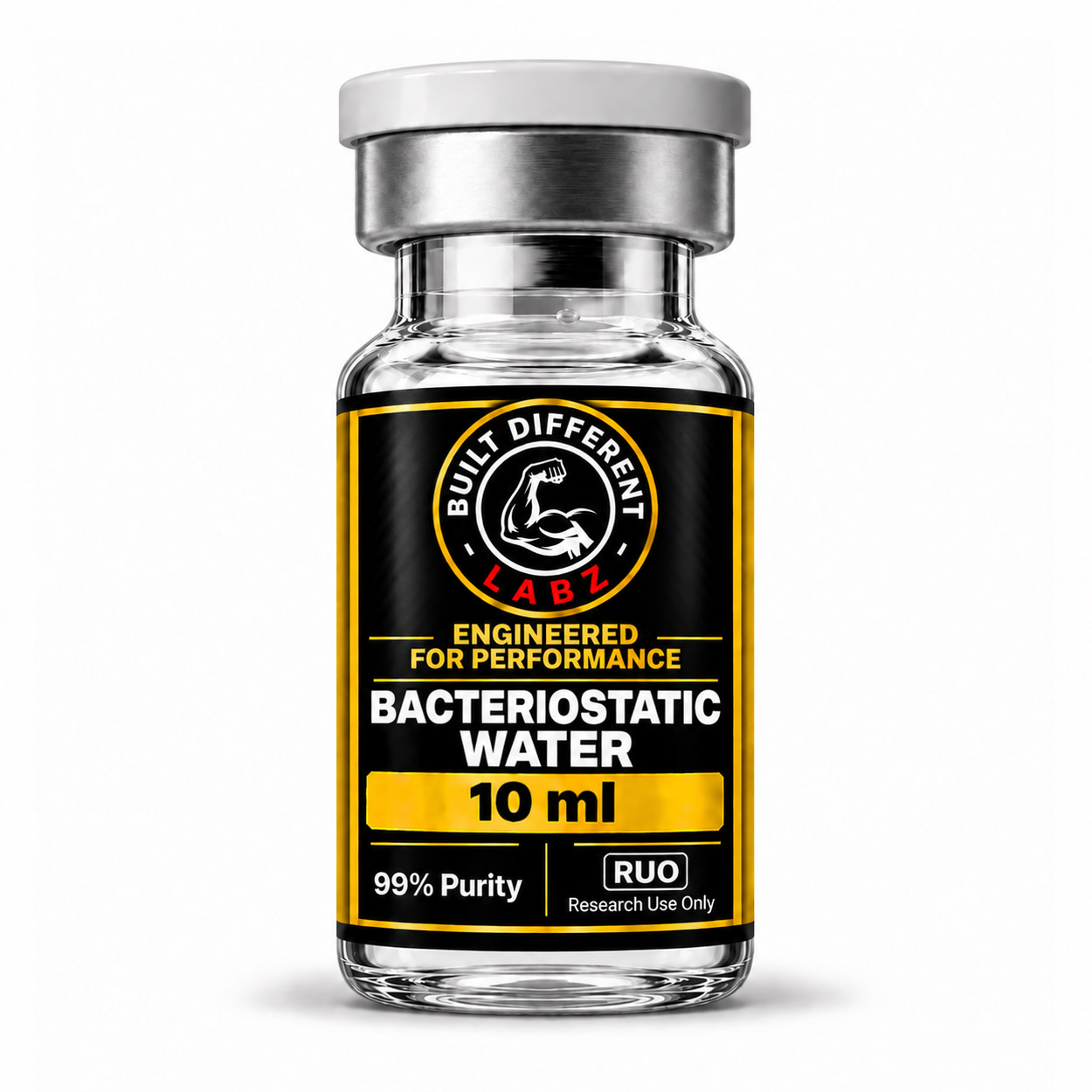
A vial labeled "Bacteriostatic Water 10mL" describes the total liquid volume contained in the vial.
Bacteriostatic Water for Injection is sterile water containing a preservative intended to inhibit the growth of certain microorganisms after a vial has been entered.
A typical pharmaceutical formulation contains:
Sterile Water for Injection
0.9 percent benzyl alcohol as a bacteriostatic preservative
The preservative is what distinguishes bacteriostatic water from ordinary Sterile Water for Injection.
Bacteriostatic means that a substance inhibits bacterial growth.
This is different from "bactericidal," which means directly killing bacteria.
The benzyl alcohol in bacteriostatic water helps prevent certain bacteria from multiplying if microorganisms are accidentally introduced during vial access.
It does not make contaminated material safe.
Benzyl alcohol is an antimicrobial preservative used in some pharmaceutical formulations.
In bacteriostatic water, it is commonly present at a concentration of 0.9 percent.
Its purpose is to allow a properly manufactured multi-dose container to resist microbial growth better than preservative-free sterile water after initial entry.
This is an important distinction.
Bacteriostatic Water:
Sterile
Contains a preservative
Commonly contains 0.9 percent benzyl alcohol
Intended for multiple withdrawals when appropriate
Used as a diluent for compatible medications
Sterile Water for Injection:
Sterile
Generally preservative-free
Usually intended for single-use applications
Does not contain benzyl alcohol unless specifically stated
The two products are not automatically interchangeable.
The medication manufacturer's instructions determine the appropriate diluent.
No.
Bacteriostatic Water is primarily water plus a bacteriostatic preservative.
Normal saline contains:
0.9 percent sodium chloride.
These are different formulations.
A medication designed for reconstitution with one should not automatically be reconstituted with the other.
No.
Distilled water may be purified through distillation, but ordinary distilled water is not necessarily:
Sterile
Endotoxin controlled
Manufactured for injection
Packaged under pharmaceutical conditions
Household distilled water should never be treated as equivalent to Bacteriostatic Water for Injection.
No.
"Purified" does not automatically mean sterile or suitable for parenteral pharmaceutical use.
Bacteriostatic Water for Injection is manufactured to pharmaceutical specifications specifically intended for use as a diluent.
Its primary purpose is dilution or reconstitution of compatible medications.
Some medications are manufactured as dry or lyophilized powders because the active ingredient may be more stable in dry form.
Before administration, the appropriate diluent specified for that medication may be added.
Bacteriostatic Water is one possible diluent when the product's instructions specifically permit it.
Reconstitution means adding an appropriate liquid to a dry medication or compound to create a solution.
The general concept is:
Dry medication
plus
Compatible sterile diluent
equals
Reconstituted solution
The appropriate diluent, concentration, storage requirements, and usable period depend on the specific medication.
Lyophilization is freeze-drying.
A pharmaceutical or research compound is frozen and water is removed under controlled conditions.
This can improve stability during storage.
Lyophilized products commonly appear as:
White powder
Compact puck
Thin layer of material
Powder residue inside the vial
The appearance varies by formulation.
Bacteriostatic water is frequently discussed alongside lyophilized peptide products because many peptides are supplied as dry powders.
However, the presence of a lyophilized peptide does not automatically mean bacteriostatic water is the correct diluent.
Compatibility depends on factors including:
Peptide chemistry
pH
Stability
Preservatives
Manufacturer instructions
Intended route of administration
For an approved medication, the official product instructions should determine the diluent.
For an RUO peptide, there is no FDA-approved human reconstitution protocol simply because the vial is labeled with a peptide name.
Not exactly.
Adding water does not "activate" a peptide in the way a chemical switch activates something.
The peptide already exists.
Reconstitution dissolves the dry material into a liquid solution.
A vial labeled:
"Bacteriostatic Water 10mL"
means the container holds approximately 10 milliliters of bacteriostatic water according to its labeled fill volume.
The 10mL refers to liquid volume.
It does not refer to:
Peptide strength
Drug concentration
Milligrams
Dose
These measurements describe different things.
mL means:
Milliliters, a measurement of liquid volume.
mg means:
Milligrams, a measurement of mass.
Therefore:
10mL bacteriostatic water
and
10mg peptide
are completely different measurements.
Bacteriostatic water itself generally does not contain the active medication being treated or administered.
Its role is as a diluent.
The benzyl alcohol is present as a preservative, not as the intended therapeutic active ingredient.
The term can be misleading.
Bacteriostatic water should not be thought of as a disinfectant.
The preservative helps inhibit bacterial growth.
It does not:
Sterilize contaminated medication
Neutralize endotoxins
Guarantee sterility after improper handling
Make dirty equipment safe
Rescue a contaminated vial
Once sterility is compromised, the presence of benzyl alcohol does not guarantee safety.
It can reduce the ability of certain microorganisms to multiply within the vial, but it cannot guarantee that infection will not occur.
Sterile manufacturing and appropriate handling remain critical.
Yes.
Possible contamination can occur through:
Improper manufacturing
Damaged packaging
Improper vial access
Repeated contamination of the stopper
Nonsterile equipment
Improper storage
The preservative provides an additional barrier against microbial growth, not absolute protection.
It should generally appear:
Clear
Colorless
Free of visible particles
A product that is:
Cloudy
Discolored
Contaminated with visible particles
Leaking
In a damaged vial
should not be assumed suitable for use.
Yes.
Commercial products have expiration dates based on stability and packaging validation.
An unopened vial should not automatically be considered usable indefinitely simply because the liquid still looks clear.
Once a multi-dose vial has been entered, contamination risk increases.
The usable period after first entry depends on the specific product labeling and applicable clinical standards.
A preservative extends usability compared with many preservative-free products, but it does not make the vial indefinitely reusable.
Every time a vial is accessed, there is another opportunity for contamination.
Multi-dose containers therefore commonly contain preservatives.
This is why bacteriostatic water can be useful when a compatible medication requires multiple withdrawals.
The stability of a reconstituted peptide depends on much more than the water itself.
Important factors can include:
Temperature
Light exposure
pH
Peptide sequence
Oxidation
Aggregation
Concentration
Preservatives
Container material
Repeated handling
Different peptides can behave very differently after reconstitution.
There is no universal rule that every peptide remains stable for the same amount of time.
Temperature can strongly influence the stability of many reconstituted biological compounds.
However, storage instructions should be based on the specific medication or validated formulation.
The storage requirements for one peptide should not automatically be applied to another.
Freezing can potentially affect the container and formulation.
Commercial pharmaceutical products should be stored according to their labeled conditions rather than intentionally frozen unless specifically permitted.
Bacteriostatic water itself is generally less light-sensitive than many active pharmaceutical compounds.
However, once it is used to reconstitute another compound, the light sensitivity of that active ingredient becomes important.
Some individuals may be sensitive to benzyl alcohol.
Potential reactions to benzyl alcohol-containing products can include:
Irritation
Hypersensitivity reactions
Local discomfort
The clinical significance depends on exposure and the individual.
Benzyl alcohol-containing injectable products are particularly inappropriate for neonates.
Serious and potentially fatal toxicity known as "gasping syndrome" has historically been associated with benzyl alcohol exposure in premature and newborn infants.
This is an important reason bacteriostatic water is not interchangeable with preservative-free sterile water in every population.
Whether a benzyl alcohol-containing diluent is appropriate depends on the medication, exposure and clinical circumstances.
The diluent should not be considered independently from the drug being administered.
Bacteriostatic water is intended primarily as a pharmaceutical diluent rather than as a therapeutic medication by itself.
It has no peptide, bodybuilding, fat-loss, anti-aging or performance benefit on its own.
No.
It has no anabolic activity.
No.
It has no established fat-burning effect.
No.
No.
No.
It has no relationship to steroid-style post-cycle therapy.
Bacteriostatic Water:
Primarily water
Contains antimicrobial preservative
No standard sodium chloride concentration
Normal Saline:
Water
0.9 percent sodium chloride
May or may not contain a preservative depending on formulation
The appropriate choice depends on the medication being prepared.
These are also different.
Bacteriostatic Water:
Sterile water plus preservative.
Bacteriostatic Saline:
Sodium chloride solution plus preservative.
The presence of sodium chloride changes the solution's tonicity and chemical environment.
This is the most important comparison.
Bacteriostatic Water:
Contains a preservative and is commonly packaged for multi-dose use.
Sterile Water for Injection:
Typically preservative-free and commonly used for single-dose preparation when specified.
Neither should automatically substitute for the other without considering the active product's instructions.
A legitimate pharmaceutical product labeled Bacteriostatic Water for Injection is manufactured as a sterile product.
That does not mean every online product labeled "bacteriostatic water" necessarily meets pharmaceutical sterility standards.
Manufacturing source matters.
A pharmaceutical sterile diluent is manufactured under controls involving:
Sterility
Endotoxins
Particulate matter
Container integrity
Ingredient concentration
Manufacturing consistency
Quality assurance
An online product using similar packaging or terminology should not automatically be assumed equivalent.
USP generally refers to standards associated with the United States Pharmacopeia.
When legitimately applied to a pharmaceutical product, USP standards can address characteristics such as:
Identity
Strength
Quality
Purity
However, printing "USP" on a label does not independently prove that an unknown supplier's product actually complies with those standards.
These terms are not interchangeable.
Purity concerns the chemical composition of the material.
Sterility concerns the absence of viable microorganisms.
A chemically pure product can still be microbiologically contaminated.
Endotoxins are inflammatory components associated primarily with the outer membrane of certain bacteria.
A solution can potentially contain endotoxins even when no living bacteria remain.
This is why sterility testing alone does not completely establish injectable product quality.
No.
The bacteriostatic preservative should not be expected to neutralize endotoxins.
This is another reason contaminated water cannot simply be made safe by adding benzyl alcohol.
Homemade preparations should not be considered equivalent to pharmaceutical Bacteriostatic Water for Injection.
Accurately combining water and benzyl alcohol does not establish:
Sterility
Endotoxin control
Particulate control
Pharmaceutical manufacturing quality
Container sterility
For parenteral applications, those differences are important.
Bacteriostatic Water for Injection is an established pharmaceutical diluent, and FDA-regulated products exist.
That is very different from experimental RUO peptides.
However, the regulatory status applies to specific manufactured pharmaceutical products, not automatically to every bottle sold online under the name "Bacteriostatic Water."
When bacteriostatic water is sold alongside products labeled:
"Research Use Only"
the water does not change the regulatory status of those products.
For example:
RUO peptide plus pharmaceutical diluent
does not equal
FDA-approved medication.
Reconstitution does not establish that an experimental compound is safe or approved for human administration.
For a Bacteriostatic Water 10mL product, important quality considerations include:
Sterility
Benzyl alcohol concentration
Endotoxin control
Particulate matter
Fill volume
Container integrity
Manufacturing conditions
Expiration dating
Storage requirements
These characteristics are more relevant than peptide-style claims such as "99 percent purity."
A legitimate product description would typically clearly identify:
Bacteriostatic Water
10mL volume
Preservative information
Intended use as a diluent
Storage information
Manufacturer or distributor
Lot information
Expiration information
Claims should accurately reflect the actual product's manufacturing and regulatory status.
Use as a pharmaceutical diluent:
Well established.
Benzyl alcohol as a bacteriostatic preservative:
Well established.
Ability to inhibit growth of certain microorganisms:
Well established.
Use for compatible multi-dose medication preparation:
Well established.
Ability to sterilize contaminated medication:
No.
Ability to eliminate endotoxins:
No.
Muscle-building effects:
None.
Fat-loss effects:
None.
Hormonal effects:
None.
Anti-aging effects:
None.
The primary advantage of Bacteriostatic Water is the presence of a bacteriostatic preservative.
Compared with preservative-free sterile water, this can make it suitable for certain compatible multi-dose preparations where repeated vial entry is expected.
The basic concept is:
Sterile water
plus
Bacteriostatic preservative
equals
A sterile pharmaceutical diluent designed to inhibit microbial growth during appropriate multi-dose use.
Bacteriostatic water is not universally compatible with every medication or every patient.
The presence of benzyl alcohol can be inappropriate in certain circumstances.
It also does not protect against every problem associated with a contaminated or poorly manufactured product.
Bacteriostatic does not mean contamination-proof.
Bacteriostatic Water 10mL is a sterile pharmaceutical diluent that commonly consists of Sterile Water for Injection containing 0.9 percent benzyl alcohol as an antimicrobial preservative.
Its primary purpose is the dilution or reconstitution of compatible medications when the applicable product instructions specify or permit its use.
"10mL" describes the total volume of liquid in the vial. It is not a medication dose or peptide strength.
The most accurate description is:
Bacteriostatic Water is a sterile, preservative-containing diluent designed to inhibit the growth of certain microorganisms during appropriate multi-dose use. It contains no peptide, hormone or performance-enhancing active ingredient. It should not be confused with Sterile Water for Injection, normal saline, household distilled water, or purified water, and the appropriate diluent for any medication depends on that specific product's formulation and instructions.
We do not accept returns or issue refunds for any reason, beside manufacturing defects.
Feel free to contact us if you have any questions or concerns about our Return Policy.