We offer FREE SHIPPPING on all orders!
We offer FREE SHIPPPING on all orders!
| THIS PRODUCT IS INTENDED AS A RESEARCH CHEMICAL ONLY. This designation allows the use of research chemicals strictly for invitro testing and laboratory experimentation only. All product information available on this website is for educational purposes only. Bodily introduction of any kind into humans or animals is strictly prohibited by law. This product should only be handled by licensed, qualified professionals. This product is not a drug, food, or cosmetic and may not be misbranded, misused or mislabeled as a drug, food, or cosmetic. |
PEG-MGF, commonly called Pegylated Mechano Growth Factor, is an experimental peptide associated with the IGF-1 growth-factor system and skeletal-muscle repair research. It is generally marketed as a pegylated version of MGF, a splice-related IGF-1 variant associated with mechanical loading and tissue injury.
PEG-MGF is primarily discussed in research involving:
Skeletal-muscle repair
Mechanical loading
Muscle adaptation
Satellite cells
Tissue regeneration
IGF-related signaling
Protein synthesis
Recovery
Cellular proliferation and differentiation
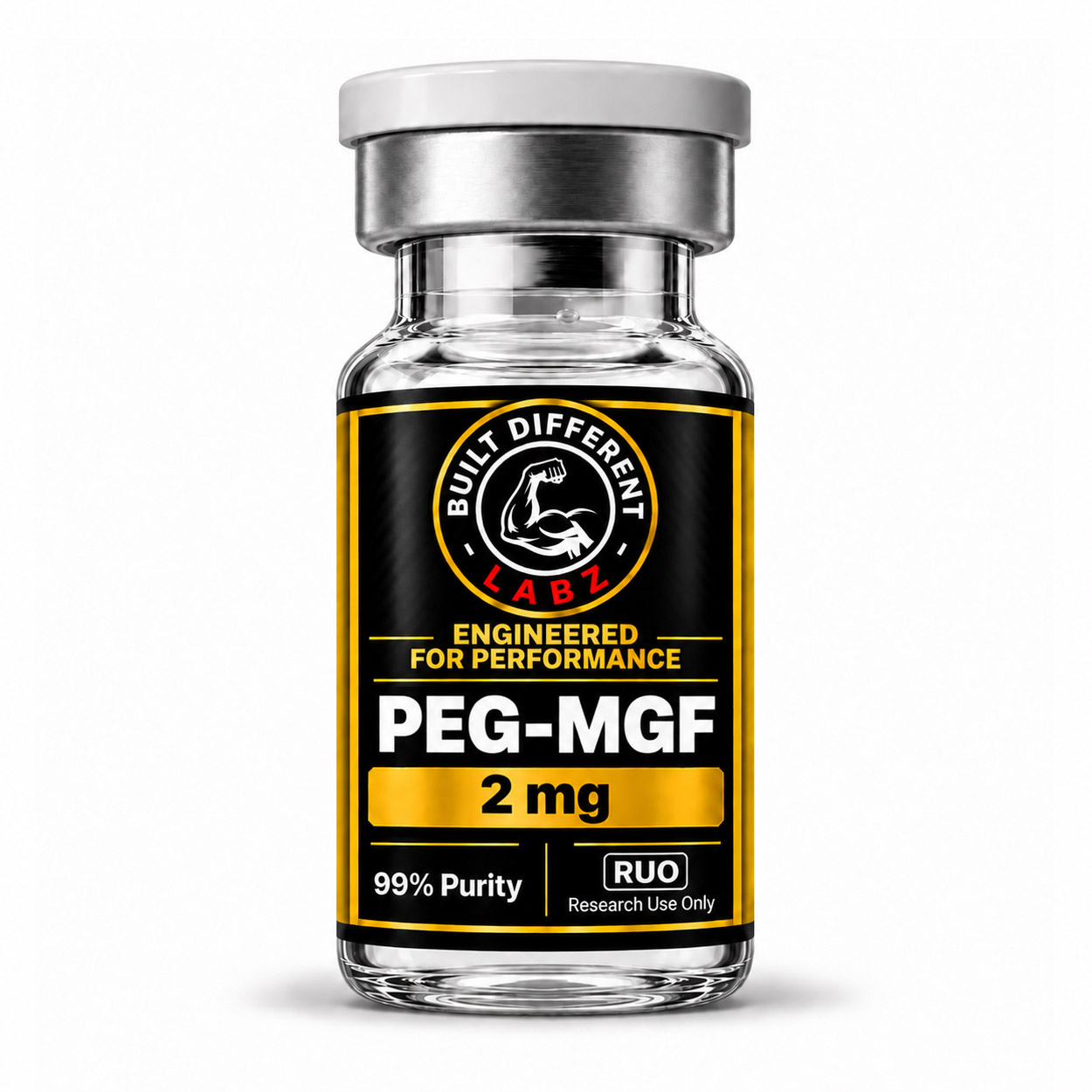
A vial labeled "PEG-MGF 2mg" represents a total of 2 milligrams of represented PEG-MGF material in the vial. This is total vial content, not an established or recommended single human dose.
MGF stands for:
Mechano Growth Factor.
The name is associated with an alternatively spliced form of the IGF-1 gene that has been studied in mechanically stressed and damaged tissue.
Mechanical loading can influence local IGF-related gene expression within skeletal muscle.
This generated the general model:
Mechanical loading or muscle damage
Altered IGF-1 gene expression
MGF-related signaling
Muscle repair and adaptation
The "mechano" portion refers to the relationship between mechanical stress and expression of the IGF-1 splice variant associated with MGF research.
Examples of mechanical stimuli include:
Resistance exercise
Muscle stretch
Muscle contraction
Tissue injury
Mechanical overload
The body responds to these stresses through numerous signaling pathways.
MGF-related biology is one component of that response.
MGF is closely associated with the IGF-1 system.
However, the terminology surrounding commercial MGF products is frequently oversimplified.
IGF-1 gene expression can produce different transcript variants through:
Alternative splicing.
These variants can generate different precursor proteins and extension peptides.
The peptide sold commercially as "MGF" is generally associated with an MGF E-domain peptide rather than simply being ordinary mature IGF-1.
Therefore:
MGF
and:
IGF-1
should not be treated as interchangeable compounds.
A single gene can sometimes produce different RNA transcripts.
This process is called:
Alternative splicing.
The simplified concept is:
One gene
Different RNA processing
Different protein or peptide variants
Different biological signaling
The IGF-1 system is one example where alternative splicing has generated substantial research interest.
PEG stands for:
Polyethylene Glycol.
Attaching polyethylene glycol to a molecule is called:
PEGylation.
PEGylation is a pharmaceutical and biotechnology technique used to modify the pharmacokinetic properties of proteins and peptides.
Small peptides can sometimes be:
Rapidly degraded
Rapidly cleared
Susceptible to proteolytic enzymes
PEGylation can potentially:
Increase molecular size
Reduce renal clearance
Protect against enzymatic degradation
Increase stability
Extend circulation time
The theoretical purpose of PEG-MGF is therefore to produce a longer-lasting version of an otherwise short-lived peptide.
The basic distinction is:
MGF:
Shorter-lived experimental peptide associated with local tissue responses.
PEG-MGF:
MGF-related peptide chemically modified with polyethylene glycol to extend systemic exposure.
The addition of PEG can substantially change:
Distribution
Clearance
Stability
Biological exposure
Therefore, PEG-MGF and non-pegylated MGF should not automatically be treated as pharmacologically identical.
Not necessarily.
PEGylation primarily changes pharmacokinetics.
A peptide that remains in circulation longer may produce prolonged exposure, but that does not automatically mean:
Greater receptor potency
Greater biological effectiveness
Greater muscle growth
Greater safety
In some cases, PEGylation can actually reduce receptor-binding activity while increasing circulating duration.
The final biological effect depends on the specific molecule.
The exact pharmacology of commercial PEG-MGF preparations is much less established than online descriptions often suggest.
MGF-related peptides have been investigated in relation to:
Muscle-cell proliferation
Satellite-cell activity
Tissue repair
Cell survival
Regenerative signaling
However, PEG-MGF does not have a thoroughly characterized human receptor and clinical pharmacology comparable to an approved drug.
This requires an important distinction.
Mature IGF-1 strongly activates:
IGF-1R.
Commercial MGF-related E-peptides are not simply long-acting IGF-1.
Some experimental evidence suggests MGF E-peptide biology may involve mechanisms that are at least partly distinct from classical IGF-1 receptor signaling.
Therefore, saying:
"PEG-MGF is just IGF-1 with a longer half-life"
would be inaccurate.
These compounds are often grouped together, but they are substantially different.
IGF-1 LR3:
Modified mature IGF-1 analogue
83 amino acids
Reduced IGF-binding-protein affinity
Direct IGF-1 receptor signaling
Strong growth-factor biology
PEG-MGF:
Pegylated MGF-related experimental peptide
Associated with MGF E-domain biology
Designed for prolonged exposure
Muscle-repair and satellite-cell research
Human pharmacology considerably less established
IGF-1 LR3 has a much clearer connection with direct IGF-1 receptor activation.
Satellite cells are muscle-associated stem cells.
They participate in:
Muscle repair
Regeneration
Adaptation
Formation of new muscle nuclei
Mechanical muscle damage can activate satellite cells.
MGF-related signaling has been investigated as one component of this response.
Satellite cells normally remain relatively inactive alongside muscle fibers.
Following sufficient mechanical stress or injury, they can become activated.
The simplified process is:
Muscle stress
Satellite-cell activation
Cell proliferation
Differentiation
Fusion with muscle fibers
Additional myonuclei
Muscle repair and adaptation
This is one reason MGF became popular in muscle-regeneration research.
MGF-related research suggests potential involvement in early muscle-repair signaling.
However, there is a large difference between:
Participating in cellular repair pathways
and:
Being proven to dramatically accelerate recovery in healthy athletes.
The latter has not been established in robust human clinical trials.
PEG-MGF is frequently marketed as a muscle-building peptide.
There is a plausible biological connection between MGF-related signaling and muscle adaptation.
However, controlled human evidence demonstrating significant PEG-MGF-induced hypertrophy is lacking.
It should therefore not be described as a clinically proven muscle-building drug.
Muscle hypertrophy involves numerous systems, including:
Mechanical tension
Amino-acid availability
mTOR signaling
Testosterone
IGF signaling
Satellite cells
Neural adaptation
Recovery
Training volume
MGF-related signaling represents only one component of this much larger network.
Because MGF is associated with the IGF-related muscle-response system, protein synthesis is frequently discussed.
However, PEG-MGF should not automatically be assigned the same direct PI3K-Akt-mTOR activity profile as mature IGF-1.
The molecular distinction matters.
Hyperplasia means:
Increasing the number of cells.
Hypertrophy means:
Increasing the size of existing cells or tissue.
MGF-related peptides have been studied in cell-proliferation contexts, which has generated claims that PEG-MGF causes muscle hyperplasia.
There is insufficient evidence demonstrating meaningful PEG-MGF-induced skeletal-muscle hyperplasia in humans.
Recovery is one of the primary areas of interest.
Potential research mechanisms include:
Satellite-cell activation
Muscle-cell survival
Regenerative signaling
Tissue adaptation
However, PEG-MGF is not an established treatment for ordinary post-workout soreness.
MGF-related signaling has also been investigated in mechanically stressed connective tissues.
Tendon cells respond to:
Mechanical loading
Growth factors
Local repair signals
This creates research interest in MGF-related peptides.
However, PEG-MGF has not been established as a treatment for torn human tendons.
The same limitation applies to ligament injuries.
A peptide influencing cellular growth pathways does not mean it can reliably reconstruct a mechanically disrupted ligament.
IGF-related signaling plays important roles in bone biology.
Mechanical loading also affects bone growth and remodeling.
MGF-related expression has therefore been investigated in skeletal tissues.
PEG-MGF is not an established osteoporosis or fracture-healing treatment.
MGF-related peptides have also attracted research interest in cardiac tissue.
Potential areas include:
Cardiomyocyte survival
Tissue repair
Ischemic injury
Regenerative signaling
This remains experimental and does not establish PEG-MGF as a cardiovascular therapy.
MGF-related peptide research has extended beyond skeletal muscle into:
Neuronal survival
Neuroprotection
Cellular injury
Again, these are experimental areas rather than established neurological treatments.
BPC-157:
Experimental tissue-repair peptide
Tendon and ligament research
GI research
Angiogenesis
Fibroblast migration
PEG-MGF:
IGF-related muscle-response peptide
Satellite-cell research
Muscle adaptation
Mechanical-stress signaling
Both are associated with repair research, but their proposed mechanisms are very different.
TB-500-related research focuses heavily on:
Actin biology
Cell migration
Angiogenesis
Wound healing
Tissue repair
PEG-MGF research focuses more heavily on:
Muscle adaptation
Satellite cells
Mechanical stress
Growth-related signaling
Neither is an established treatment for serious musculoskeletal injuries.
Growth hormone acts through the:
Growth hormone receptor.
It can also stimulate production of IGF-1.
PEG-MGF does not function as growth hormone.
The simplified distinction is:
GH
GH receptor
Systemic GH effects and IGF-1 production
versus:
PEG-MGF
Experimental MGF-related tissue signaling
CJC-1295 is a GHRH analogue.
It stimulates:
Pituitary GH
which can subsequently influence:
IGF-1.
PEG-MGF does not primarily stimulate the pituitary gland to release GH.
Therefore:
CJC-1295 -> GH -> IGF-1.
PEG-MGF -> MGF-related experimental tissue signaling.
Ipamorelin activates the:
GHS-R1a ghrelin receptor.
This stimulates endogenous GH secretion.
PEG-MGF does not primarily activate the ghrelin receptor.
The two compounds belong to fundamentally different research categories.
PEG-MGF does not primarily stimulate:
GnRH
LH
FSH
Testosterone
It is not an androgen.
PEG-MGF does not have the classic androgen-receptor-mediated testosterone suppression associated with anabolic steroids.
However, long-term endocrine effects of experimental PEG-MGF exposure have not been thoroughly characterized.
Traditional steroid-style post-cycle therapy is not inherently associated with PEG-MGF.
It is not an anabolic steroid or SARM.
PEG-MGF is not primarily a fat-loss compound.
It does not primarily work through:
GLP-1
Amylin
Appetite suppression
Carnitine transport
Direct lipolysis
Any claim that PEG-MGF is a powerful direct fat burner is unsupported.
Performance-related interest is based largely on the possibility of improving:
Recovery
Muscle adaptation
Regenerative signaling
There is insufficient controlled human evidence demonstrating reliable improvements in:
Strength
Speed
Power
Endurance
Athletic performance
A common bodybuilding claim is that MGF-related peptides can be used to produce localized muscle growth.
There is insufficient evidence demonstrating reliable site-specific hypertrophy in humans from PEG-MGF.
PEGylation is specifically intended to increase systemic persistence, which makes simplistic claims of purely localized action even more questionable.
Non-pegylated MGF-related signaling is often discussed as a localized tissue response.
PEGylation is intended to prolong circulation.
Therefore, the idea that PEG-MGF simultaneously has very prolonged systemic exposure but only affects the exact tissue near administration is biologically difficult to justify.
A vial labeled:
"PEG-MGF 2mg"
means the supplier represents the vial as containing a total of:
2 milligrams
of PEG-MGF.
That describes total represented vial content.
It does not establish a single human administration amount.
There is no FDA-approved PEG-MGF regimen for bodybuilding, muscle growth, injury repair, athletic performance, or anti-aging.
The principal reason for PEGylation is to increase molecular persistence.
Non-pegylated MGF-related peptides are generally expected to be relatively short-lived.
PEGylation can reduce:
Proteolytic degradation
Renal clearance
and increase circulating duration.
However, precise claims assigning PEG-MGF a universal human half-life should be treated cautiously because robust human pharmacokinetic studies are lacking.
A longer circulating half-life does not necessarily mean biological activity remains constant for the same duration.
Important distinctions include:
Circulating peptide
Receptor interaction
Cellular signaling
Tissue distribution
Biological response
These are related but not identical.
This is an important area of uncertainty.
Growth and regenerative pathways can influence:
Cellular proliferation
Cell survival
Tissue growth
IGF-related biology is also relevant to cancer research.
There is insufficient evidence demonstrating that PEG-MGF causes cancer.
There is also insufficient evidence establishing its safety in individuals with existing or undiagnosed malignancies.
Long-term exposure to poorly characterized growth-related compounds deserves particular caution.
Claims that PEG-MGF selectively affects skeletal muscle while completely avoiding other tissues have not been established.
Systemic distribution of a prolonged-action growth-related molecule creates questions regarding:
Tissue specificity
Receptor distribution
Off-target activity
Human data are insufficient to quantify these risks.
PEG-MGF does not have a sufficiently developed human clinical database to define reliable adverse-event frequencies.
Potential or theoretically relevant effects can include:
Injection-site reactions
Headache
Fatigue
Dizziness
Nausea
Swelling
Fluid-related changes
Hypersensitivity reactions
Additional concerns relate to:
Growth signaling
Cellular proliferation
Immune reactions
PEG exposure
The actual frequency and severity of these effects are not adequately characterized.
Polyethylene glycol is widely used in pharmaceuticals.
However, some individuals can develop:
Anti-PEG antibodies.
PEG-related hypersensitivity reactions are also possible.
This does not mean PEGylated products are inherently unsafe.
Numerous legitimate pharmaceutical drugs use PEGylation successfully.
It does mean PEG itself is not biologically irrelevant.
Long-term human safety of PEG-MGF is not established.
Important unanswered questions include:
Chronic growth signaling
Tissue specificity
Cancer-related implications
Cardiovascular effects
Organ effects
Immune responses
Anti-PEG antibodies
Reproductive effects
Long-term endocrine effects
This is a major limitation when discussing repeated use.
Product identity is especially important with PEG-MGF.
A label saying:
PEG-MGF
does not by itself establish:
Exact peptide sequence
Correct PEG attachment
PEG molecular size
Attachment site
Degree of PEGylation
Biological potency
These structural characteristics can substantially affect pharmacology.
A properly characterized PEGylated peptide is more complicated than simply mixing a peptide with polyethylene glycol.
PEGylation involves a chemical modification of the molecule.
Important analytical questions include:
Where is PEG attached?
What PEG structure is used?
What is the molecular weight?
Is the product mono-PEGylated?
Are multiple PEGylated species present?
How much unmodified peptide remains?
These factors can affect biological behavior.
A supplier may advertise high chemical purity.
However, even strong HPLC purity does not automatically establish:
Correct PEGylation
Correct attachment site
Biological potency
Exact vial quantity
Sterility
Endotoxin levels
Pharmaceutical manufacturing quality
Human safety
For a modified molecule such as PEG-MGF, structural characterization is particularly important.
For an injectable-style research product:
Chemical purity
is not the same as:
Sterility.
A vial can contain chemically pure peptide and still contain:
Bacteria
Fungi
Endotoxins
Particulates
Endotoxins can trigger substantial inflammatory reactions even when no living bacteria remain.
Research Use Only, or RUO, means that the particular product is marketed for laboratory or analytical research rather than as an approved medication for human treatment.
An RUO PEG-MGF vial should not be treated as a pharmaceutical muscle-growth or injury-repair medication.
No.
PEG-MGF is not FDA approved as a therapeutic drug for:
Muscle growth
Bodybuilding
Muscle recovery
Tendon repair
Ligament repair
Athletic performance
Fat loss
Anti-aging
Injury rehabilitation
General wellness
There is no FDA-approved human PEG-MGF dosing regimen for these purposes.
IGF-1 involvement in muscle biology:
Very strong.
Alternative IGF-1 gene splicing:
Well established.
Mechanical loading affecting IGF-related expression:
Strong.
MGF-related expression following muscle stress:
Supported.
Satellite cells in muscle repair:
Very strong.
MGF-related peptides and cell proliferation:
Promising experimental evidence.
MGF-related tissue repair:
Promising preclinical evidence.
PEGylation as a method of prolonging peptide exposure:
Very strong as a general pharmaceutical principle.
Specific PEG-MGF human pharmacokinetics:
Insufficiently established.
PEG-MGF human muscle growth:
Not established.
PEG-MGF localized muscle growth:
Not established.
PEG-MGF athletic-performance enhancement:
Not established.
PEG-MGF tendon or ligament healing:
Not established clinically.
PEG-MGF anti-aging:
Not established.
Long-term systemic human safety:
Insufficiently characterized.
The theoretical advantage of PEG-MGF is the combination of:
MGF-related regenerative signaling
with:
PEGylation designed to prolong exposure.
The proposed model is:
Mechanical-stress-related MGF biology
Satellite-cell and regenerative signaling
PEGylation
Longer systemic persistence
Potential prolonged tissue exposure
This makes PEG-MGF scientifically interesting for muscle and regenerative research.
The biggest limitation is that the marketing reputation of PEG-MGF is substantially ahead of the human evidence.
There is good evidence that:
IGF-1 biology is important in muscle
Mechanical loading alters IGF-related signaling
Satellite cells participate in muscle repair
MGF-related transcripts are associated with tissue responses
PEGylation can extend peptide circulation
There is much less evidence establishing that a commercial PEG-MGF research vial produces predictable:
Human muscle hypertrophy
Localized muscle growth
Faster injury healing
Increased athletic performance
There is also substantial uncertainty regarding exactly what commercial products labeled PEG-MGF contain and how closely they reproduce compounds used in experimental research.
PEG-MGF, or Pegylated Mechano Growth Factor, is an experimental MGF-related peptide associated with the IGF-1 system, mechanical loading, satellite-cell biology, muscle repair, and regenerative signaling.
Its major research areas include:
Muscle adaptation
Satellite cells
Mechanical-stress signaling
Muscle regeneration
Cellular proliferation
Tissue repair
IGF-related biology
Regenerative medicine
"PEG-MGF 2mg" describes a represented total vial content of 2 milligrams. It should not be interpreted as a recommended 2mg dose.
The most accurate description is:
PEG-MGF is an experimental pegylated MGF-related compound designed to extend the biological exposure of a peptide associated with mechanical-stress and muscle-repair signaling. MGF biology has legitimate connections with skeletal-muscle adaptation and satellite-cell responses, while PEGylation is a well-established pharmaceutical strategy for prolonging peptide circulation. However, PEG-MGF should not be treated as simply "long-acting IGF-1," and controlled human evidence demonstrating substantial muscle growth, localized hypertrophy, accelerated injury healing or enhanced athletic performance is lacking. Its human pharmacokinetics, long-term safety, tissue specificity and optimal pharmaceutical characterization remain insufficiently established.
We do not accept returns or issue refunds for any reason, beside manufacturing defects.
Feel free to contact us if you have any questions or concerns about our Return Policy.