We offer FREE SHIPPPING on all orders!
We offer FREE SHIPPPING on all orders!
| THIS PRODUCT IS INTENDED AS A RESEARCH CHEMICAL ONLY. This designation allows the use of research chemicals strictly for invitro testing and laboratory experimentation only. All product information available on this website is for educational purposes only. Bodily introduction of any kind into humans or animals is strictly prohibited by law. This product should only be handled by licensed, qualified professionals. This product is not a drug, food, or cosmetic and may not be misbranded, misused or mislabeled as a drug, food, or cosmetic. |
Melanotan II, commonly abbreviated MT-II or MT2, is a synthetic melanocortin peptide originally developed from research on alpha-melanocyte-stimulating hormone, or alpha-MSH.
It is best known for effects involving:
Skin pigmentation and tanning
Melanocortin receptor activation
Appetite reduction
Sexual arousal
Erectile response
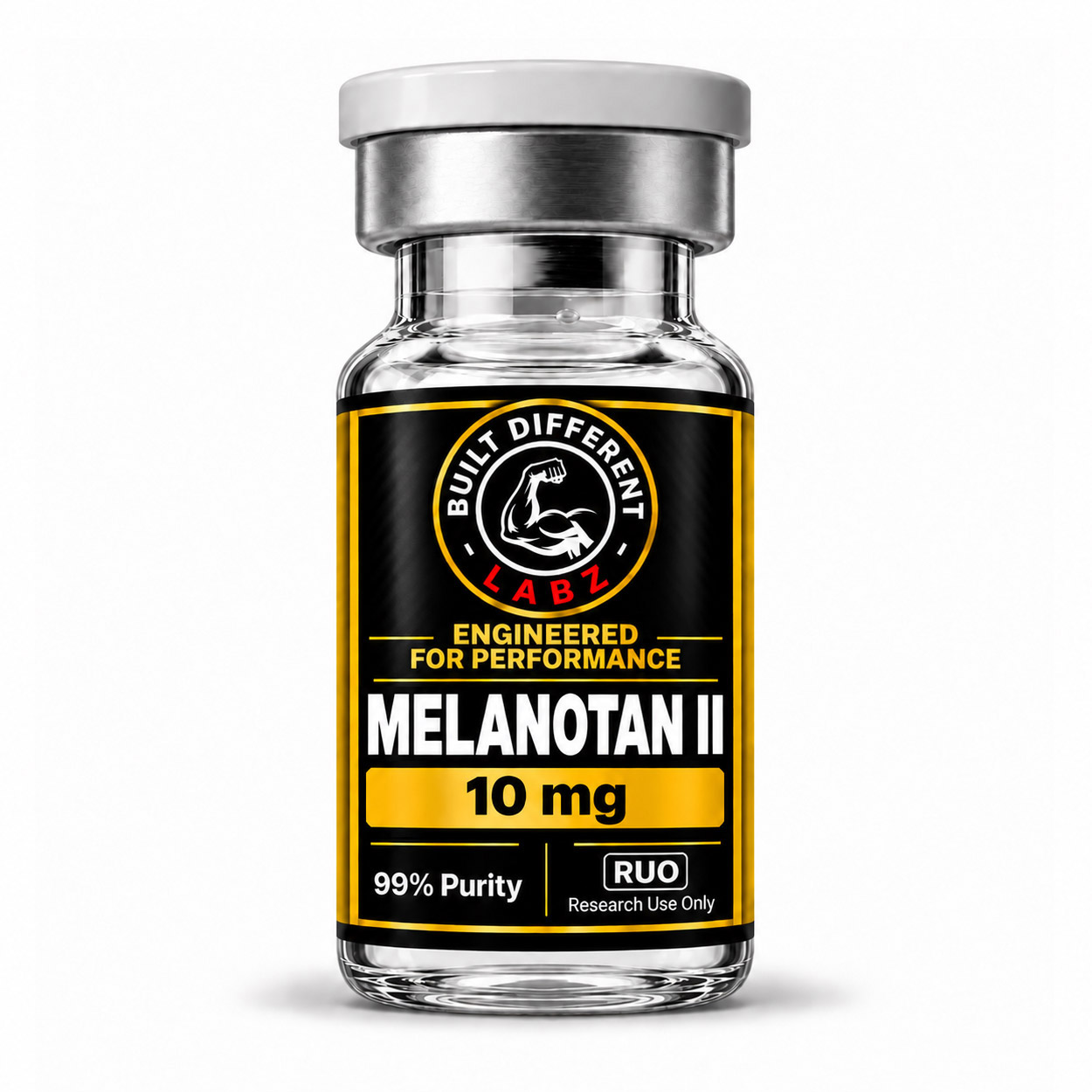
A vial labeled "Melanotan II 10mg" represents a total of 10 milligrams of Melanotan II in the vial. It does not mean that 10mg is an established or appropriate single human dose.
Melanotan II is a synthetic cyclic peptide derived from alpha-MSH.
Alpha-MSH is a naturally occurring peptide involved in:
Pigmentation
Appetite
Energy balance
Sexual behavior
Melanocortin signaling
Melanotan II was designed to be more stable and longer acting than natural alpha-MSH.
It is structurally related to bremelanotide, also known as PT-141.
Melanotan II acts as an agonist at several melanocortin receptors.
These include:
MC1R
MC3R
MC4R
MC5R
Different receptors are associated with different biological effects.
A simplified breakdown is:
MC1R = skin pigmentation
MC3R and MC4R = appetite, energy balance, sexual behavior and central nervous system effects
This broad receptor activity explains why Melanotan II can produce multiple effects rather than only tanning.
Tanning is the most famous effect of Melanotan II.
Melanotan II activates melanocortin receptors on melanocytes.
Melanocytes are pigment-producing cells in the skin.
This signaling increases production of melanin.
Melanin is the pigment responsible for:
Skin color
Hair color
Part of the eye's pigmentation
UV protection
Increased melanin can cause the skin to become darker.
Melanogenesis is the biological process that produces melanin.
The simplified pathway is:
Melanotan II
MC1 receptor activation
Melanocyte signaling
Increased melanin production
Increased skin pigmentation
This mechanism is different from a cosmetic bronzer, which only adds pigment to the surface of the skin.
Melanotan II can increase melanogenic signaling without UV exposure.
However, UV exposure strongly affects visible tanning because ultraviolet radiation also stimulates melanogenesis.
This is one reason Melanotan II is frequently associated with intentional sun or tanning-bed exposure.
That does not make excessive UV exposure safe.
UV radiation remains a major cause of:
Premature skin aging
DNA damage
Skin cancer
A darker tan does not eliminate those risks.
Increased melanin can provide some natural photoprotection.
However, Melanotan II should not be treated as sunscreen.
It does not replace:
Broad-spectrum sunscreen
Protective clothing
Shade
Avoiding excessive UV exposure
A person can still sustain significant UV damage despite having darker pigmentation.
Because Melanotan II increases melanocyte activity, existing pigmented areas can become darker.
This can include:
Freckles
Moles
Other pigmented spots
Freckles may become substantially more noticeable before the surrounding skin darkens.
Changes in moles are one of the more important safety concerns associated with unsupervised Melanotan II use.
Reported changes can include:
Darkening
Increased visibility
Apparent enlargement
Melanocortin stimulation can increase pigmentation within melanocytic lesions.
Any mole that changes in:
Size
Shape
Color
Border
Symptoms
should be medically evaluated.
It has not been established that Melanotan II directly causes melanoma.
However, this does not mean the concern can be dismissed.
Important issues include:
It directly stimulates melanocytes
Pigmented lesions may change
Users may intentionally increase UV exposure
Long-term safety data are inadequate
UV radiation itself is a well-established skin-cancer risk.
Therefore, darker skin produced by Melanotan II should never be interpreted as protection from melanoma.
The melanocortin system contains several related receptors.
MC1R:
Primarily associated with pigmentation.
MC2R:
Primarily activated by ACTH and involved in adrenal cortisol production.
MC3R:
Involved in energy balance and central signaling.
MC4R:
Important for appetite, body weight, autonomic function and sexual behavior.
MC5R:
Involved in several exocrine and physiological processes.
Melanotan II is not highly selective for only one receptor.
That contributes to both its effects and its side effects.
Melanotan II can reduce appetite.
This is thought to occur primarily through central melanocortin signaling involving MC4 receptors.
Possible effects include:
Reduced hunger
Earlier fullness
Reduced food intake
This explains why some people associate Melanotan II with weight loss.
Not directly.
Its potential influence on body weight is more closely associated with:
Appetite reduction
Central energy-balance signaling
Reduced calorie consumption
It should not be described as a direct fat-burning peptide.
Weight loss can occur if appetite suppression causes sustained calorie reduction.
However, Melanotan II is not an approved obesity medication.
Its risk-benefit profile for weight management is poorly characterized.
There are far better studied medications specifically developed for obesity.
One of the most unexpected findings during early Melanotan II research was an increase in sexual arousal and spontaneous erections.
These effects helped lead to the development of bremelanotide, or PT-141.
Melanotan II can potentially influence:
Sexual desire
Sexual arousal
Erectile response
The effect is believed to occur primarily through central melanocortin pathways rather than by directly increasing genital blood flow.
Melanotan II can produce spontaneous erections.
This is fundamentally different from PDE5 inhibitors such as sildenafil.
Sildenafil:
Primarily improves peripheral blood flow through the nitric oxide and PDE5 pathway.
Melanotan II:
Acts centrally through melanocortin receptors involved in sexual behavior and arousal.
These peptides are closely related but are not identical.
Melanotan II:
Strong pigmentation effects
Appetite effects
Sexual effects
Broad melanocortin receptor activity
PT-141:
Developed from Melanotan II research
Designed primarily around sexual-function effects
Much less emphasis on tanning
Known pharmaceutically as bremelanotide
PT-141 ultimately became the clinically developed sexual-function peptide.
Melanotan I is also known as afamelanotide.
It is more selective toward MC1R and primarily associated with pigmentation.
Melanotan II:
Cyclic peptide
Broader melanocortin receptor activity
Tanning
Appetite suppression
Sexual effects
Melanotan I or afamelanotide:
Primarily MC1R activity
More focused pigmentation effects
Less prominent sexual and appetite effects
A pharmaceutical afamelanotide implant exists for a specific medical condition, but that should not be confused with research Melanotan II.
Nausea is one of the most commonly discussed adverse effects.
Melanocortin signaling affects several central nervous system pathways, including those involved in:
Appetite
Autonomic function
Gastrointestinal sensations
Nausea may be accompanied by:
Reduced appetite
Stomach discomfort
Flushing
Facial and body flushing can occur.
This may appear as:
Warmth
Redness
Temporary facial flushing
The intensity varies considerably.
Some people report:
Fatigue
Lethargy
Temporary tiredness
Others describe increased arousal or alertness.
Responses can vary because Melanotan II affects several central melanocortin pathways.
Headache is another possible side effect.
A headache does not necessarily indicate a dangerous reaction, but severe or unusual neurological symptoms require appropriate medical assessment.
The melanocortin system influences autonomic and cardiovascular regulation.
Changes in:
Blood pressure
Heart rate
Autonomic activity
are biologically possible.
The cardiovascular safety of unsupervised long-term Melanotan II use has not been adequately established.
Because Melanotan II can stimulate erectile pathways, prolonged erections can occur.
An erection lasting around four hours or longer is a medical emergency.
Prolonged priapism can damage penile tissue if untreated.
Melanotan II may increase sexual desire in some people.
This effect is central rather than hormonal.
It does not require an increase in testosterone to affect libido.
Melanotan II is not primarily a reproductive hormone peptide.
There is no established evidence that its sexual effects depend on significantly increasing testosterone.
Its primary sexual mechanism involves melanocortin signaling in the brain.
It is not known to suppress endogenous testosterone in the manner of anabolic steroids.
Traditional steroid-style post-cycle therapy is not generally associated with Melanotan II.
It does not primarily suppress the hypothalamic-pituitary-gonadal axis.
No.
Melanotan II is not a growth hormone secretagogue.
It should not be grouped with:
Sermorelin
Tesamorelin
Ipamorelin
CJC-1295
No.
Melanotan II is not an anabolic peptide.
It does not directly stimulate:
Androgen receptors
Muscle protein synthesis
Growth hormone release
IGF-1 signaling
Any change in body composition would be indirect.
Bodybuilders have sometimes used Melanotan II primarily for cosmetic reasons.
Potential reasons include:
Darker skin can increase visual muscle contrast
Reduced appetite may help during dieting
Tanning without as much UV exposure may be perceived as cosmetically useful
None of these effects make Melanotan II a muscle-building compound.
Because melanocytes are involved in hair pigmentation, people sometimes ask whether Melanotan II can darken hair.
Pigmentation changes are biologically possible, but effects are inconsistent.
It should not be considered a treatment for gray hair.
Melanotan II should not be expected to meaningfully change eye color.
The pigmentation biology of the iris is much more complex than ordinary tanning of the skin.
Claims of dramatic eye-color changes are not established.
Scars can sometimes pigment differently from surrounding skin.
Melanotan II does not reliably make scars blend normally.
In some cases, uneven pigmentation could become more noticeable.
Vitiligo involves destruction or dysfunction of melanocytes.
Simply activating melanocortin signaling cannot create pigmentation where functional melanocytes are absent.
Melanocortin-based approaches have research relevance to pigmentation disorders, but Melanotan II is not an established vitiligo treatment.
Many forms of albinism involve genetic defects affecting melanin production.
Stimulating melanocytes does not necessarily overcome the underlying defect.
Melanotan II should not be described as a treatment for albinism.
A tan can temporarily change the visual appearance of skin.
However, intentional UV exposure accelerates photoaging.
UV-related skin aging includes:
Wrinkles
Pigmentation irregularities
Collagen degradation
Loss of elasticity
Using Melanotan II alongside excessive UV exposure could therefore undermine cosmetic skin-aging goals.
Tanning beds expose the skin to ultraviolet radiation.
This increases skin-cancer and photoaging risk.
Melanotan II does not make tanning beds safe.
A vial labeled:
"Melanotan II 10mg"
means the supplier represents the vial as containing a total of 10 milligrams of Melanotan II.
The 10mg is the total represented content of the vial.
It should not be interpreted as a single established administration amount.
There is no FDA-approved Melanotan II dosing regimen.
Research suppliers commonly sell Melanotan II as lyophilized powder.
This does not mean an RUO product has been established as safe for human injection.
Potential concerns include:
Sterility
Endotoxins
Peptide identity
Concentration accuracy
Impurities
Storage conditions
Nasal spray products are also marketed online.
Intranasal absorption can be highly dependent on:
Formulation
Concentration
Nasal condition
Manufacturing quality
A nasal product should not automatically be assumed to produce predictable exposure.
Peptides are generally vulnerable to digestion.
Reliable oral bioavailability for standard Melanotan II products is not established.
Claims that ordinary oral capsules provide predictable systemic Melanotan II exposure should therefore be treated cautiously.
Melanotan II was specifically developed to have greater biological stability than natural alpha-MSH.
However, precise pharmacokinetic claims from research-product vendors should be treated cautiously.
The visible tanning response can persist substantially longer than the peptide itself because increased melanin remains in the skin.
The visible pigmentation timeline depends on:
Baseline skin tone
Genetics
Existing melanin
UV exposure
Individual melanocortin responsiveness
Pigmentation changes are not necessarily immediate.
Melanin production and movement through skin cells require time.
Melanin remains until pigmented skin cells are naturally shed.
Therefore, pigmentation can persist after Melanotan II itself is no longer present.
The skin gradually lightens as epidermal cells turn over.
People have very different natural pigmentation responses.
Factors include:
MC1R genetics
Baseline skin tone
Hair color
Freckling tendency
UV sensitivity
People with very fair skin or certain MC1R variants may respond differently from people who naturally tan easily.
Many people with naturally red hair carry MC1R variants that affect eumelanin production.
This contributes to:
Fair skin
Freckling
Reduced tanning ability
Increased UV sensitivity
Melanotan II may still influence pigmentation, but genetics remain a major factor.
Potential side effects include:
Nausea
Flushing
Reduced appetite
Headache
Fatigue
Dizziness
Spontaneous erections
Increased libido
Darkening of freckles
Darkening of moles
Uneven pigmentation
Injection-site reactions
Less common or more serious concerns can include:
Priapism
Significant cardiovascular symptoms
Concerning changes in pigmented lesions
Severe allergic reactions
Long-term safety has not been adequately established.
Important unanswered questions include:
Chronic melanocyte stimulation
Long-term cardiovascular effects
Repeated central melanocortin stimulation
Interaction with UV exposure
Effects on existing melanocytic lesions
This is one of the biggest limitations of Melanotan II.
Anyone with changing pigmented lesions requires appropriate medical assessment regardless of whether Melanotan II is involved.
Common warning signs for melanoma include changes in:
Asymmetry
Border
Color
Diameter
Evolution over time
Melanotan II can make monitoring more complicated because normal freckles and moles may darken.
Research-grade peptide quality is a major consideration.
Potential problems include:
Incorrect peptide identity
Incorrect vial quantity
Chemical impurities
Degradation
Bacterial contamination
Endotoxins
Poor sterility
Incorrect storage
A label stating:
"Melanotan II 10mg - 99 percent purity"
does not establish pharmaceutical quality.
HPLC can help evaluate chemical purity.
Mass spectrometry can help verify molecular identity.
However, 99 percent analytical purity does not automatically establish:
Sterility
Endotoxin level
Exact vial quantity
Correct formulation
Pharmaceutical manufacturing quality
Safety for injection
These are separate measurements.
Research Use Only, or RUO, indicates that a particular product is marketed for laboratory or analytical research rather than as an approved medication for human treatment.
An RUO Melanotan II vial should not be assumed to have the manufacturing controls of an approved pharmaceutical.
Melanotan II is not FDA approved in the United States for:
Cosmetic tanning
Weight loss
Appetite suppression
Erectile dysfunction
Libido enhancement
Skin protection
Vitiligo
Anti-aging
There is no FDA-approved Melanotan II dosing protocol.
This should not be confused with related melanocortin drugs.
Afamelanotide is an approved pharmaceutical for a specific rare photosensitivity disorder.
Bremelanotide is an approved pharmaceutical for a specific sexual-desire disorder in certain women.
Neither approval makes Melanotan II an approved drug.
Afamelanotide:
Primarily MC1R-focused pigmentation drug.
Bremelanotide:
Primarily developed for sexual-desire effects.
Melanotan II:
Broad experimental melanocortin agonist with pigmentation, appetite and sexual effects.
These compounds are related but not interchangeable.
Melanocortin receptor activation:
Strong.
Increased pigmentation:
Strong biological and human evidence.
Appetite suppression:
Meaningful biological evidence.
Sexual arousal and erectile effects:
Meaningful human evidence.
Cosmetic tanning:
Clear biological effect, but not approved therapeutic use.
Weight-loss treatment:
Not established.
Skin-cancer prevention:
Not established.
Vitiligo treatment:
Not established.
Muscle growth:
Not established.
Testosterone enhancement:
Not established.
Long-term safety:
Insufficiently characterized.
Melanotan II has a very clear and biologically powerful mechanism.
Unlike many highly speculative peptides, its ability to activate the melanocortin system and increase pigmentation is well established.
The simplified tanning pathway is:
Melanotan II
MC1R activation
Melanocyte stimulation
Increased melanin production
Darker skin pigmentation
It also demonstrates how melanocortin signaling can affect appetite and sexual behavior through central receptors.
The biggest limitation is that its broad melanocortin activity produces effects beyond pigmentation.
The same lack of receptor selectivity that creates:
Tanning
Appetite suppression
Sexual effects
also creates:
Nausea
Flushing
Pigmented-lesion changes
Autonomic effects
Uncertain long-term safety
There is also no established FDA-approved cosmetic-tanning use.
Melanotan II is a synthetic cyclic melanocortin peptide derived from alpha-MSH.
Its primary biological effects involve:
Skin pigmentation
Melanocortin receptor activation
Appetite suppression
Sexual arousal
Erectile response
Its main pigmentation mechanism involves activation of MC1 receptors on melanocytes, while central MC3 and MC4 receptor activity contributes to appetite and sexual effects.
"Melanotan II 10mg" describes the represented total amount of peptide contained in a vial. It should not be interpreted as a recommended 10mg dose.
The most accurate description is:
Melanotan II is an experimental broad-spectrum melanocortin agonist with well-established biological effects on pigmentation and additional effects on appetite and sexual behavior. However, it is not an FDA-approved cosmetic tanning drug, and long-term human safety remains inadequately characterized, particularly regarding pigmented skin lesions, repeated melanocyte stimulation, cardiovascular effects, and use alongside ultraviolet exposure.
We do not accept returns or issue refunds for any reason, beside manufacturing defects.
Feel free to contact us if you have any questions or concerns about our Return Policy.