We offer FREE SHIPPPING on all orders!
We offer FREE SHIPPPING on all orders!
| THIS PRODUCT IS INTENDED AS A RESEARCH CHEMICAL ONLY. This designation allows the use of research chemicals strictly for invitro testing and laboratory experimentation only. All product information available on this website is for educational purposes only. Bodily introduction of any kind into humans or animals is strictly prohibited by law. This product should only be handled by licensed, qualified professionals. This product is not a drug, food, or cosmetic and may not be misbranded, misused or mislabeled as a drug, food, or cosmetic. |
AOD-9604 is a synthetic peptide fragment derived from the C-terminal region of human growth hormone, or hGH.
It was originally developed as a potential obesity treatment with a specific goal: isolate some of growth hormone's effects on fat metabolism without producing the broader growth-promoting and IGF-1-related effects associated with full-length HGH.
Its primary research areas include:
Fat metabolism
Lipolysis
Lipogenesis
Body-weight regulation
Adipose tissue
Obesity
Metabolic health
Cartilage and osteoarthritis research
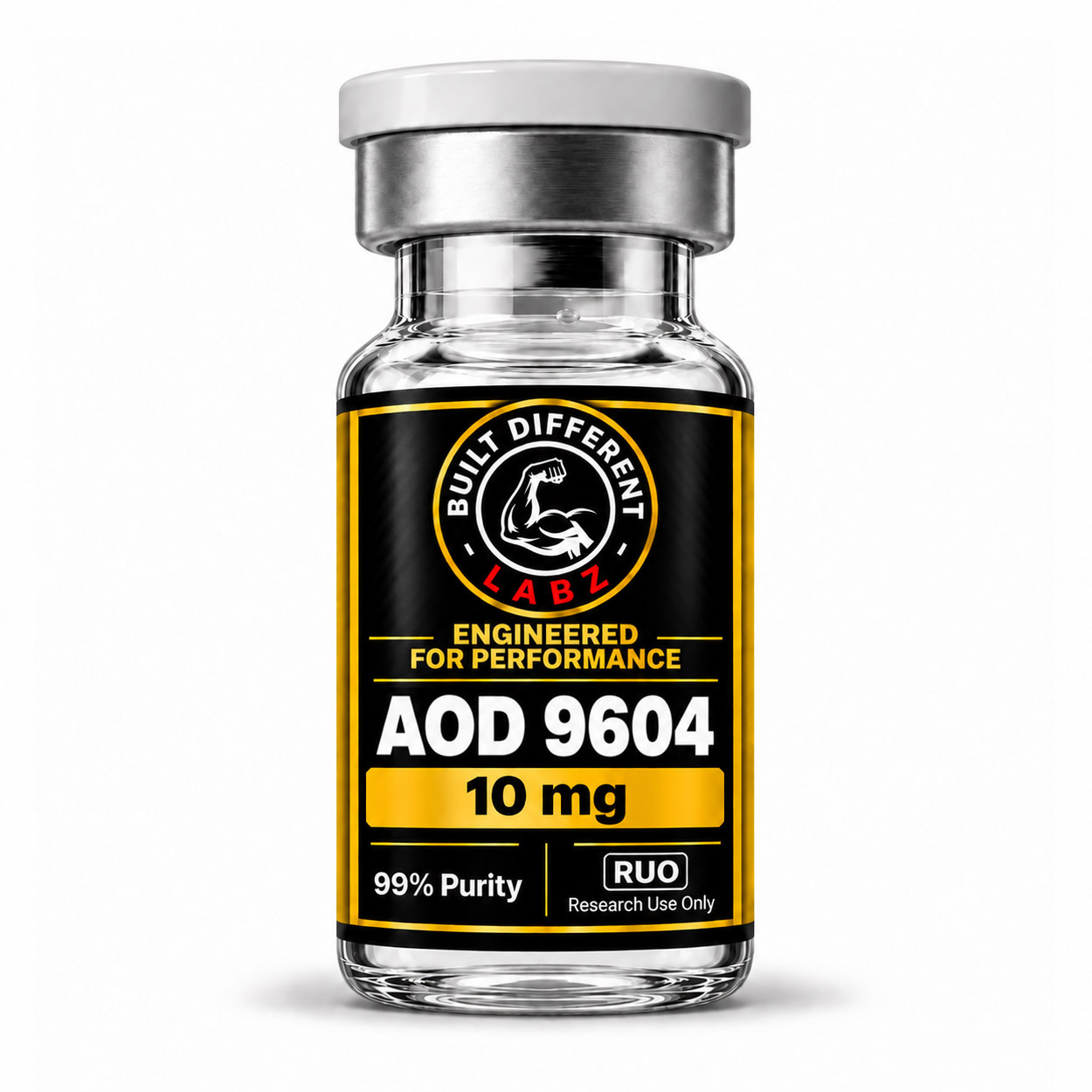
A vial labeled "AOD-9604 10mg" represents a total of 10 milligrams of AOD-9604 in the vial. It does not mean that 10mg is an established or appropriate single human dose.
AOD-9604 is a synthetic 16-amino-acid peptide based on the C-terminal portion of human growth hormone.
The FDA describes it as containing the 15 amino acids corresponding to hGH residues 177-191 plus an additional N-terminal tyrosine. (U.S. Food and Drug Administration)
It is commonly associated with names such as:
AOD-9604
AOD9604
HGH Fragment 176-191
HGH Frag
Tyr-hGH 177-191
However, commercial products labeled simply "HGH Fragment 176-191" are not always chemically or scientifically interchangeable with the specifically developed AOD-9604 molecule.
AOD is commonly expanded as:
Anti-Obesity Drug
AOD-9604 was originally investigated specifically as a potential obesity medication.
The concept was to separate growth hormone's proposed fat-metabolism effects from its broader growth-promoting activity.
Human growth hormone is a 191-amino-acid hormone produced by the pituitary gland.
HGH affects numerous physiological processes, including:
Growth
IGF-1 production
Protein metabolism
Fat metabolism
Bone
Muscle
Glucose metabolism
Tissue growth
Full-length HGH therefore has much broader biological activity than AOD-9604.
Researchers believed that some of HGH's effects on fat metabolism could be associated with its C-terminal region.
This led to the idea of isolating that portion of the hormone.
The theoretical goal was:
HGH fat-metabolism region
Isolate the active fragment
Maintain lipolytic and anti-lipogenic activity
Avoid significant HGH growth signaling
Avoid substantial IGF-1 elevation
Potentially create a more targeted obesity treatment
That was the original pharmaceutical hypothesis behind AOD-9604.
The proposed mechanism involves regulation of fat metabolism.
Two important processes are:
Lipolysis
and
Lipogenesis
Lipolysis means breaking stored triglycerides into fatty acids and glycerol.
Lipogenesis means creating and storing new fat.
Preclinical research suggested AOD-9604 could potentially:
Increase lipolysis
Reduce lipogenesis
Increase fat oxidation
Influence adipose-tissue metabolism
However, its exact mechanism in humans remains incompletely established.
Lipolysis is the process of mobilizing stored body fat.
Stored triglycerides are broken down into:
Free fatty acids
Glycerol
These fatty acids can then potentially be used for energy.
Early laboratory and animal research suggested that the C-terminal HGH fragment retained some of HGH's effects on adipose-tissue metabolism.
This became the main biological rationale for AOD-9604.
Lipogenesis is essentially the opposite process.
It involves converting excess energy into stored fat.
Preclinical research suggested that AOD-9604 might reduce certain lipogenic processes.
This led to the popular description of AOD-9604 as potentially:
"Increasing fat breakdown while reducing fat storage."
That description represents the experimental mechanism, not proven substantial human fat loss.
This requires an important distinction.
AOD-9604 demonstrated effects involving fat metabolism in laboratory and animal research.
However, the human obesity-development program did not establish sufficiently meaningful weight-loss effectiveness.
The FDA's detailed review concluded that the available evidence did not establish AOD-9604 as an effective obesity treatment. (U.S. Food and Drug Administration)
Therefore, describing AOD-9604 as a "proven fat-burning peptide" would overstate the evidence.
AOD-9604 progressed much further into human development than many research peptides.
It underwent clinical investigation for obesity.
This is scientifically important because the original fat-loss hypothesis was actually tested in humans rather than remaining entirely based on animal experiments.
Unfortunately, the later obesity-development program did not demonstrate the level of effectiveness necessary to establish it as a successful obesity drug.
Development for obesity was ultimately discontinued.
The main problem was effectiveness rather than the original concept alone.
Earlier research generated enough interest to continue development.
But larger obesity studies did not establish a clinically convincing weight-loss advantage.
This is an important distinction.
AOD-9604 did not disappear simply because nobody tested it.
It was developed specifically for obesity and progressed into human testing, but the efficacy results were not strong enough to establish it as an obesity medication. (U.S. Food and Drug Administration)
AOD-9604 and HGH are very different.
HGH:
Full 191-amino-acid hormone
Strong GH receptor activity
Increases IGF-1
Influences muscle and bone
Influences tissue growth
Influences glucose metabolism
Has systemic endocrine effects
AOD-9604:
Small C-terminal HGH-derived peptide
Developed primarily around fat metabolism
Not intended to reproduce HGH's growth-promoting activity
Does not appear to significantly increase IGF-1
Not an HGH replacement
AOD-9604 should therefore not be described as "HGH in a smaller dose."
No.
AOD-9604 is not a growth hormone secretagogue.
It does not primarily stimulate the pituitary to release HGH.
This makes it completely different from:
Sermorelin
Ipamorelin
CJC-1295
Tesamorelin
Those compounds stimulate pathways associated with endogenous growth hormone secretion.
AOD-9604 is a fragment derived from HGH itself.
One of the original goals of AOD-9604 was to avoid significant IGF-1 stimulation.
Available research has not demonstrated the substantial IGF-1 elevations expected from pharmacological full-length HGH.
This was considered a potentially attractive feature of the compound.
Growth hormone stimulates production of insulin-like growth factor 1, or IGF-1.
IGF-1 contributes to:
Tissue growth
Protein synthesis
Bone growth
Cellular proliferation
Excessive GH and IGF-1 signaling can also contribute to unwanted effects.
AOD-9604 was designed to avoid much of this growth-related signaling.
Full-length HGH can reduce insulin sensitivity under certain circumstances.
This is one of the concerns associated with excessive HGH exposure.
Preclinical AOD-9604 research did not demonstrate the same strong diabetogenic profile.
However, this does not mean AOD-9604 has been established as metabolically harmless during long-term human use.
AOD-9604 was specifically attractive because researchers hoped to separate fat-metabolism effects from some of HGH's undesirable metabolic effects.
Animal studies did not demonstrate the same degree of glucose intolerance or insulin resistance associated with excessive full-length HGH exposure.
Human long-term safety evidence remains much more limited.
AOD-9604 should not be considered a muscle-building peptide.
It was specifically designed to avoid the growth-promoting activity of full HGH.
It does not have established anabolic effects comparable with:
HGH
IGF-1
Testosterone
Anabolic steroids
Its research focus has primarily been adipose tissue and metabolism.
AOD-9604 became popular in bodybuilding and physique communities because of its reputation as a fat-loss peptide.
The theoretical attraction is obvious:
Potentially increase fat metabolism
without
Strong HGH-like growth effects.
However, bodybuilding popularity should not be confused with clinical evidence.
There is insufficient evidence demonstrating substantial fat-loss effects in healthy trained athletes.
AOD-9604 is commonly marketed for bodybuilding "cutting" phases.
The theoretical goal is reducing body fat while preserving lean mass.
However, there is no strong controlled human evidence demonstrating that AOD-9604 selectively removes fat while preserving muscle during a bodybuilding diet.
That claim exceeds the available evidence.
There is no convincing evidence that AOD-9604 directly preserves muscle tissue during calorie restriction.
Because it lacks the broader anabolic effects of HGH, it should not automatically inherit HGH's effects on lean tissue.
Tesamorelin:
GHRH analogue
Stimulates endogenous HGH
Increases IGF-1
Has controlled human clinical evidence
FDA-approved for reducing excess abdominal visceral fat in adults with HIV-associated lipodystrophy
AOD-9604:
HGH-derived fragment
Does not primarily stimulate GH secretion
Designed to avoid substantial IGF-1 elevation
Developed for obesity
Failed to establish sufficient effectiveness as an obesity treatment
Tesamorelin has substantially stronger clinical evidence for its approved indication.
Sermorelin stimulates the pituitary through the GHRH receptor.
The pathway is:
Sermorelin
Pituitary
Growth hormone
IGF-1
AOD-9604 does not work this way.
Its proposed effects occur more directly at the level of fat metabolism.
Ipamorelin activates the ghrelin receptor, GHS-R1a, and stimulates endogenous GH release.
AOD-9604 does not.
Therefore:
Ipamorelin = GH secretagogue.
AOD-9604 = HGH-derived metabolic fragment.
These compounds are fundamentally different.
Cagrilintide:
Long-acting amylin analogue
Reduces appetite
Increases satiety
Reduces food intake
Has substantial modern human weight-loss research
AOD-9604:
HGH-derived fragment
Does not primarily suppress appetite
Proposed direct effects on adipose metabolism
Much weaker human efficacy evidence for weight loss
GLP-1-based medications can affect:
Appetite
Satiety
Gastric emptying
Glucose regulation
AOD-9604 was designed around:
Lipolysis
Lipogenesis
Adipose metabolism
AOD-9604 does not reproduce GLP-1 pharmacology.
AOD-9604 is not primarily an appetite suppressant.
Its original mechanism was intended to affect how fat is metabolized rather than substantially reduce hunger.
This differentiates it from:
Cagrilintide
Semaglutide
Tirzepatide
AOD-9604 is not a thyroid hormone.
There is no established evidence that its principal fat-metabolism effects occur through directly increasing thyroid hormones.
It should not be compared with T3 or T4 therapy.
Animal research suggests effects on energy and fat metabolism.
However, statements such as "AOD-9604 dramatically increases human metabolism" are not supported by strong clinical evidence.
AOD-9604 has been investigated for obesity and body-fat reduction.
However, it does not have the same established evidence for selective visceral-fat reduction that pharmaceutical Tesamorelin has in its approved HIV-associated lipodystrophy population.
AOD-9604 cannot be expected to specifically target abdominal fat.
Human fat distribution is influenced by:
Genetics
Sex hormones
Age
Calorie balance
Insulin sensitivity
Overall body-fat percentage
Claims that AOD-9604 selectively "melts belly fat" are not established.
"Stubborn fat" is a popular fitness term rather than a specific medical diagnosis.
There is no strong evidence showing that AOD-9604 selectively eliminates fat from areas such as:
Lower abdomen
Love handles
Thighs
Lower back
Localized fat reduction claims should therefore be treated cautiously.
AOD-9604 has also generated research interest outside obesity.
Preclinical research has investigated possible effects on cartilage and osteoarthritis.
A rabbit study reported potentially beneficial cartilage-related effects.
However, animal cartilage findings do not establish treatment of human osteoarthritis. (PeptideGrids)
AOD-9604 is sometimes marketed for:
Joint health
Cartilage repair
Osteoarthritis
The evidence for these claims is considerably weaker than marketing sometimes suggests.
There is no established FDA-approved AOD-9604 treatment for osteoarthritis.
This has not been established in humans.
Preclinical cartilage findings are interesting, but they do not prove that AOD-9604 regrows damaged human cartilage.
Cartilage regeneration is biologically difficult, particularly in advanced osteoarthritis.
There is insufficient evidence to classify AOD-9604 as an established treatment for joint pain.
Pain improvement and cartilage regeneration are also different outcomes.
A compound could theoretically influence inflammation or symptoms without rebuilding cartilage.
BPC-157 is primarily associated with experimental research involving:
Tissue protection
Tendons
Ligaments
Gastrointestinal tissue
Wound healing
AOD-9604 is primarily associated with:
Fat metabolism
Obesity research
Adipose tissue
Experimental cartilage research
Their proposed mechanisms are substantially different.
TB-500-related research focuses primarily on:
Cell migration
Actin
Tissue repair
Angiogenesis
AOD-9604 focuses primarily on metabolic and adipose-tissue research.
It should not be considered a substitute for TB-500.
These names are frequently used interchangeably commercially, but there is an important chemical distinction.
AOD-9604 contains the C-terminal HGH sequence plus an additional N-terminal tyrosine.
The FDA describes AOD-9604 as a synthetic 16-amino-acid peptide consisting of hGH residues 177-191 with an additional N-terminal tyrosine. (U.S. Food and Drug Administration)
Therefore, claims based on AOD-9604 clinical research should not automatically be transferred to every product marketed simply as "HGH Frag 176-191."
AOD-9604 is not an androgenic peptide.
It does not primarily stimulate:
GnRH
LH
FSH
Testosterone
There is no established evidence that it significantly increases testosterone.
AOD-9604 is not known to suppress natural testosterone production in the manner of anabolic steroids.
Traditional steroid-style post-cycle therapy is not generally associated with AOD-9604.
It does not primarily act through androgen receptors or suppress the reproductive hormone axis.
A vial labeled:
"AOD-9604 10mg"
means that the supplier represents the vial as containing a total of 10 milligrams of AOD-9604.
The entire 10mg represents total vial content.
It should not be interpreted as a recommended single administration amount.
There is no FDA-approved AOD-9604 human dosing regimen.
AOD-9604 is commonly sold online as lyophilized research powder.
This should not be confused with a clinically approved injectable medication.
An RUO vial does not automatically establish:
Sterility
Endotoxin control
Concentration accuracy
Pharmaceutical manufacturing
Stability
Safety for injection
Oral formulations were investigated during AOD-9604's pharmaceutical development.
However, the existence of oral clinical research does not mean that arbitrary oral AOD-9604 products have predictable bioavailability or effectiveness.
Peptide absorption is highly dependent on formulation.
Topical and transdermal AOD-9604 products are also marketed.
Reliable systemic absorption through ordinary skin is not established simply because a product contains the peptide.
Formulation matters considerably.
Pharmacokinetic information is limited compared with approved drugs.
Peptide fragments can be degraded relatively quickly by enzymes.
Claims about precise half-life and duration from research-product suppliers should therefore be treated cautiously.
A short circulating half-life also does not automatically tell us how long downstream metabolic signaling persists.
Human clinical development produced some safety information, but long-term safety for current research-product use remains inadequately characterized.
Potential reported or theoretical adverse effects include:
Headache
Nausea
Fatigue
Dizziness
Injection-site irritation
Redness
Gastrointestinal discomfort
Hypersensitivity reactions
The FDA has also highlighted broader concerns relevant to peptide products, including immunogenicity, aggregation, peptide-related impurities and difficulties in characterization. (U.S. Food and Drug Administration)
AOD-9604 was specifically developed to avoid many of the effects associated with full-length HGH.
It has not demonstrated the same degree of:
IGF-1 elevation
Tissue-growth signaling
HGH receptor activity
Therefore, it should not automatically produce the same pharmacological profile as HGH.
However, this does not establish that AOD-9604 is risk-free.
There is insufficient evidence to conclude that AOD-9604 causes cancer.
Because it was designed to avoid significant HGH and IGF-1 growth signaling, it differs from full-length HGH in this respect.
However, long-term human safety data remain inadequate.
It would also be inappropriate to claim that AOD-9604 prevents cancer.
Research-product quality can vary significantly.
Potential concerns include:
Incorrect peptide identity
Incorrect peptide sequence
Incorrect vial quantity
Chemical impurities
Degradation products
Aggregation
Endotoxins
Bacterial contamination
Poor sterility
This matters especially when comparing commercial RUO material with material manufactured for formal clinical trials.
HPLC can help assess chemical purity.
Mass spectrometry can help confirm molecular identity.
However, even 99 percent analytical purity does not automatically establish:
Sterility
Endotoxin level
Exact vial quantity
Correct formulation
Pharmaceutical manufacturing quality
Human safety
Those require separate testing.
Research Use Only, or RUO, means a product is marketed for laboratory or analytical research rather than as an approved medication for human treatment.
An RUO AOD-9604 vial should not be treated as an FDA-approved obesity medication.
No.
AOD-9604 is not an FDA-approved drug for:
Obesity
Weight loss
Fat loss
Bodybuilding
Visceral-fat reduction
Osteoarthritis
Cartilage regeneration
Anti-aging
FDA's formal review states that neither AOD-9604 free base nor AOD-9604 acetate is a component of an FDA-approved drug. FDA's evaluation also found insufficient evidence supporting effectiveness for obesity and raised concerns about characterization and safety of compounded peptide products. (U.S. Food and Drug Administration)
AOD-9604 has also undergone FDA consideration regarding pharmacy compounding.
In December 2024, the FDA Pharmacy Compounding Advisory Committee voted against recommending AOD-9604 free base and acetate for inclusion on the 503A Bulks List after FDA evaluated the substances for obesity. (U.S. Food and Drug Administration)
This is separate from ordinary drug approval, but it further emphasizes that AOD-9604 should not be presented as an FDA-approved weight-loss therapy.
HGH-derived structure:
Strong.
Effects on fat metabolism in laboratory research:
Meaningful.
Animal lipolysis and obesity research:
Promising.
Avoidance of strong HGH-like growth signaling:
Supported by preclinical development.
Human exposure:
Yes.
Human obesity research:
Substantial enough to test the concept.
Clinically meaningful human weight loss:
Not established.
FDA-approved obesity treatment:
No.
Selective belly-fat reduction:
Not established.
Bodybuilding fat loss:
Not established.
Muscle preservation:
Not established.
Cartilage repair:
Promising preclinical research only.
Human osteoarthritis treatment:
Not established.
Long-term research-vial safety:
Insufficiently characterized.
AOD-9604 was designed around an attractive pharmacological concept:
Separate HGH's potential effects on fat metabolism from its broader endocrine and growth-promoting effects.
The theoretical pathway is:
AOD-9604
Adipose-tissue metabolic signaling
Increased lipolysis
Reduced lipogenesis
Potential increased fat utilization
without substantial HGH or IGF-1 growth signaling.
That makes AOD-9604 mechanistically interesting.
The biggest limitation is that the attractive mechanism did not translate into convincing obesity-treatment effectiveness.
AOD-9604 progressed into human clinical development.
That gives it more human exposure data than many research peptides.
But it also means its central claim was actually put to a meaningful test.
The clinical development program ultimately failed to establish sufficient weight-loss effectiveness, and AOD-9604 never became an approved obesity medication. (U.S. Food and Drug Administration)
This is important because animal lipolysis does not automatically equal clinically meaningful human fat loss.
AOD-9604 is a synthetic 16-amino-acid peptide derived from the C-terminal region of human growth hormone.
Its primary research areas include:
Lipolysis
Lipogenesis
Fat metabolism
Adipose tissue
Obesity
Body composition
Cartilage
Osteoarthritis
It was designed to isolate some of HGH's proposed fat-metabolism effects while avoiding substantial growth hormone receptor activity and IGF-1 elevation.
"AOD-9604 10mg" describes the represented total amount of peptide contained in a vial. It should not be interpreted as a recommended 10mg dose.
The most accurate description is:
AOD-9604 is an experimental HGH-derived metabolic peptide originally developed as an obesity treatment. Laboratory and animal research demonstrated potentially interesting effects on fat metabolism, and the compound progressed into human clinical development. However, the obesity program did not establish sufficiently meaningful weight-loss efficacy, and AOD-9604 is not FDA approved for obesity, fat loss, bodybuilding, cartilage regeneration, or osteoarthritis. Its reputation as a powerful "fat-burning peptide" is therefore substantially stronger than the human efficacy evidence supporting that claim.
We do not accept returns or issue refunds for any reason, beside manufacturing defects.
Feel free to contact us if you have any questions or concerns about our Return Policy.