We offer FREE SHIPPPING on all orders!
We offer FREE SHIPPPING on all orders!
| THIS PRODUCT IS INTENDED AS A RESEARCH CHEMICAL ONLY. This designation allows the use of research chemicals strictly for invitro testing and laboratory experimentation only. All product information available on this website is for educational purposes only. Bodily introduction of any kind into humans or animals is strictly prohibited by law. This product should only be handled by licensed, qualified professionals. This product is not a drug, food, or cosmetic and may not be misbranded, misused or mislabeled as a drug, food, or cosmetic. |
Pinealon is a short synthetic tripeptide primarily researched for potential effects involving the brain, nervous system, cognitive function, cellular stress, gene regulation, and age-related neurological changes.
It is generally classified as a peptide bioregulator rather than a growth hormone peptide, metabolic peptide, or direct tissue-repair peptide.
Pinealon is commonly identified as the three-amino-acid sequence:
Glu-Asp-Arg
or:
EDR
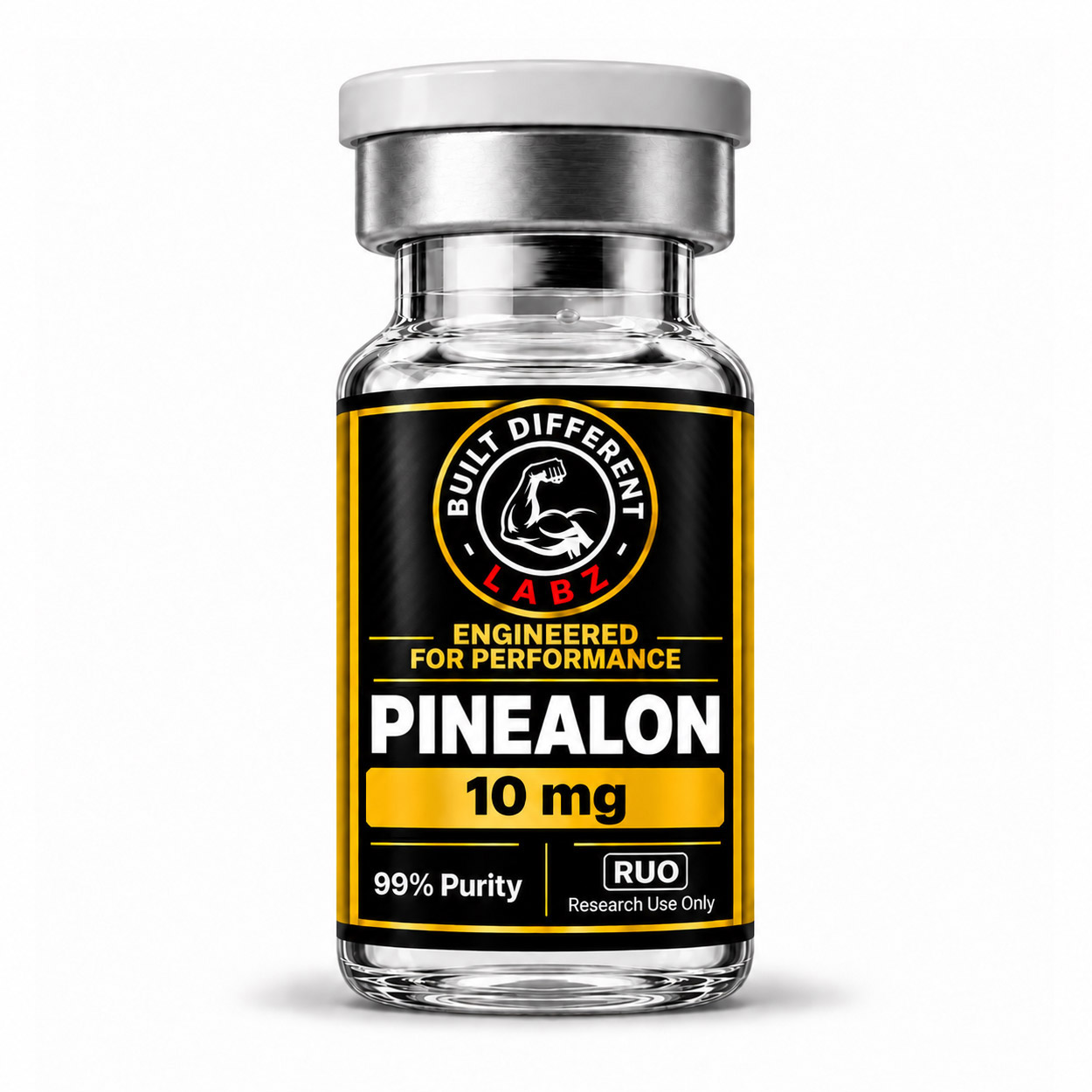
A vial labeled "Pinealon 10mg" represents a total of 10 milligrams of Pinealon in the vial. It does not mean that 10mg is an established or appropriate single human dose.
Pinealon is a synthetic tripeptide consisting of:
Glutamic acid
Aspartic acid
Arginine
It belongs to a broader group of short peptides sometimes called peptide bioregulators.
These compounds have been studied largely in Eastern European and Russian research programs for possible effects on:
Gene expression
Cellular regulation
Aging
Nervous-system function
Cognitive decline
Oxidative stress
Tissue-specific signaling
Pinealon is primarily associated with the brain and nervous system.
Research interest around Pinealon includes possible effects involving:
Memory
Learning
Cognitive function
Neuroprotection
Oxidative stress
Cellular aging
Gene regulation
Neuronal survival
Brain metabolism
Stress-related neurological damage
The proposed effects are primarily regulatory and neuroprotective rather than stimulatory.
Pinealon is not generally described as a stimulant like caffeine or amphetamine.
The exact mechanism is not fully established.
Research on short peptide bioregulators suggests that they may influence cellular function through mechanisms involving:
Gene expression
DNA-related regulatory processes
Protein synthesis
Cellular signaling
Antioxidant systems
Neuronal metabolism
Pinealon has specifically been studied for potential effects on gene expression in nervous-system cells.
However, the idea that a peptide "regulates genes" should not be interpreted as meaning that it permanently rewrites DNA.
One of the more unusual areas of Pinealon research concerns gene regulation.
Short peptides have been proposed to interact with cellular regulatory mechanisms that influence which genes are more or less active.
This could theoretically affect:
Protein production
Cellular repair
Stress responses
Neuronal function
Aging-related cellular pathways
This remains an experimental area.
It would be inaccurate to describe Pinealon as genetic engineering or gene therapy.
The brain is the primary tissue associated with Pinealon research.
Potential areas of interest include:
Neuronal protection
Cognitive function
Memory
Learning
Brain aging
Recovery from neurological stress
Much of the supporting research is preclinical or based on relatively limited clinical literature.
Neuroprotection refers to protecting neurons from damage or degeneration.
Potential mechanisms proposed for Pinealon include:
Reduced oxidative damage
Improved cellular stress tolerance
Regulation of neuronal metabolism
Modulation of gene expression
Preservation of neuronal function
This does not establish Pinealon as a proven treatment for neurodegenerative disease.
Memory is one of the most commonly discussed potential benefits.
Experimental studies have investigated whether Pinealon may influence:
Memory formation
Memory retention
Learning
Cognitive performance
Some research suggests possible improvements under conditions involving neurological stress or aging.
However, strong modern randomized clinical evidence in healthy humans is lacking.
Pinealon has also been investigated for possible effects on learning ability.
Potential mechanisms may include:
Improved neuronal signaling
Reduced oxidative stress
Improved cellular metabolism
Neuroprotective effects
There is not enough evidence to classify Pinealon as a proven cognitive-enhancing drug.
Pinealon is sometimes marketed as a nootropic.
Possible claimed benefits include:
Better focus
Improved mental clarity
Better concentration
Improved memory
These claims are not established to the same degree as conventional medications used for attention disorders.
Pinealon is not a stimulant.
Both peptides are associated with brain and nervous-system research, but their emphasis is different.
Pinealon:
Neuroprotection
Cognitive aging
Gene regulation
Cellular stress
Memory
Selank:
Anxiety
Stress
GABA-related signaling
Mood
Cognition
Selank is more commonly associated with anxiolytic effects.
Pinealon is more commonly associated with neuroprotection and cellular regulation.
Semax is another peptide frequently discussed in cognitive and neurological research.
Semax is more strongly associated with:
BDNF
Neuroprotection
Attention
Cognitive performance
Recovery from neurological injury
Pinealon is more commonly associated with:
Short-peptide bioregulation
Gene expression
Cellular aging
Neuroprotection
Both remain experimental in the United States.
BDNF stands for brain-derived neurotrophic factor.
BDNF supports:
Neuronal survival
Learning
Memory
Neuroplasticity
Pinealon is sometimes discussed alongside compounds that influence neurotrophic signaling.
However, it should not be claimed that Pinealon reliably or dramatically increases BDNF in humans unless specifically demonstrated in controlled research.
Neuroplasticity refers to the ability of the nervous system to adapt and reorganize.
Because Pinealon has been investigated for:
Gene regulation
Neuronal protection
Cognitive function
there is theoretical interest in its relationship with neuroplasticity.
However, direct evidence showing major enhancement of human neuroplasticity is limited.
Pinealon is strongly associated with anti-aging research within the peptide bioregulator field.
The theory is that age-related decline involves changes in:
Gene expression
Cellular repair
Oxidative stress
Protein synthesis
Mitochondrial function
Neuronal resilience
Short regulatory peptides have been studied as potential ways to influence some of these systems.
No.
There is no convincing evidence that Pinealon reverses human aging.
Claims that it:
Makes cells young again
Reverses biological age
Permanently rejuvenates the brain
Extends human lifespan
go beyond established evidence.
One of the more reasonable research areas involves age-related changes in cognitive function.
Researchers have investigated short peptides for potential effects on:
Memory decline
Learning
Brain metabolism
Neuronal function
Pinealon may be especially interesting in older populations or models of neurological stress.
However, modern large-scale human trials remain limited.
Oxidative stress occurs when reactive molecules overwhelm the body's antioxidant defenses.
The brain is particularly vulnerable because it:
Uses large amounts of oxygen
Has high metabolic activity
Contains lipid-rich membranes
Pinealon has been investigated for potential antioxidant and cytoprotective effects.
Reducing oxidative damage could theoretically help preserve neuronal function.
It is more accurate to describe Pinealon as potentially influencing antioxidant defense and cellular stress pathways rather than as a simple antioxidant.
Its proposed effects may involve:
Cellular regulation
Gene expression
Stress-response pathways
rather than merely neutralizing free radicals directly.
Healthy neurons require substantial mitochondrial energy.
Mitochondrial dysfunction can contribute to:
Cognitive decline
Neurodegeneration
Fatigue
Oxidative stress
Pinealon has been studied in contexts involving cellular energy and stress.
However, it is not primarily a mitochondria-targeting peptide like SS-31.
SS-31:
Directly targets mitochondrial membranes
Interacts with cardiolipin
Supports ATP production
Focuses strongly on mitochondrial bioenergetics
Pinealon:
Short peptide bioregulator
Associated with gene expression
Neuroprotection
Cognitive aging
Both may be discussed in relation to cellular aging, but their mechanisms are very different.
Because Pinealon is associated with neuroprotection and cognitive research, it is sometimes promoted online for Alzheimer's disease.
There is insufficient evidence to establish Pinealon as a treatment for Alzheimer's disease.
It should not replace established neurological evaluation or treatment.
Similar claims exist around Parkinson's disease.
Theoretical interest comes from:
Oxidative stress
Neuronal protection
Cellular aging
But Pinealon is not an established treatment for Parkinson's disease.
Neuroprotective peptides are sometimes investigated following ischemic brain injury.
Pinealon has been discussed in neurological recovery research.
However, it should not be described as an established treatment for stroke.
Stroke requires immediate emergency medical treatment.
There is theoretical interest in neuroprotective compounds following traumatic brain injury because brain trauma can involve:
Oxidative stress
Inflammation
Mitochondrial dysfunction
Neuronal damage
Pinealon has not been established as a standard therapy for concussion or traumatic brain injury.
Pinealon is not primarily considered an anxiolytic peptide.
For anxiety-related research, Selank has a much stronger association.
Any improvement in anxiety from Pinealon would likely be indirect rather than its primary known effect.
Pinealon is not an established antidepressant.
There is insufficient evidence to recommend it as a treatment for depression.
Pinealon is not primarily a sleep peptide.
It does not have the same research profile as DSIP.
Any sleep-related effects would likely be secondary to nervous-system regulation rather than direct sleep induction.
Pinealon is not a stimulant.
It does not work like:
Caffeine
Amphetamine
Modafinil
Some people may report improved mental energy or reduced cognitive fatigue.
Those effects have not been firmly established in large controlled trials.
Pinealon is not a bodybuilding peptide in the traditional sense.
It does not directly:
Increase testosterone
Increase growth hormone
Increase IGF-1
Stimulate muscle hypertrophy
Burn fat
Interest among athletes would more likely involve:
Cognitive performance
Mental recovery
Stress resistance
Nervous-system health
No strong evidence shows that Pinealon directly builds muscle.
It is not an anabolic compound.
No.
Pinealon is not considered a fat-loss peptide.
Pinealon is not known to directly stimulate testosterone production.
It should not be grouped with reproductive peptides such as Kisspeptin.
Pinealon is not a growth hormone secretagogue.
It should not be grouped with:
Sermorelin
Tesamorelin
Ipamorelin
CJC-1295
There is no established evidence that Pinealon suppresses natural testosterone production in the manner of anabolic steroids.
Traditional post-cycle therapy is not generally associated with Pinealon.
It does not primarily affect the androgen system.
A vial labeled:
"Pinealon 10mg"
means that the supplier represents the vial as containing a total of 10 milligrams of Pinealon.
That is the total represented vial quantity.
It should not be interpreted as an established single dose.
There is no FDA-approved Pinealon dosing regimen.
Pinealon has appeared in different research and peptide-bioregulator contexts.
Online research products may be sold as lyophilized powder.
Some short peptide bioregulator products are also marketed in oral or capsule forms.
However, formulations are not automatically equivalent.
Differences can include:
Absorption
Bioavailability
Purity
Stability
Manufacturing quality
Short peptides may sometimes have different stability and absorption characteristics from larger peptides.
However, oral bioavailability should not automatically be assumed simply because Pinealon consists of only three amino acids.
Claims of highly efficient oral absorption require formulation-specific evidence.
Pinealon is frequently promoted as capable of affecting the central nervous system.
Its small size is one reason researchers are interested in its potential ability to reach nervous-system tissues.
However, statements that it freely crosses the human blood-brain barrier in large quantities should be treated cautiously unless supported by pharmacokinetic evidence.
Detailed modern human pharmacokinetic information for Pinealon is limited.
A short plasma half-life would not necessarily mean a peptide has no biological effect.
Short peptides may trigger regulatory responses that continue after the peptide itself has been cleared.
There is no well-established universal onset.
Potential cognitive or neurological effects would likely depend on:
Individual biology
Route
Exposure
Baseline cognitive condition
Age
Duration of use
Claims of immediate dramatic cognitive enhancement are not well supported.
Because high-quality human safety data are limited, the true side-effect profile is not well defined.
Potentially reported or theoretically possible effects include:
Headache
Fatigue
Dizziness
Nausea
Changes in sleep
Injection-site irritation
Allergic reactions
Absence of commonly reported severe effects does not prove long-term safety.
Long-term safety in healthy people is insufficiently characterized.
Important unanswered questions include potential effects on:
Gene regulation
Nervous-system adaptation
Immune function
Cellular signaling
Chronic exposure
More long-duration controlled human research is needed.
Because Pinealon is sometimes discussed in relation to gene regulation and cellular growth, questions arise about cancer risk.
There is not adequate evidence to conclude that Pinealon causes cancer.
There is also not adequate evidence to claim that it prevents cancer.
Claims in either direction should be treated cautiously.
Some peptide-bioregulator research discusses interactions between short peptides and DNA-related regulatory processes.
This does not mean Pinealon:
Changes a person's genetic code
Permanently edits DNA
Functions as gene therapy
The more accurate concept is possible modulation of gene expression.
These two peptides are frequently associated with the peptide-bioregulator field.
Pinealon:
EDR tripeptide
Brain and nervous-system focus
Cognitive and neuroprotective research
Epitalon:
Tetrapeptide
Frequently associated with pineal-gland and aging research
Telomerase and circadian research interest
Both are commonly discussed in longevity circles, but they are distinct compounds.
Pinealon:
Cognitive aging
Neuroprotection
Gene expression
Cellular stress
Selank:
Anxiety
Stress
GABA signaling
Mood regulation
Pinealon:
Short peptide bioregulator
Cognitive aging
Gene-regulatory research
Semax:
Neuroprotection
Cognitive performance
BDNF-related research
Neurological recovery
Semax has a somewhat broader modern nootropic research profile.
Pinealon primarily focuses on neurological and cognitive regulation.
DSIP primarily focuses on sleep and neuroendocrine regulation.
Pinealon should not be considered primarily a sleep-inducing peptide.
Pinealon:
Neuroregulatory peptide
Gene-expression research
Cognitive function
SS-31:
Mitochondrial membrane peptide
Cardiolipin
ATP production
Cellular bioenergetics
Pinealon primarily affects neurological research areas.
Kisspeptin primarily controls:
GnRH
LH
FSH
Testosterone
Estrogen
Fertility
They act in completely different biological systems.
Research peptide quality is an important issue.
Potential problems include:
Incorrect peptide identity
Incorrect quantity
Chemical impurities
Peptide degradation
Bacterial contamination
Endotoxins
Poor sterility
Improper storage
A vial labeled:
"Pinealon 10mg - 99 percent purity"
does not independently demonstrate pharmaceutical quality.
HPLC can be used to assess peptide purity.
Mass spectrometry can help verify molecular identity.
However, even a genuine 99 percent analytical purity result does not automatically establish:
Sterility
Endotoxin safety
Exact vial quantity
Correct formulation
Pharmaceutical manufacturing quality
Safety for injection
Those require separate testing.
Research Use Only, or RUO, indicates that the product is marketed for laboratory or analytical research rather than as an approved medication for human treatment.
An RUO Pinealon vial should not be treated as an approved pharmaceutical product.
No.
Pinealon is not an FDA-approved medication in the United States for:
Memory improvement
Cognitive impairment
Alzheimer's disease
Parkinson's disease
Brain injury
Anti-aging
Longevity
General cognitive enhancement
There is no FDA-approved Pinealon dosing regimen.
Short-peptide biological activity:
Plausible and supported by experimental research.
Gene-expression effects:
Interesting experimental evidence.
Neuroprotection:
Promising preclinical evidence.
Memory:
Promising but limited evidence.
Learning:
Possible benefit in experimental research.
Cognitive aging:
Interesting but not definitively established.
Alzheimer's disease:
Not established.
Parkinson's disease:
Not established.
Stroke treatment:
Not established.
General nootropic effects in healthy adults:
Not established.
Anti-aging:
Not established.
Life extension:
Not established.
Muscle growth:
Not established.
Fat loss:
Not established.
Long-term safety:
Insufficiently characterized.
Pinealon's most interesting feature is its simplicity.
It consists of only three amino acids yet has been investigated for effects involving:
Neuronal function
Gene regulation
Cognitive aging
Cellular stress
The theoretical concept is:
Short regulatory peptide
Cellular signaling
Changes in gene expression and protein synthesis
Improved neuronal resilience
Potential cognitive benefit
That makes Pinealon biologically interesting despite its very small molecular size.
The primary limitation is the quality and amount of modern clinical evidence.
Much of Pinealon's reputation comes from:
Experimental research
Regional peptide-bioregulator literature
Small studies
Animal models
Mechanistic research
There is considerably less large-scale modern human evidence than exists for established neurological medications.
It is therefore reasonable to say:
"Pinealon is an experimental neuroregulatory peptide with potentially interesting effects on neuronal function and gene expression."
It is much less appropriate to claim:
"Pinealon reverses brain aging, prevents dementia, restores memory, and extends lifespan."
Those claims are not established.
Pinealon is a synthetic three-amino-acid peptide, Glu-Asp-Arg or EDR, primarily associated with research involving:
Neuroprotection
Cognitive function
Memory
Learning
Gene expression
Cellular regulation
Oxidative stress
Brain aging
Neuronal resilience
It is fundamentally different from hormone-stimulating peptides such as Sermorelin, Tesamorelin, Ipamorelin, and Kisspeptin.
Its primary scientific interest is the possibility that a very short peptide can influence regulatory processes in nervous-system cells and potentially improve cellular resilience under conditions of aging or neurological stress.
"Pinealon 10mg" describes the represented total amount of peptide contained in the vial. It should not be interpreted as a recommended 10mg dose.
The most accurate description is:
Pinealon is an experimental EDR tripeptide bioregulator primarily investigated for neuroprotective, cognitive, and gene-regulatory effects. Preclinical and limited human research is scientifically interesting, but evidence remains insufficient to establish Pinealon as a proven treatment for cognitive decline, neurological disease, anti-aging, or longevity.
We do not accept returns or issue refunds for any reason, beside manufacturing defects.
Feel free to contact us if you have any questions or concerns about our Return Policy.