We offer FREE SHIPPPING on all orders!
We offer FREE SHIPPPING on all orders!
| THIS PRODUCT IS INTENDED AS A RESEARCH CHEMICAL ONLY. This designation allows the use of research chemicals strictly for invitro testing and laboratory experimentation only. All product information available on this website is for educational purposes only. Bodily introduction of any kind into humans or animals is strictly prohibited by law. This product should only be handled by licensed, qualified professionals. This product is not a drug, food, or cosmetic and may not be misbranded, misused or mislabeled as a drug, food, or cosmetic. |
Melanotan, commonly referred to as Melanotan I, is a synthetic peptide derived from alpha-melanocyte-stimulating hormone, or alpha-MSH.
It is primarily researched for its effects on:
Skin pigmentation
Melanin production
Melanocortin signaling
Photoprotection
UV sensitivity
Melanotan I is also closely related to afamelanotide, a pharmaceutical melanocortin peptide developed from the same basic structure.
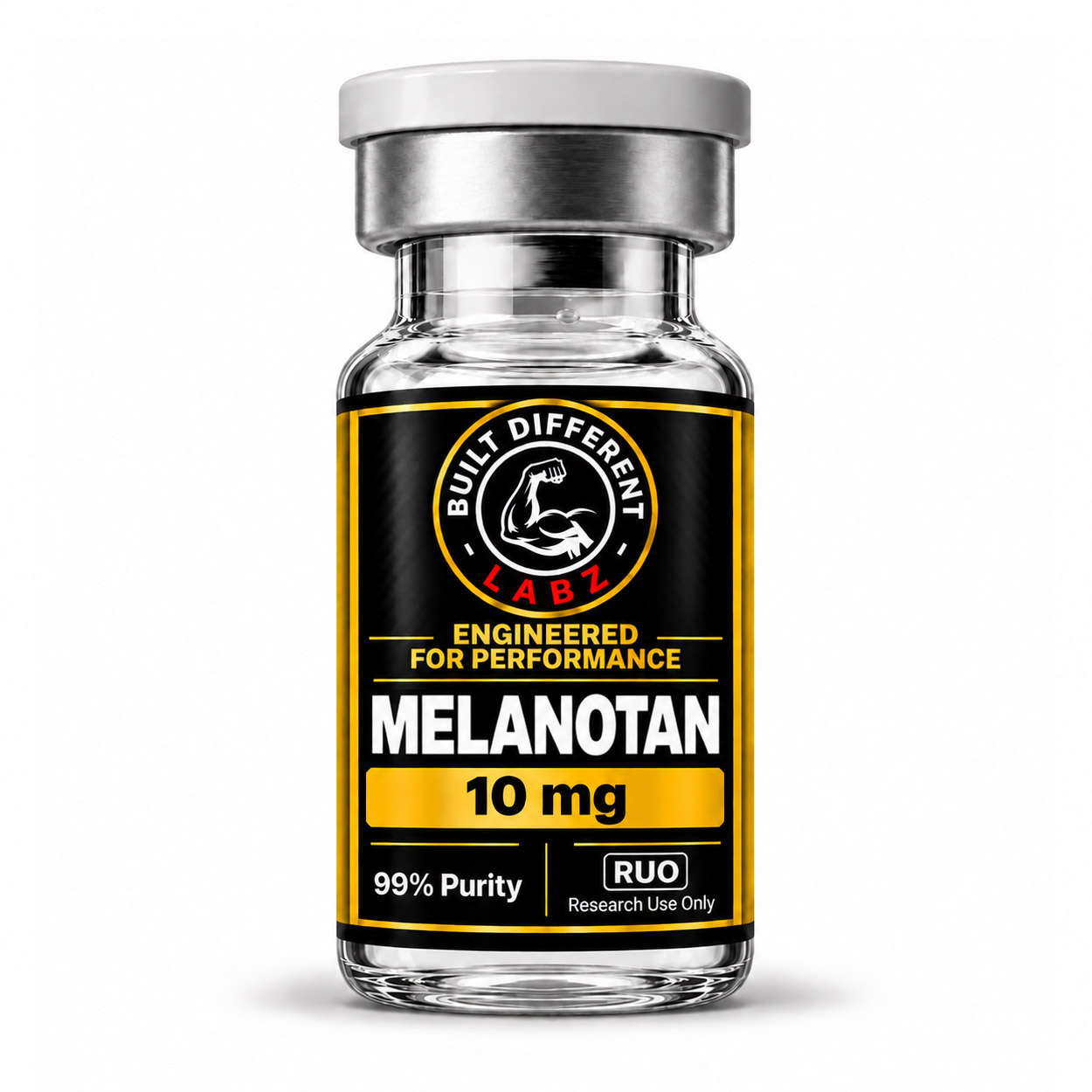
A vial labeled "Melanotan 10mg" represents a total of 10 milligrams of Melanotan in the vial. It does not mean that 10mg is an established or appropriate single human dose.
Melanotan I is a synthetic analogue of alpha-MSH.
Alpha-MSH is a naturally occurring peptide involved in:
Skin pigmentation
Melanin production
Melanocortin receptor signaling
Regulation of melanocyte activity
Melanotan I was designed to produce stronger and longer-lasting melanocortin activity than natural alpha-MSH.
Its primary effect is stimulation of melanin production.
These are related but distinctly different compounds.
Melanotan I:
Primarily associated with pigmentation
More selective toward MC1R
Less associated with sexual effects
Less associated with appetite suppression
Closely related to afamelanotide
Melanotan II:
Broader melanocortin receptor activity
Strong pigmentation effects
Appetite suppression
Sexual arousal
Spontaneous erections can occur
A simple comparison is:
Melanotan I = primarily pigmentation.
Melanotan II = pigmentation plus stronger central melanocortin effects.
Melanotan primarily activates the melanocortin-1 receptor, or MC1R.
MC1R is found on melanocytes.
Melanocytes are the cells responsible for producing melanin.
The simplified pathway is:
Melanotan
MC1R activation
Melanocyte stimulation
Increased melanin synthesis
Increased skin pigmentation
Melanin is the pigment responsible for much of the coloration of:
Skin
Hair
Eyes
In the skin, melanin also helps absorb ultraviolet radiation.
This provides a degree of natural photoprotection.
There are two major forms of melanin:
Eumelanin
Pheomelanin
Eumelanin is darker and provides more effective UV protection.
Pheomelanin is lighter and more common in people with red hair and very fair skin.
Melanogenesis is the process through which melanocytes produce melanin.
MC1R activation stimulates intracellular signaling that increases enzymes involved in melanin production.
One of the most important enzymes is:
Tyrosinase
Tyrosinase helps convert the amino acid tyrosine into compounds that eventually become melanin.
Yes, increased pigmentation is the main biological effect associated with Melanotan I.
The degree of pigmentation depends on factors such as:
Genetics
Baseline skin color
MC1R function
Existing melanin levels
UV exposure
Individual biological response
Not everyone responds equally.
Melanotan can stimulate melanocyte signaling without ultraviolet exposure.
However, UV radiation itself is also a powerful stimulus for melanin production.
This is why pigmentation can become more noticeable when melanocortin stimulation occurs alongside UV exposure.
That does not make unnecessary UV exposure safe.
Melanotan may increase melanin production, but increased pigmentation does not completely protect against ultraviolet damage.
UV radiation can still cause:
DNA damage
Sunburn
Premature skin aging
Wrinkles
Pigmentation irregularities
Skin cancer
Melanotan should not be treated as a substitute for sunscreen.
Tanning beds expose the skin to concentrated ultraviolet radiation.
Melanotan does not make tanning beds safe.
Tanning-bed exposure remains associated with increased:
Photoaging
DNA damage
Skin-cancer risk
Additional melanin can provide some degree of natural protection against UV radiation.
However, this effect is limited.
A Melanotan-induced tan should not be considered adequate sun protection.
Standard protection remains important, including:
Broad-spectrum sunscreen
Protective clothing
Shade
Limiting excessive UV exposure
Melanotan I and afamelanotide are closely related.
Afamelanotide is the pharmaceutical name for an alpha-MSH analogue developed from Melanotan I research.
It is a synthetic 13-amino-acid peptide designed to activate MC1R.
Unlike an online research vial, pharmaceutical afamelanotide is manufactured under controlled medical standards.
Afamelanotide has a legitimate medical application involving a rare photosensitivity disorder.
The condition is called:
Erythropoietic protoporphyria
or:
EPP
People with EPP can experience severe pain when exposed to visible light or sunlight.
Afamelanotide increases eumelanin production and can improve tolerance to light exposure in affected patients.
This medical use should not be interpreted as approval of research Melanotan products for cosmetic tanning.
EPP involves abnormal accumulation of protoporphyrin in the body.
Exposure to light can trigger severe pain and skin reactions.
Afamelanotide's increased melanin production provides additional photoprotection.
This is one of the strongest examples demonstrating that melanocortin-driven pigmentation can have legitimate therapeutic value.
MC1R is one of five major melanocortin receptors.
MC1R is particularly important for:
Pigmentation
Melanocyte activity
Eumelanin production
Melanotan I has greater emphasis on MC1R than Melanotan II.
This helps explain why Melanotan I tends to have fewer appetite and sexual effects.
The melanocortin receptor family includes:
MC1R:
Primarily pigmentation.
MC2R:
ACTH and adrenal function.
MC3R:
Energy balance and central nervous system signaling.
MC4R:
Appetite, body weight and sexual signaling.
MC5R:
Various exocrine and physiological functions.
Melanotan I's stronger MC1R preference makes its effects more focused on pigmentation.
Freckles contain concentrated areas of pigmentation.
Melanotan may cause freckles to:
Darken
Become more visible
Appear before the surrounding skin darkens significantly
This is a consequence of increased melanocyte signaling.
Existing moles can potentially become darker because they contain melanocytes.
Pigmentation changes can make existing lesions more noticeable.
Any mole showing significant changes in:
Size
Shape
Border
Color
Texture
should be evaluated medically.
There is not adequate evidence establishing that Melanotan I directly causes melanoma.
However, caution remains appropriate because:
It stimulates melanocytic activity
Pigmented lesions can darken
Long-term cosmetic use is not well studied
Users may increase UV exposure
UV radiation itself is a well-established melanoma risk factor.
No.
Increased melanin provides some natural UV protection, but this does not mean Melanotan prevents skin cancer.
It should never be marketed as a melanoma-prevention treatment.
The relationship between pigmentation and skin cancer is complex.
Naturally higher eumelanin levels generally provide greater protection against UV damage.
However, artificially increasing pigmentation does not eliminate:
UV-induced DNA damage
Basal cell carcinoma risk
Squamous cell carcinoma risk
Melanoma risk
Sun protection remains important regardless of skin tone.
Many people with red hair have genetic variants affecting MC1R.
These variants can reduce eumelanin production and increase pheomelanin production.
This is associated with:
Fair skin
Freckles
Reduced natural tanning
Increased sun sensitivity
Melanotan may still stimulate pigmentation, but genetic differences strongly affect response.
People with very fair skin may experience:
Darkening of freckles
Uneven pigmentation
Gradual background skin darkening
Response can vary considerably based on MC1R genetics.
Melanocytes are also involved in hair pigmentation.
Melanotan-related signaling could theoretically influence pigmentation in hair follicles.
However, it should not be considered an established treatment for gray hair.
Melanotan is not established as a method for changing eye color.
Iris pigmentation is biologically different from tanning of the skin.
Claims of dramatic permanent eye-color changes are not supported.
Vitiligo involves loss or dysfunction of melanocytes.
Melanocortin stimulation can only increase pigmentation if functional melanocytes are present.
Melanocortin therapies have research relevance to pigmentation disorders, but Melanotan research vials are not established vitiligo treatments.
Albinism involves genetic defects affecting melanin synthesis.
Stimulating MC1R cannot necessarily overcome the underlying biochemical defect.
Melanotan should not be described as a treatment for albinism.
Melanin can reduce some UV penetration.
However, intentional tanning through ultraviolet exposure accelerates skin aging.
Chronic UV exposure contributes to:
Collagen breakdown
Wrinkles
Loss of elasticity
Uneven pigmentation
Sunspots
A darker appearance should not be confused with healthier skin.
Photoaging refers to skin aging caused by chronic ultraviolet exposure.
Typical features include:
Wrinkles
Rough skin texture
Pigmentation changes
Loss of elasticity
Telangiectasia
Melanotan does not reverse photoaging.
Unlike Melanotan II, Melanotan I is not primarily associated with significant appetite suppression.
Its greater MC1R selectivity generally produces a more pigmentation-focused profile.
No.
Melanotan I is not an established fat-burning peptide.
It does not primarily act through:
GLP-1
Amylin
Growth hormone
Direct lipolysis
Significant appetite suppression is more strongly associated with Melanotan II because of broader central melanocortin receptor activity.
Melanotan I is much less associated with this effect.
Strong sexual effects are not the defining characteristic of Melanotan I.
Those effects are much more associated with:
Melanotan II
PT-141
Melanotan I was developed primarily around pigmentation.
PT-141, or bremelanotide, was developed primarily for sexual-function effects.
Melanotan I:
Primarily MC1R
Pigmentation
Photoprotection
PT-141:
Central melanocortin signaling
Sexual desire
Sexual arousal
Their primary applications are very different.
Melanotan I is not a reproductive hormone peptide.
There is no established evidence that it meaningfully increases testosterone.
There is no established evidence that Melanotan I suppresses natural testosterone production in the manner of anabolic steroids.
No traditional steroid-style post-cycle therapy is inherently associated with Melanotan I.
It does not primarily act through androgen signaling.
No.
Melanotan is not a growth hormone secretagogue.
It should not be grouped with:
Sermorelin
Tesamorelin
Ipamorelin
CJC-1295
No.
Melanotan is not anabolic and does not directly stimulate muscle hypertrophy.
It does not activate:
Androgen receptors
Growth hormone receptors
IGF-1 receptors
Interest among bodybuilders is primarily cosmetic.
A darker skin tone can increase visual contrast and make muscular definition appear more prominent.
This does not mean Melanotan actually increases muscle definition or muscle mass.
Artificial tanning products are already commonly used in physique sports because darker skin can make:
Muscle separation
Vascularity
Definition
appear more visible under bright stage lighting.
Melanotan's relevance is similarly cosmetic rather than anabolic.
A vial labeled:
"Melanotan 10mg"
means the supplier represents the vial as containing a total of 10 milligrams of peptide.
The 10mg represents total vial content.
It should not be interpreted as a single established administration amount.
There is no FDA-approved human dosing regimen for a research Melanotan 10mg vial.
This distinction is extremely important.
Research Melanotan:
Commonly sold as lyophilized powder
May be labeled Research Use Only
Quality depends heavily on manufacturer
Not equivalent to an FDA-approved pharmaceutical
Afamelanotide:
Pharmaceutical product
Controlled manufacturing
Defined formulation
Approved for a specific medical indication
Clinically monitored administration
Similar peptide biology does not make the products interchangeable.
Research suppliers commonly sell Melanotan as lyophilized powder.
A research vial does not automatically establish:
Human safety
Sterility
Endotoxin control
Accurate concentration
Appropriate formulation
The pharmaceutical form of afamelanotide uses a controlled implant formulation rather than simply an online research vial.
Nasal Melanotan products are also marketed.
Intranasal exposure can vary considerably based on:
Formulation
Concentration
Nasal absorption
Product quality
An intranasal research product should not be assumed to provide predictable pharmaceutical exposure.
Peptides are generally vulnerable to digestion.
Reliable oral systemic exposure from standard Melanotan capsules has not been established.
Claims of predictable oral bioavailability should therefore be viewed cautiously.
Melanotan I was designed to be more resistant to enzymatic degradation than natural alpha-MSH.
Its biological effect on pigmentation can substantially outlast the peptide's circulation because newly produced melanin remains in the skin.
This means:
Peptide exposure may be relatively short.
Pigmentation can last much longer.
Pigmentation develops gradually.
The timeline depends on:
Genetics
Baseline pigmentation
Skin type
Melanocyte responsiveness
UV exposure
Melanin synthesis and distribution through the epidermis require time.
Skin pigmentation fades gradually as skin cells naturally turn over.
The epidermis continually replaces older cells.
As melanin-containing cells are shed, the skin gradually returns toward baseline color unless melanogenesis remains elevated.
Potential side effects associated with melanocortin peptides can include:
Nausea
Headache
Flushing
Fatigue
Dizziness
Pigmentation changes
Darkening freckles
Darkening moles
Uneven pigmentation
Injection-site reactions
Melanotan I generally has fewer central appetite and sexual effects than Melanotan II, but individual responses can vary.
Long-term cosmetic use has not been adequately characterized.
Important areas of uncertainty include:
Chronic melanocyte stimulation
Long-term mole changes
Repeated exposure
Interaction with UV radiation
Long-term cardiovascular effects
Effects on unusual pigmented lesions
One of the most important practical safety issues is monitoring pigmented lesions.
Changes requiring medical evaluation can include:
Increasing asymmetry
Irregular borders
Multiple colors
Increasing diameter
Rapid evolution
Bleeding
Itching
New symptoms
Pigmentation caused by melanocortin stimulation can make monitoring more difficult.
Research peptide quality varies.
Potential problems include:
Incorrect peptide identity
Incorrect vial quantity
Chemical impurities
Degradation
Endotoxins
Bacterial contamination
Poor sterility
Improper storage
A vial labeled:
"Melanotan 10mg - 99 percent purity"
does not independently establish pharmaceutical quality.
HPLC can help determine chemical purity.
Mass spectrometry can help confirm molecular identity.
However, 99 percent analytical purity does not automatically establish:
Sterility
Endotoxin level
Exact vial quantity
Correct formulation
Stability
Pharmaceutical-grade manufacturing
Safety for injection
These require separate controls.
Research Use Only, or RUO, indicates that a product is marketed for laboratory or analytical research rather than as an approved medication for human treatment.
An RUO Melanotan vial should not be treated as equivalent to pharmaceutical afamelanotide.
A research product marketed as Melanotan or Melanotan I for cosmetic tanning is not an FDA-approved cosmetic tanning medication.
However, a closely related pharmaceutical version, afamelanotide, has an approved medical use for erythropoietic protoporphyria.
This distinction is important.
Approval of afamelanotide for a specific disease does not establish approval of research Melanotan vials for cosmetic tanning.
MC1R activation:
Strong.
Melanin stimulation:
Strong.
Increased skin pigmentation:
Strong.
Photoprotection through increased eumelanin:
Biologically and clinically supported.
Erythropoietic protoporphyria:
Strong evidence for pharmaceutical afamelanotide.
Cosmetic tanning with research vials:
Biological effect clear, but not an approved use.
Fat loss:
Not established.
Appetite suppression:
Not a primary established Melanotan I effect.
Sexual enhancement:
Much less prominent than Melanotan II.
Muscle growth:
Not established.
Testosterone enhancement:
Not established.
Anti-aging:
Not established.
Long-term cosmetic safety:
Insufficiently characterized.
Melanotan I has a much more focused biological mechanism than Melanotan II.
The simplified pathway is:
Melanotan
MC1R activation
Melanocyte stimulation
Increased eumelanin production
Increased pigmentation and photoprotection
Its relatively stronger emphasis on MC1R means it is primarily a pigmentation peptide rather than a broad central melanocortin agonist.
The biggest limitation is the difference between a legitimate pharmaceutical melanocortin product and an unapproved research vial.
Afamelanotide demonstrates that this pathway has real medical value.
However, that does not mean an RUO vial labeled "Melanotan 10mg" has:
Equivalent manufacturing
Equivalent formulation
Equivalent purity
Equivalent safety
An approved cosmetic indication
Long-term cosmetic use also remains inadequately studied.
Melanotan, generally referring to Melanotan I, is a synthetic alpha-MSH analogue primarily designed to activate MC1R and increase melanin production.
Its main research and biological areas include:
Skin pigmentation
Melanin production
MC1R activation
Eumelanin production
Photoprotection
UV sensitivity
It is considerably more pigmentation-focused than Melanotan II and is closely related to pharmaceutical afamelanotide.
"Melanotan 10mg" describes the represented total amount of peptide contained in a vial. It should not be interpreted as a recommended 10mg dose.
The most accurate description is:
Melanotan I is a synthetic melanocortin peptide primarily associated with MC1R activation and increased melanin production. Its biological ability to increase pigmentation is well established, and the related pharmaceutical afamelanotide has a legitimate medical role in erythropoietic protoporphyria. However, research Melanotan 10mg vials marketed for cosmetic tanning are not equivalent to an approved pharmaceutical product, and their long-term safety, manufacturing quality, and effects on pigmented skin lesions remain important limitations.
We do not accept returns or issue refunds for any reason, beside manufacturing defects.
Feel free to contact us if you have any questions or concerns about our Return Policy.