We offer FREE SHIPPPING on all orders!
We offer FREE SHIPPPING on all orders!
| THIS PRODUCT IS INTENDED AS A RESEARCH CHEMICAL ONLY. This designation allows the use of research chemicals strictly for invitro testing and laboratory experimentation only. All product information available on this website is for educational purposes only. Bodily introduction of any kind into humans or animals is strictly prohibited by law. This product should only be handled by licensed, qualified professionals. This product is not a drug, food, or cosmetic and may not be misbranded, misused or mislabeled as a drug, food, or cosmetic. |
Oxytocin is a naturally occurring peptide hormone and neurotransmitter produced primarily in the hypothalamus and released into the bloodstream through the posterior pituitary gland. It plays major physiological roles in childbirth, breastfeeding, reproductive biology, social behavior, and nervous-system signaling.
Oxytocin is a nine-amino-acid peptide, making it a:
Nonapeptide.
Its major biological and research areas include:
Uterine contractions
Labor and childbirth
Milk ejection during breastfeeding
Reproductive physiology
Social behavior
Pair bonding and attachment
Stress and anxiety signaling
Sexual behavior
Autonomic nervous-system activity
Brain and behavioral research
Unlike many experimental research peptides, oxytocin is also an established pharmaceutical drug with important medical applications. However, a research-market vial labeled "Oxytocin 10mg" should not automatically be treated as equivalent to an FDA-approved pharmaceutical oxytocin product.
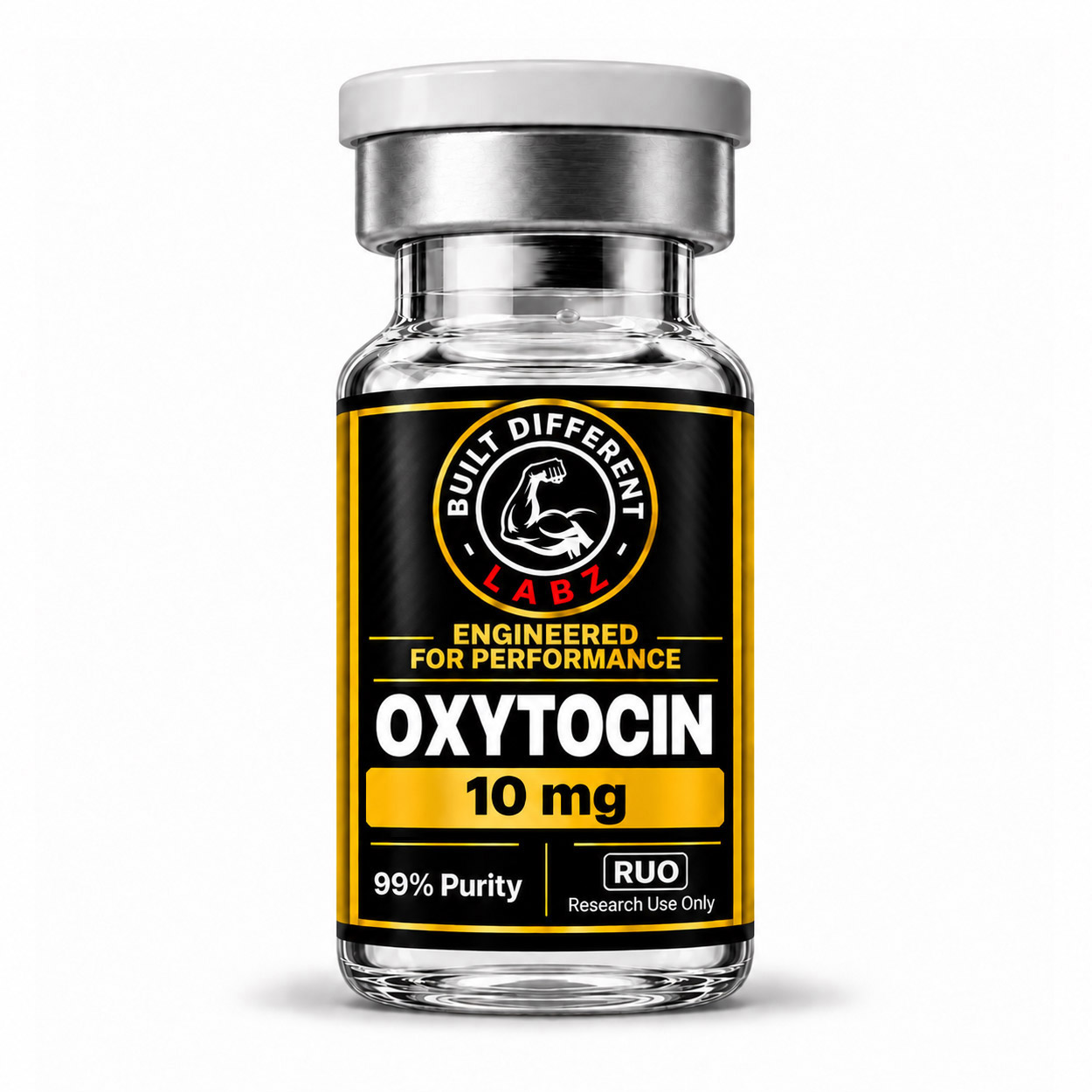
A vial labeled "Oxytocin 10mg" represents 10 milligrams of total represented oxytocin material. It does not mean 10mg is an appropriate single human dose. This distinction is especially important for oxytocin because pharmaceutical oxytocin is normally measured and administered in units rather than simply treating a vial's milligram content as a dose.
Oxytocin is one of the body's natural peptide hormones.
It consists of nine amino acids arranged in a cyclic structure containing a disulfide bond.
Oxytocin is closely related structurally to another peptide hormone:
Vasopressin.
Despite their structural similarity, they have different primary physiological functions.
Oxytocin is synthesized primarily in specialized neurons within the hypothalamus.
Important regions include:
Paraventricular nucleus
Supraoptic nucleus
Oxytocin can then be transported down nerve fibers to the:
Posterior pituitary.
From there, it can be released into the bloodstream.
Oxytocin is unusual because it functions in both peripheral and central signaling.
Peripheral oxytocin can influence organs such as:
Uterus
Mammary glands
Central oxytocin signaling can influence:
Social behavior
Stress
Fear
Attachment
Reward
Sexual behavior
This means oxytocin cannot accurately be described simply as a reproductive hormone.
Oxytocin primarily acts through the:
Oxytocin receptor
or:
OXTR.
OXTR is a G-protein-coupled receptor.
Activation can initiate intracellular signaling involving:
Phospholipase C
IP3
Intracellular calcium
Smooth-muscle contraction and cellular signaling
This pathway is particularly important in the uterus.
Oxytocin is strongly associated with labor because it stimulates contraction of uterine smooth muscle.
Toward the end of pregnancy, uterine sensitivity to oxytocin increases.
This occurs partly through increased expression of oxytocin receptors.
The simplified pathway is:
Oxytocin
OXTR
Increased intracellular calcium
Uterine smooth-muscle contraction
Oxytocin participates in a classic physiological positive-feedback loop.
The simplified model is:
Pressure on cervix
Neural signaling
Oxytocin release
Stronger uterine contractions
Greater cervical pressure
Additional oxytocin release
This contributes to progression of labor.
Oxytocin has legitimate medical uses.
Pharmaceutical oxytocin is commonly associated with the brand name:
Pitocin.
Medical oxytocin can be used under appropriate clinical circumstances for purposes including:
Induction of labor
Augmentation of labor
Management of postpartum uterine bleeding
These applications involve medical monitoring because excessive uterine stimulation can become dangerous.
After delivery, contraction of the uterus helps compress blood vessels at the placental site.
Oxytocin can promote strong uterine contraction.
This makes it an important medication in preventing or treating certain forms of postpartum hemorrhage.
This is an established medical application, not merely experimental peptide research.
Oxytocin plays a critical role in:
Milk ejection.
This is sometimes called the:
Let-down reflex.
When an infant suckles, sensory signals reach the brain.
The posterior pituitary releases oxytocin.
Oxytocin then causes specialized myoepithelial cells surrounding mammary glands to contract.
The result is movement of milk through the ducts.
Oxytocin and prolactin both participate in breastfeeding, but they perform different functions.
Prolactin:
Primarily stimulates milk production.
Oxytocin:
Primarily stimulates milk ejection.
A simplified distinction is:
Prolactin = make the milk.
Oxytocin = release the milk.
Oxytocin is extensively studied as a neuropeptide.
Oxytocin receptors and oxytocin-sensitive circuits are found in brain regions associated with:
Emotion
Reward
Social recognition
Fear
Stress
Reproduction
Attachment
This has generated enormous interest in behavioral neuroscience.
Oxytocin is frequently called:
The love hormone.
This is an oversimplification.
Oxytocin participates in bonding and social behavior, but it does not simply make people love each other.
Its behavioral effects depend heavily on:
Social context
Existing relationships
Stress
Sex
Individual biology
Environment
Brain region
A better description is:
Oxytocin is an important neuropeptide involved in social and reproductive behavior.
Animal studies, particularly involving prairie voles, have provided important evidence connecting oxytocin signaling with pair bonding.
Human research also supports relationships between oxytocin and aspects of:
Attachment
Social interaction
Relationship behavior
However, oxytocin cannot reliably manufacture emotional attachment between two people.
Some experimental human studies have investigated whether intranasal oxytocin influences trust.
Certain studies have reported behavioral effects under specific conditions.
Later research demonstrated that the effects are much more context-dependent than early popular descriptions suggested.
Therefore:
"Oxytocin increases trust"
is too simplistic.
Oxytocin has also been investigated in relation to:
Empathy
Emotion recognition
Social cognition
Eye contact
Results vary substantially.
Effects can depend on the person and social environment.
Because oxytocin influences social and stress-related brain circuits, researchers have investigated it for:
Social anxiety
Fear
Stress
Social avoidance
The evidence has not established oxytocin as a universal anti-anxiety treatment.
Oxytocin signaling can interact with the body's stress-response systems, including the:
Hypothalamic-pituitary-adrenal axis.
Some experimental studies have reported reduced stress responses or changes in cortisol under certain conditions.
These effects are not consistent enough to treat oxytocin as a simple cortisol-lowering medication.
Oxytocin is involved in reproductive and sexual physiology.
Oxytocin concentrations and neural signaling can change during:
Sexual arousal
Orgasm
Physical intimacy
It may influence:
Sexual behavior
Bonding
Reproductive signaling
However, oxytocin is not equivalent to a conventional erectile-dysfunction medication.
PT-141, or bremelanotide:
Primarily targets melanocortin receptors involved in sexual desire and arousal.
Oxytocin:
Primarily targets oxytocin receptors and participates in reproductive, social, and bonding-related physiology.
Both can influence aspects of sexual behavior, but their mechanisms are completely different.
Sildenafil primarily increases erectile blood flow through:
PDE5 inhibition
and:
Nitric-oxide-related vascular signaling.
Oxytocin primarily influences:
Neural signaling
Reproductive behavior
Smooth-muscle activity
Social and emotional circuits
Oxytocin is not a substitute for a PDE5 inhibitor.
Oxytocin release is associated with orgasm in both sexes.
However, this does not mean additional oxytocin reliably intensifies orgasm.
Natural hormone release and pharmacological administration are not equivalent.
Oxytocin receptors and oxytocin-related signaling are present within the male reproductive system.
Research has investigated potential roles involving:
Ejaculation
Sperm transport
Erectile physiology
Testicular function
Reproductive-tract smooth muscle
However, oxytocin is not an established testosterone-enhancing compound.
Oxytocin's best-established reproductive effects involve:
Uterine contraction
Labor
Postpartum uterine contraction
Milk ejection
It also participates in broader sexual and reproductive signaling.
Oxytocin does not primarily stimulate:
GnRH
LH
FSH
Testosterone
It is not an androgen.
Oxytocin does not produce the classic androgen-mediated suppression associated with anabolic steroids.
It should not be classified as a testosterone-suppressive anabolic compound.
No.
Traditional steroid-style post-cycle therapy is not inherently associated with oxytocin.
Oxytocin is not a growth hormone secretagogue.
It does not work like:
CJC-1295
GHRP-2
GHRP-6
Ipamorelin
Sermorelin
Tesamorelin
It primarily targets oxytocin receptors.
Oxytocin is not a conventional muscle-building compound.
It does not directly function like:
Testosterone
Anabolic steroids
IGF-1 LR3
Growth hormone
There is experimental research involving oxytocin and muscle regeneration, particularly in aging models, but this has not established oxytocin as a human bodybuilding drug.
Interesting preclinical research has examined oxytocin in relation to:
Muscle stem cells
Tissue regeneration
Age-related decline in muscle repair
Some animal studies suggest oxytocin signaling may participate in maintaining regenerative capacity.
This remains very different from proving that exogenous oxytocin builds muscle in healthy humans.
Oxytocin has been investigated in aging research because endocrine and regenerative signaling change with age.
Areas of interest include:
Muscle regeneration
Bone metabolism
Social behavior
Metabolic function
Cellular aging
There is no convincing evidence that oxytocin reverses human aging or extends human lifespan.
Oxytocin receptors have been identified in bone-related cells.
Experimental research suggests potential interactions with:
Osteoblasts
Bone formation
Bone remodeling
This has generated interest in osteoporosis and aging research.
Oxytocin is not an established osteoporosis treatment.
Oxytocin has also been investigated in metabolic research.
Animal and early human studies have explored possible relationships with:
Appetite
Food intake
Body weight
Glucose metabolism
Energy expenditure
These findings are interesting but do not establish oxytocin as a weight-loss medication.
Central oxytocin signaling participates in neural pathways regulating food intake.
Experimental administration has sometimes been associated with reduced caloric intake.
However, effects are not comparable in evidence or magnitude with established obesity medications.
Oxytocin should not be described as a direct fat burner.
Potential metabolic effects may involve:
Appetite
Energy balance
Neural regulation
Glucose metabolism
There is insufficient evidence to establish oxytocin as a reliable fat-loss treatment.
Cagrilintide:
Primarily targets amylin-related appetite and satiety pathways and has been developed specifically for weight management.
Oxytocin:
Primarily serves reproductive and neurobehavioral functions, with metabolic effects representing an additional research area.
Cagrilintide has a much stronger obesity-development rationale.
Intranasal oxytocin has been extensively investigated for social functioning in autism spectrum disorder.
Early small studies generated considerable enthusiasm.
Larger and more rigorous research has produced mixed results.
Oxytocin has not become an established general treatment for autism.
Researchers have investigated oxytocin in:
Autism
Social anxiety
Depression
Schizophrenia
PTSD
Relationship behavior
Results have generally been inconsistent or context-dependent.
The complexity of social behavior makes it unlikely that one hormone simply produces universally positive social effects.
Intranasal oxytocin has received extensive research attention because researchers are interested in influencing central oxytocin pathways.
However, an important scientific question is how much intranasally administered oxytocin reaches relevant brain regions intact.
Potential effects may involve:
Direct nose-to-brain pathways
Peripheral absorption
Secondary endogenous signaling
The pharmacology remains more complicated than simply saying nasal oxytocin goes directly into the brain.
Injectable pharmaceutical oxytocin is well established in obstetric medicine.
However, clinical oxytocin is administered under carefully controlled conditions for specific indications.
A research-market injectable-style vial is not automatically equivalent to a regulated pharmaceutical oxytocin product.
Oxytocin receptors and related signaling exist within cardiovascular tissues.
Oxytocin can influence:
Vascular tone
Heart rate
Autonomic activity
Blood pressure
Responses can depend on amount, route, physiological state, and other factors.
Oxytocin and vasopressin are structurally similar nine-amino-acid peptides.
They differ by only two amino acids.
Vasopressin is primarily associated with:
Water retention
Kidney function
Blood-vessel constriction
Oxytocin is primarily associated with:
Uterine contraction
Milk ejection
Reproductive behavior
Social signaling
At sufficiently high concentrations, receptor cross-reactivity can become relevant.
This is an important safety consideration.
Because oxytocin and vasopressin are structurally related, oxytocin can have antidiuretic effects under certain circumstances.
Excessive exposure, particularly combined with substantial fluid intake, can contribute to:
Water intoxication
and:
Hyponatremia.
Hyponatremia means abnormally low sodium concentration in the blood.
Potential symptoms include:
Headache
Nausea
Vomiting
Confusion
Weakness
Lethargy
Severe hyponatremia can cause:
Seizures
Brain swelling
Coma
This is one reason oxytocin should not be treated casually simply because it is a naturally occurring hormone.
Oxytocin has powerful effects on the uterus.
Exposure during pregnancy can potentially stimulate uterine contractions.
Outside appropriate obstetric care, this creates obvious risks to both the pregnant individual and fetus.
Pharmaceutical oxytocin used to induce or augment labor requires medical monitoring.
Excessive oxytocin activity during pregnancy can cause:
Uterine tachysystole
or excessive uterine contractions.
This can compromise fetal oxygen delivery and create serious complications.
This is one of the major reasons pharmaceutical oxytocin administration during labor is medically supervised.
Potential adverse effects associated with oxytocin can include:
Nausea
Headache
Flushing
Dizziness
Changes in heart rate
Changes in blood pressure
Abdominal cramping
Injection-site reactions
Depending on exposure and clinical circumstances, more serious complications can include:
Excessive uterine contractions
Fetal distress during pregnancy
Hyponatremia
Water intoxication
Cardiovascular abnormalities
Hypersensitivity reactions
A vial labeled:
"Oxytocin 10mg"
means the supplier represents the vial as containing:
10 milligrams
of total oxytocin material.
This is total represented vial content.
It should not be interpreted as a recommended 10mg administration.
This distinction is particularly important because legitimate pharmaceutical oxytocin is commonly described and administered in:
International Units
rather than treating milligrams as a routine dosing unit.
Pharmaceutical oxytocin:
Manufactured under regulated pharmaceutical standards
Standardized potency
Sterile injectable formulations
Defined concentration
Established medical indications
Clinically controlled administration
Research-market oxytocin:
May be labeled RUO
May use milligram quantities
May lack equivalent pharmaceutical manufacturing controls
Is not automatically equivalent to Pitocin or another approved drug product
These should not be treated as interchangeable merely because both labels say oxytocin.
For peptide hormones, chemical mass alone does not tell the entire story.
Biological potency and pharmaceutical standardization matter.
This is especially relevant when comparing a research vial labeled in milligrams with pharmaceutical oxytocin labeled in units.
For research-market oxytocin, important quality characteristics include:
Correct nine-amino-acid sequence
Correct disulfide structure
Molecular identity
Chemical purity
Biological potency
Exact vial quantity
Sterility
Endotoxin levels
Stability
Manufacturing conditions
HPLC can provide information about chemical purity.
Mass spectrometry can help verify molecular identity.
However, a claim of 99 percent purity does not automatically establish:
Sterility
Endotoxin levels
Biological potency
Correct disulfide structure
Exact vial amount
Pharmaceutical equivalence
Human safety
These are separate characteristics.
Oxytocin is a peptide and can degrade depending on:
Temperature
Light
pH
Formulation
Storage conditions
Oxidation
Container characteristics
The presence of the correct peptide at manufacturing does not guarantee full potency indefinitely.
Research Use Only, or RUO, means that the particular product is marketed for laboratory or analytical research rather than as an approved medication for human treatment.
An RUO oxytocin vial should not be assumed equivalent to regulated pharmaceutical oxytocin.
Yes, pharmaceutical oxytocin has established FDA-approved medical uses in obstetrics.
This is very different from saying that every oxytocin product or every proposed use is FDA approved.
Oxytocin is not broadly FDA approved specifically for purposes such as:
Increasing romantic attachment
Improving relationships
Increasing trust
Bodybuilding
Fat loss
Anti-aging
Autism treatment
General anxiety treatment
Athletic performance
General wellness
Regulatory approval applies to specific products, formulations, routes, and indications.
Oxytocin as a naturally occurring human hormone:
Extremely strong.
Oxytocin receptor biology:
Extremely strong.
Uterine contraction:
Extremely strong.
Labor-related physiology:
Extremely strong.
Milk-ejection reflex:
Extremely strong.
Pharmaceutical obstetric applications:
Very strong and clinically established.
Central nervous-system signaling:
Strong.
Social-behavior involvement:
Strong biologically.
Pair-bonding biology:
Strong animal evidence with supportive but complex human research.
Trust enhancement:
Mixed and context dependent.
Empathy enhancement:
Mixed.
Sexual-function effects:
Biologically plausible with some human evidence, but not an established general treatment.
Metabolic effects:
Promising experimental research.
Muscle regeneration:
Promising preclinical research.
Anti-aging:
Not established.
Bodybuilding:
Not established.
Major fat loss:
Not established.
Autism treatment:
Not established as a general therapeutic use.
Human lifespan extension:
Not established.
Oxytocin is especially interesting because the molecule has both exceptionally well-established physiological functions and fascinating central nervous-system effects.
The core pathways include:
Oxytocin
OXTR
Uterine contraction
Milk ejection
Reproductive physiology
and separately:
Oxytocin
Central nervous-system signaling
Social behavior
Attachment
Stress responses
Reward and reproductive behavior
Few peptide hormones bridge peripheral physiology and complex social neuroscience as clearly as oxytocin.
The biggest limitation is the popular tendency to reduce oxytocin to the:
"Love hormone."
Human social behavior cannot be controlled predictably by simply increasing one neuropeptide.
Oxytocin can influence social processing, but its effects depend heavily on:
Context
Individual biology
Existing relationships
Emotional state
Environment
Route of administration
It also has powerful peripheral physiological effects and potentially serious risks, particularly involving pregnancy, uterine contractions, cardiovascular responses, and water balance.
Oxytocin is a naturally occurring nine-amino-acid peptide hormone and neuropeptide with exceptionally well-established roles in childbirth, uterine contraction, breastfeeding, reproductive physiology, and central nervous-system signaling.
Its major biological and research areas include:
Labor
Uterine contraction
Milk ejection
Reproduction
Social behavior
Attachment
Stress
Sexual behavior
Metabolism
Muscle and bone research
Behavioral neuroscience
"Oxytocin 10mg" describes a represented total vial content of 10 milligrams. It should not be interpreted as a recommended 10mg dose, particularly because regulated pharmaceutical oxytocin is normally standardized and administered using units and specific medical protocols.
The most accurate description is:
Oxytocin is a powerful naturally occurring peptide hormone and neuropeptide that acts through oxytocin receptors to regulate uterine contraction, milk ejection, reproductive physiology and numerous central nervous-system processes associated with social and emotional behavior. Pharmaceutical oxytocin has legitimate and well-established medical applications, particularly in obstetrics, but research-market oxytocin is not automatically equivalent to regulated pharmaceutical products. Claims involving bonding, trust, sexual enhancement, bodybuilding, fat loss and anti-aging are considerably less established than oxytocin's reproductive physiology, and its potent uterine, cardiovascular and water-balance effects mean that it should not be regarded as a harmless "love hormone."
We do not accept returns or issue refunds for any reason, beside manufacturing defects.
Feel free to contact us if you have any questions or concerns about our Return Policy.