We offer FREE SHIPPPING on all orders!
We offer FREE SHIPPPING on all orders!
| THIS PRODUCT IS INTENDED AS A RESEARCH CHEMICAL ONLY. This designation allows the use of research chemicals strictly for invitro testing and laboratory experimentation only. All product information available on this website is for educational purposes only. Bodily introduction of any kind into humans or animals is strictly prohibited by law. This product should only be handled by licensed, qualified professionals. This product is not a drug, food, or cosmetic and may not be misbranded, misused or mislabeled as a drug, food, or cosmetic. |
LL-37 is a naturally occurring human antimicrobial peptide and an important component of the innate immune system. It is the active 37-amino-acid peptide derived from the human cathelicidin precursor protein known as hCAP18.
Unlike growth-hormone secretagogues such as GHRP-6 or CJC-1295, LL-37 is primarily associated with:
Innate immune defense
Antimicrobial activity
Bacterial membrane disruption
Wound healing
Skin defense
Inflammation and immune signaling
Biofilm research
Tissue repair
Angiogenesis
Host defense against certain pathogens
LL-37 is scientifically interesting because it does considerably more than directly attack microbes. It also acts as an immune-signaling molecule capable of influencing inflammation, cell migration, wound repair, and interactions between the immune system and damaged tissue.
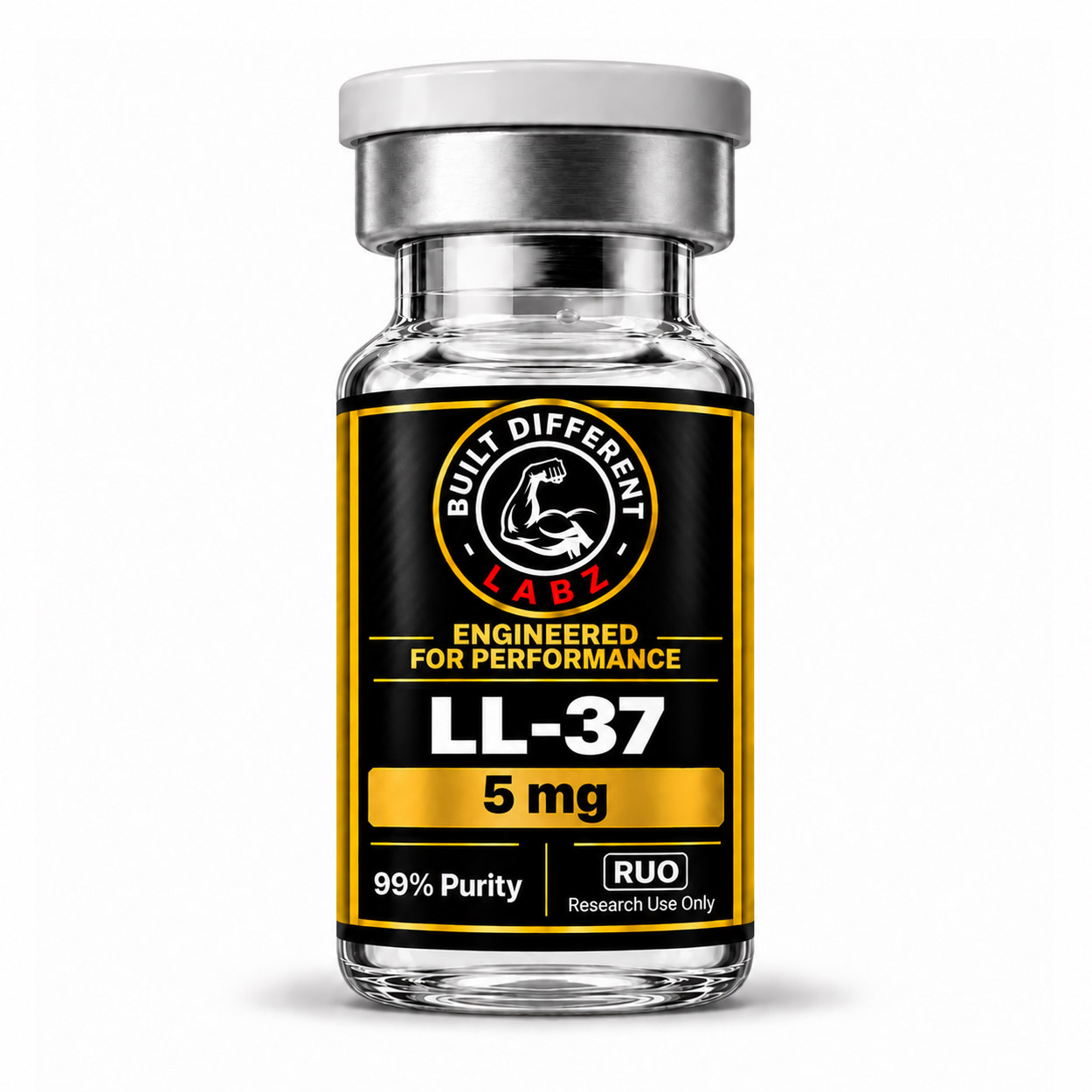
A vial labeled "LL-37 5mg" represents a total of 5 milligrams of represented LL-37 peptide in the vial. It does not mean that 5mg is an established or appropriate single human dose.
LL-37 is a 37-amino-acid peptide naturally produced by the human body.
Its name comes from its structure:
"LL" refers to the two leucine amino acids at the beginning of the peptide.
"37" refers to its length of 37 amino acids.
LL-37 belongs to a class of molecules called:
Antimicrobial peptides
or:
AMPs.
These peptides form part of the body's first line of defense against microorganisms.
LL-37 is not initially produced as an isolated 37-amino-acid peptide.
The body produces a larger precursor protein called:
hCAP18.
This stands for:
Human Cationic Antimicrobial Protein 18.
Enzymatic processing can release the active LL-37 portion from this precursor.
Therefore:
hCAP18
Enzymatic processing
LL-37
Innate immune and antimicrobial activity
LL-37 can be produced or released by numerous cells and tissues, including:
Neutrophils
Macrophages
Epithelial cells
Skin cells
Respiratory tissue
Gastrointestinal tissue
This distribution makes sense because many of these tissues are continuously exposed to microorganisms.
The immune system has two broad components:
Innate immunity
and:
Adaptive immunity.
Innate immunity responds rapidly and relatively broadly to potential threats.
Adaptive immunity uses highly specific responses involving systems such as:
Antibodies
B cells
T cells
Immune memory
LL-37 is primarily part of innate host defense.
LL-37 has several proposed and experimentally demonstrated mechanisms.
One of the most important involves microbial membranes.
LL-37 is:
Cationic.
This means it carries a positive electrical charge under physiological conditions.
Many microbial membranes contain negatively charged components.
This creates an interaction between:
Positively charged LL-37
and
Negatively charged microbial membranes.
LL-37 can then associate with the membrane and potentially disrupt its integrity.
A simplified mechanism is:
LL-37
Bacterial membrane binding
Membrane disruption
Loss of membrane integrity
Leakage of cellular contents
Microbial damage or death
This membrane-targeting mechanism differs fundamentally from many conventional antibiotics.
Many antibiotics target specific microbial structures or enzymes.
For example, antibiotics may interfere with:
Cell-wall synthesis
Protein synthesis
DNA replication
Folate metabolism
LL-37 can act through direct membrane interactions while also modifying host immune responses.
However, this does not make LL-37 a replacement for clinically validated antibiotics.
LL-37 is sometimes described as a "natural antibiotic."
That description is understandable but incomplete.
A more accurate description is:
A human antimicrobial and immunomodulatory host-defense peptide.
Unlike an ordinary antibiotic medication, LL-37 can also influence:
Cytokines
Immune-cell recruitment
Inflammation
Angiogenesis
Cell migration
Wound healing
Laboratory studies have demonstrated activity against various Gram-positive organisms.
Gram-positive bacteria have a thick peptidoglycan cell wall.
However, susceptibility varies substantially between:
Species
Strains
Environmental conditions
LL-37 concentrations
LL-37 should therefore not be described as universally effective against Gram-positive infections.
LL-37 has also demonstrated experimental activity against Gram-negative bacteria.
Gram-negative organisms possess an outer membrane containing:
Lipopolysaccharide
or:
LPS.
LL-37 can interact with microbial membrane components and has also been investigated for its ability to interact with or neutralize aspects of LPS activity.
Again, laboratory activity does not establish LL-37 as a clinical treatment for bacterial infection.
LPS is an important component of the outer membrane of Gram-negative bacteria.
It can strongly stimulate inflammatory responses through immune pathways.
LL-37 has been investigated for its ability to bind LPS and modify LPS-associated inflammatory signaling.
This adds another dimension to its host-defense activity.
Biofilms are communities of microorganisms embedded within a protective extracellular matrix.
They can form on:
Wounds
Teeth
Medical devices
Tissue surfaces
Biofilms can make microorganisms considerably more difficult to eliminate.
LL-37 has generated substantial interest because antimicrobial peptides may influence:
Biofilm formation
Bacterial attachment
Biofilm signaling
Established microbial communities
Some experimental studies suggest LL-37 can inhibit biofilm formation at concentrations different from those required for direct bacterial killing.
Bacteria inside a biofilm can behave differently from free-floating bacteria.
Biofilms can:
Reduce antibiotic penetration
Alter bacterial metabolism
Protect microbes from immune attack
Encourage persistent infection
This is one reason antimicrobial-peptide research remains scientifically important.
That has not been established.
Laboratory biofilm research is promising, but it should not be translated into claims that an LL-37 research vial can eradicate chronic human biofilm infections.
LL-37 has demonstrated experimental activity involving certain fungal organisms.
However, antifungal activity varies according to the organism and experimental conditions.
It should not be considered a replacement for established antifungal medications.
Candida species are frequently discussed in antimicrobial-peptide research.
LL-37 can interact with Candida and influence fungal biology under laboratory conditions.
This does not establish injectable LL-37 as a treatment for systemic or gastrointestinal Candida infections.
LL-37 has also been investigated for antiviral effects.
Potential mechanisms include:
Interaction with viral envelopes
Interference with viral entry
Modulation of host immune responses
Activity is highly virus-specific.
It is therefore inaccurate to describe LL-37 as a universal antiviral peptide.
LL-37 is sometimes marketed online in connection with:
Lyme disease
Chronic Lyme symptoms
Borrelia
Biofilms
Laboratory antimicrobial activity does not establish LL-37 as an effective treatment for Lyme disease.
It is not an established substitute for evidence-based antimicrobial treatment.
LL-37's antimicrobial and biofilm-related properties make persistent infection an understandable research interest.
However, chronic infections can involve:
Bacteria
Viruses
Fungi
Parasites
Biofilms
Immune dysfunction
There is no established general LL-37 treatment protocol for chronic infections.
Wound healing is one of the most interesting areas of LL-37 biology.
Successful wound repair requires coordinated:
Inflammation
Cell migration
Angiogenesis
Keratinocyte activity
Fibroblast activity
Extracellular-matrix remodeling
LL-37 can influence several of these processes.
Keratinocytes are the predominant cells of the epidermis.
LL-37 can influence:
Keratinocyte migration
Cellular signaling
Re-epithelialization
Re-epithelialization is the process through which new epithelial cells cover a wound.
This provides a biological basis for studying LL-37 in wound repair.
Angiogenesis means:
Formation of new blood vessels.
New blood-vessel development is an important component of tissue repair because healing tissue requires:
Oxygen
Nutrients
Immune-cell access
LL-37 has demonstrated pro-angiogenic activity in experimental research.
No.
Angiogenesis is necessary for:
Wound healing
Tissue growth
Normal repair
But abnormal angiogenesis can also participate in:
Cancer
Certain inflammatory diseases
Abnormal tissue growth
Therefore, increased angiogenesis should not automatically be considered beneficial.
The skin represents one of the body's largest barriers against microorganisms.
LL-37 participates in normal cutaneous defense.
Skin research involving LL-37 includes:
Wounds
Infection
Inflammation
Barrier function
Keratinocyte migration
However, LL-37 biology in skin disease is complicated because excessive LL-37 signaling may itself contribute to certain inflammatory disorders.
Rosacea provides an important example of why "more LL-37" is not necessarily better.
Abnormal processing and elevated activity of cathelicidin-related peptides have been implicated in rosacea inflammation.
This demonstrates that LL-37 can potentially be:
Protective in one context
and
Pro-inflammatory in another.
LL-37 has also been implicated in psoriasis.
In psoriasis, LL-37 can interact with self-DNA and potentially stimulate immune pathways.
This can contribute to inappropriate inflammatory activation.
Therefore, LL-37 should not simply be described as an anti-inflammatory peptide.
One of LL-37's most important biological complexities is its ability to influence immune recognition.
LL-37 can form complexes with:
DNA
RNA
These complexes may activate immune receptors under certain circumstances.
This creates potential relevance to autoimmune and inflammatory disease.
LL-37 can have both:
Pro-inflammatory effects
and:
Anti-inflammatory effects.
Its behavior depends on:
Tissue
Concentration
Immune environment
Pathogen presence
Receptor activity
This is why the term:
Immunomodulatory
is more accurate than simply:
Anti-inflammatory.
LL-37 can influence cytokine and chemokine signaling.
These signaling molecules help control:
Immune-cell recruitment
Inflammation
Tissue repair
Host defense
This means LL-37 can influence the immune response even when it is not directly killing a microorganism.
Neutrophils are among the body's first immune cells to arrive at sites of infection.
They contain hCAP18 and can release antimicrobial peptides as part of their defense response.
LL-37 therefore participates directly in the body's immediate response to microbial threats.
Macrophages participate in:
Pathogen recognition
Phagocytosis
Inflammation
Tissue repair
LL-37 can influence macrophage signaling and other immune-cell behaviors.
Again, its function extends beyond simple antimicrobial activity.
Vitamin D signaling can influence expression of the human cathelicidin antimicrobial peptide gene.
This creates an interesting connection between:
Vitamin D
and
Innate antimicrobial defense.
It is one reason vitamin D has been extensively investigated in immune biology.
This does not mean vitamin D supplementation automatically produces clinically meaningful increases in LL-37 in every individual.
The gastrointestinal tract continuously interacts with enormous populations of microorganisms.
Antimicrobial peptides contribute to maintaining the intestinal barrier and microbial balance.
LL-37 has been investigated in relation to:
Intestinal epithelial defense
Microbial interactions
Inflammation
Barrier integrity
However, it is not an established treatment for inflammatory bowel disease or intestinal infections.
Crohn's disease involves complex interactions among:
Genetics
Immune signaling
Intestinal barrier function
Microbiome
Inflammation
Although antimicrobial peptides are relevant to intestinal immune biology, LL-37 is not an established Crohn's disease treatment.
The same limitation applies to ulcerative colitis.
Experimental immune and epithelial effects should not be interpreted as proof of clinical effectiveness.
Airway epithelial cells use antimicrobial peptides as part of their defense against inhaled microorganisms.
LL-37 has therefore been investigated in:
Pulmonary immunity
Airway infection
Inflammation
Epithelial defense
It is not an established treatment for pneumonia, asthma, COPD, or other respiratory diseases.
Because LL-37 can interact with microbial products such as LPS, researchers have investigated its potential relevance to systemic infection and inflammation.
Sepsis is a life-threatening medical emergency.
Experimental LL-37 research should never be interpreted as an alternative to emergency medical treatment.
Both peptides are frequently discussed in immune-related research, but their profiles differ substantially.
LL-37:
37 amino acids
Antimicrobial
Host-defense peptide
Immune signaling
Biofilm research
Wound healing
KPV:
3 amino acids
Derived from alpha-MSH
Primarily anti-inflammatory and immunomodulatory research
GI and skin research
LL-37 has substantially more direct antimicrobial activity.
Thymosin Alpha-1:
Primarily immunomodulatory, particularly involving T cells, dendritic cells, and innate-adaptive immune coordination.
LL-37:
Primarily antimicrobial and innate host-defense related, while also influencing immune signaling.
Therefore:
TA1 = immune regulation.
LL-37 = antimicrobial host defense plus immune regulation.
BPC-157 research primarily focuses on:
Tissue repair
GI tissue
Tendons
Ligaments
Angiogenesis
Wound healing
LL-37 research primarily focuses on:
Antimicrobial activity
Innate immunity
Biofilms
Wound defense
Immune signaling
Both have wound-healing research, but their primary mechanisms are very different.
TB-500 and thymosin beta-4 research emphasizes:
Cell migration
Actin biology
Angiogenesis
Wound healing
Tissue repair
LL-37 emphasizes:
Antimicrobial defense
Immune signaling
Microbial membranes
Wound defense
There is some overlap in tissue-repair biology but not in primary mechanism.
LL-37 is not a muscle-building peptide.
It does not primarily activate:
Androgen receptors
Growth hormone receptors
IGF-1 receptors
GHRH receptors
Ghrelin receptors
It should not be grouped with anabolic or GH-related compounds.
LL-37 is not a conventional fat-loss compound.
It does not primarily work through:
Appetite suppression
GLP-1
Amylin
Lipolysis
Mitochondrial fatty-acid transport
There is no established role for LL-37 as a weight-loss drug.
LL-37 does not primarily target:
GnRH
LH
FSH
Testosterone
It is not an androgen.
LL-37 is not known to produce the classic testosterone suppression associated with anabolic steroids.
No traditional steroid-style post-cycle therapy is associated with LL-37.
It is not an anabolic steroid or SARM.
LL-37 is not a growth hormone secretagogue.
It does not work like:
GHRP-2
GHRP-6
Ipamorelin
CJC-1295
Sermorelin
Tesamorelin
Its primary biological role involves innate immunity and host defense.
The relationship between LL-37 and cancer is complicated.
LL-37 can influence:
Cell migration
Angiogenesis
Inflammation
Immune signaling
Cellular proliferation
Depending on the cancer type and biological environment, these pathways may potentially have different effects.
Some tumors have demonstrated altered cathelicidin expression.
This does not establish that LL-37 causes cancer.
It also does not establish that LL-37 treats or prevents cancer.
Long-term pharmacological exposure has not been adequately characterized.
LL-37's biological activity can move in different directions depending on context.
It may:
Damage microorganisms
Recruit immune cells
Promote wound healing
Increase angiogenesis
Modify inflammatory signaling
But it can also participate in:
Psoriasis-related immune activation
Rosacea inflammation
Abnormal inflammatory signaling
This makes the simplistic description "immune boosting peptide" inaccurate.
A vial labeled:
"LL-37 5mg"
means the supplier represents the vial as containing a total of:
5 milligrams
of LL-37.
That describes the total represented vial quantity.
It should not be interpreted as an established single administration amount.
There is no FDA-approved LL-37 dosing regimen for infection, biofilms, Lyme disease, wound healing, immune enhancement, or general wellness.
Research suppliers commonly provide LL-37 as lyophilized material.
An injectable-style vial does not establish that it is an approved injectable medication.
Important product-quality considerations include:
Correct 37-amino-acid sequence
Molecular identity
Chemical purity
Exact vial quantity
Sterility
Endotoxin levels
Stability
Manufacturing conditions
Sterility is particularly important for a product marketed around antimicrobial biology.
An antimicrobial peptide is not automatically capable of sterilizing a contaminated vial.
No.
This is an important misconception.
Even though LL-37 has antimicrobial properties, an LL-37 product can still:
Become contaminated
Contain endotoxins
Contain microorganisms
Contain particulate contamination
Antimicrobial activity under laboratory conditions does not guarantee pharmaceutical sterility.
LL-37 can be degraded by proteolytic enzymes.
Its stability depends strongly on:
Biological environment
Protease activity
Formulation
Temperature
Concentration
Storage conditions
Robust human pharmacokinetic information for systemic research-market LL-37 is limited.
Highly precise claims about human half-life should therefore be treated cautiously.
Because systemic LL-37 has not undergone the type of large clinical development program expected for an approved injectable drug, its adverse-effect profile is not fully characterized.
Potential concerns include:
Injection-site irritation
Redness
Swelling
Headache
Fatigue
Nausea
Dizziness
Hypersensitivity reactions
Inflammatory reactions
Because LL-37 directly influences immune signaling, unpredictable inflammatory responses are also theoretically important.
Long-term systemic safety is insufficiently characterized.
Important unanswered questions include:
Chronic immune activation
Autoimmune effects
Angiogenesis
Cancer-related signaling
Cardiovascular effects
Tissue-specific inflammation
Microbiome effects
Antibody formation
Repeated-exposure effects
This uncertainty is especially important because LL-37 is a biologically active immune peptide rather than an inert nutritional compound.
Research-market LL-37 quality can vary.
Potential problems include:
Incorrect peptide identity
Incorrect sequence
Incorrect vial quantity
Degradation products
Chemical impurities
Endotoxins
Bacterial contamination
Poor sterility
HPLC can help evaluate chemical purity.
Mass spectrometry can help verify molecular identity.
However, a claim of 99 percent purity does not automatically establish:
Sterility
Endotoxin levels
Exact vial quantity
Pharmaceutical manufacturing quality
Correct biological activity
Human safety
Clinical effectiveness
These are separate characteristics.
Research Use Only, or RUO, means that a particular product is marketed for laboratory or analytical research rather than as an approved medication for human treatment.
An RUO LL-37 vial should not be treated as an approved antimicrobial medication.
LL-37 is not FDA approved as a therapeutic drug for:
Bacterial infections
Viral infections
Fungal infections
Lyme disease
Biofilm eradication
Chronic infections
Wound healing
Immune enhancement
Autoimmune disease
Anti-aging
General wellness
There is no FDA-approved systemic LL-37 dosing regimen for these purposes.
LL-37 as a naturally occurring human antimicrobial peptide:
Very strong.
LL-37 as part of innate immunity:
Very strong.
Direct antimicrobial activity in laboratory systems:
Strong.
Interaction with microbial membranes:
Strong.
Immune-modulating activity:
Strong.
Wound-healing biology:
Strong preclinical evidence.
Keratinocyte migration:
Strong experimental evidence.
Angiogenesis:
Supported experimentally.
Biofilm effects:
Promising experimental evidence.
Antiviral effects:
Pathogen-dependent experimental evidence.
Antifungal effects:
Experimental evidence.
LL-37 for treating systemic human infections:
Not established.
LL-37 for Lyme disease:
Not established.
LL-37 for chronic biofilm eradication:
Not established.
LL-37 for autoimmune disease:
Not established.
LL-37 for bodybuilding:
Not established.
Long-term systemic human safety:
Insufficiently characterized.
LL-37's most interesting characteristic is that it combines direct antimicrobial activity with host immune signaling.
The basic model is:
LL-37
Microbial membrane interaction
plus
Immune-cell signaling
plus
Wound-repair signaling
Antimicrobial defense and tissue response
This makes LL-37 considerably more sophisticated biologically than a molecule that simply kills bacteria.
It represents part of the body's integrated host-defense system.
The biggest limitation is exactly the same characteristic that makes LL-37 interesting:
Its biological effects are extremely context dependent.
LL-37 is not simply:
"More LL-37 = stronger immune system."
Depending on the biological environment, LL-37 can participate in:
Antimicrobial defense
Wound healing
Angiogenesis
Beneficial immune recruitment
but also potentially:
Excessive inflammation
Psoriasis-related immune signaling
Rosacea-related inflammation
Autoimmune signaling
Therefore, laboratory evidence showing antimicrobial activity cannot automatically be translated into systemic human treatment.
LL-37 is a naturally occurring 37-amino-acid human cathelicidin antimicrobial peptide and an important component of innate immune defense.
Its major biological and research areas include:
Antimicrobial activity
Bacterial membrane disruption
Innate immunity
Biofilms
Wound healing
Keratinocyte migration
Angiogenesis
Immune signaling
Inflammation
Host defense
"LL-37 5mg" describes a represented total vial content of 5 milligrams. It should not be interpreted as a recommended 5mg dose.
The most accurate description is:
LL-37 is an experimental form of a naturally occurring human host-defense peptide with well-established antimicrobial and immunomodulatory biology. It can interact directly with microbial membranes while also influencing immune-cell recruitment, inflammation, angiogenesis, and wound repair. Its laboratory activity against bacteria, biofilms, fungi, and certain viruses makes it scientifically interesting, but these findings do not establish systemic LL-37 as a treatment for chronic infections, Lyme disease, biofilms, or other infectious diseases. Its ability to influence inflammatory and immune pathways also creates meaningful safety uncertainty, particularly because excessive or abnormal LL-37 activity has been implicated in inflammatory conditions such as psoriasis and rosacea. Long-term systemic human safety remains insufficiently characterized, and LL-37 is not an FDA-approved antimicrobial or immune-enhancement treatment.
We do not accept returns or issue refunds for any reason, beside manufacturing defects.
Feel free to contact us if you have any questions or concerns about our Return Policy.