We offer FREE SHIPPPING on all orders!
We offer FREE SHIPPPING on all orders!
| THIS PRODUCT IS INTENDED AS A RESEARCH CHEMICAL ONLY. This designation allows the use of research chemicals strictly for invitro testing and laboratory experimentation only. All product information available on this website is for educational purposes only. Bodily introduction of any kind into humans or animals is strictly prohibited by law. This product should only be handled by licensed, qualified professionals. This product is not a drug, food, or cosmetic and may not be misbranded, misused or mislabeled as a drug, food, or cosmetic. |
Cagrilintide is a long-acting synthetic analogue of amylin being developed for weight management and metabolic disease. It is designed to mimic the effects of amylin, a hormone normally released by the pancreas alongside insulin after eating.
Unlike BPC-157, TB-500, GHK-Cu, PT-141, or Ipamorelin, Cagrilintide is primarily a metabolic and appetite-regulating peptide.
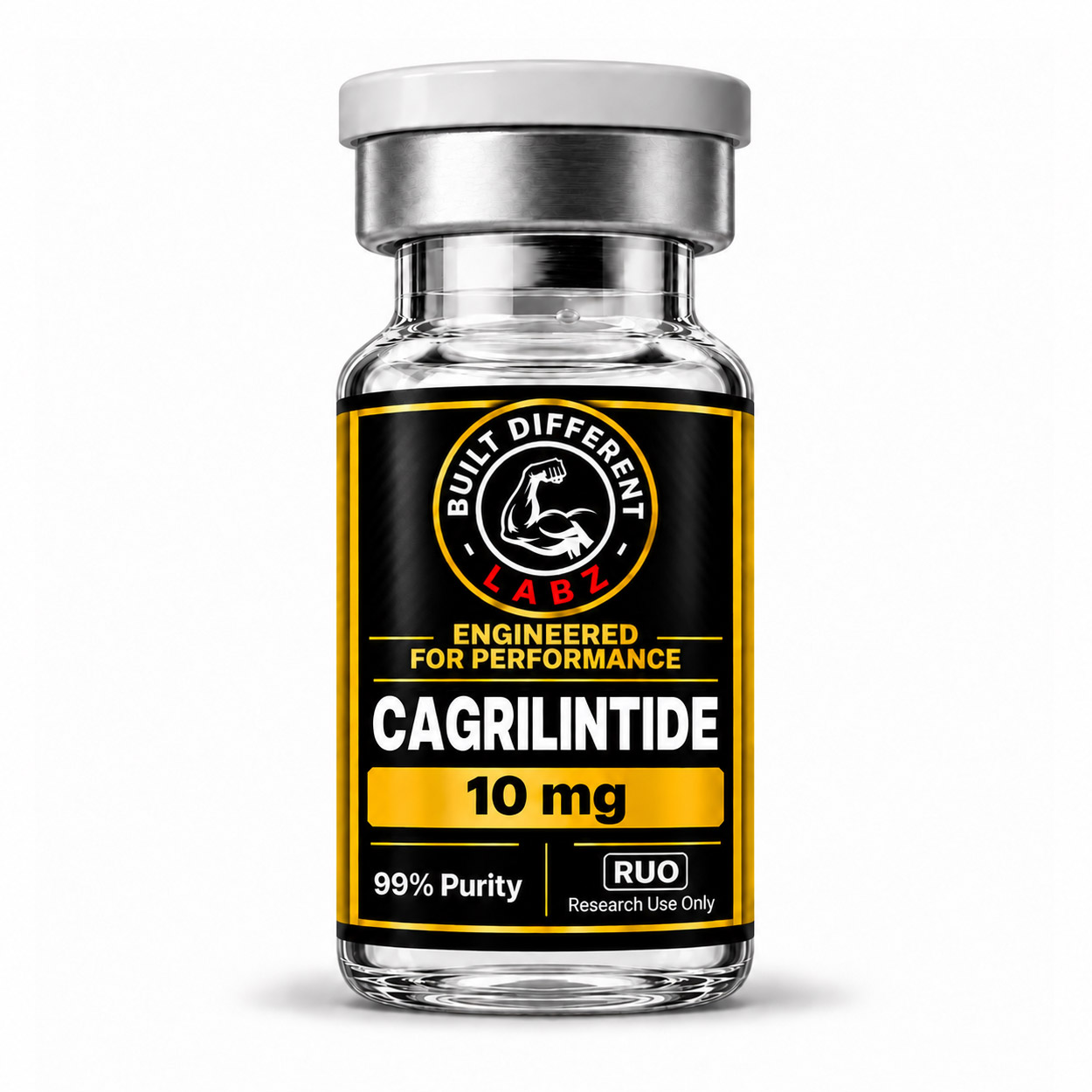
A vial labeled "Cagrilintide 10mg" represents a total of 10 milligrams of Cagrilintide in the vial. It does not mean that 10mg is an established or appropriate single human dose.
Cagrilintide is a long-acting amylin analogue.
Amylin is a naturally occurring peptide hormone produced by pancreatic beta cells.
It is normally released together with insulin after meals.
Amylin helps regulate:
Appetite
Satiety
Gastric emptying
Food intake
Post-meal glucose control
Cagrilintide was engineered to reproduce these effects for a much longer period than natural amylin.
Its main effects are related to appetite suppression and satiety.
Cagrilintide may:
Reduce hunger
Increase fullness
Reduce food intake
Slow gastric emptying
Reduce meal size
Support substantial weight loss
Improve some metabolic parameters
Its weight-loss effects primarily come from reducing calorie intake rather than directly "burning fat."
Amylin is an important but less widely discussed hormone involved in eating behavior.
After a meal, insulin and amylin are released from pancreatic beta cells.
Insulin helps move glucose into tissues.
Amylin sends signals that help tell the brain:
"You have eaten enough."
Amylin also slows the movement of food from the stomach into the intestine.
This contributes to longer-lasting fullness after meals.
Cagrilintide activates amylin receptors.
Amylin signaling affects areas of the brain involved in appetite and food intake.
The general pathway is:
Cagrilintide
Amylin receptor activation
Brain satiety signaling
Reduced hunger
Greater fullness
Reduced calorie intake
Weight loss
This is quite different from peptides that primarily increase growth hormone or influence tissue repair.
Appetite suppression is one of the most important effects.
People exposed to amylin-based therapies may experience:
Less hunger between meals
Feeling full sooner
Smaller meal sizes
Less interest in food
Reduced cravings
The effect is not simply willpower.
The peptide is altering biological signals involved in hunger and satiety.
Weight loss is the primary reason Cagrilintide has generated so much interest.
Clinical research has shown that Cagrilintide can produce meaningful weight loss when used as a therapeutic investigational agent.
Its effects appear especially powerful when combined with semaglutide.
That combination is known as CagriSema.
Cagrilintide and semaglutide work through different pathways.
Cagrilintide:
Amylin analogue
Activates amylin receptors
Increases satiety
Reduces food intake
Slows gastric emptying
Semaglutide:
GLP-1 receptor agonist
Increases satiety
Reduces appetite
Slows gastric emptying
Improves glucose regulation
Increases glucose-dependent insulin secretion
Because they operate through complementary mechanisms, combining them can produce a stronger weight-loss effect.
CagriSema is the name used for the combination of:
Cagrilintide
plus
Semaglutide
This combination is being developed as a once-weekly treatment for obesity and overweight.
Clinical development has progressed into Phase 3 studies.
The combination has produced very substantial weight loss in clinical trials.
In major Phase 3 research, CagriSema has produced average weight losses in the range typically associated with some of the strongest modern obesity treatments.
One recent trial reported approximately 23 percent average weight loss over 84 weeks in participants receiving CagriSema.
That is a major degree of weight reduction.
However, CagriSema is a combination product.
Those results cannot automatically be attributed to Cagrilintide alone.
Cagrilintide has also been studied independently.
Research suggests that Cagrilintide alone can produce significant weight loss.
In one large development program, Cagrilintide 2.4mg produced weight loss in the neighborhood of roughly 12 percent over the study period among participants receiving treatment.
This indicates that Cagrilintide itself has substantial appetite and body-weight effects even without semaglutide.
Cagrilintide is not a GLP-1 receptor agonist.
This is an important distinction.
It belongs to a different hormonal pathway.
Cagrilintide:
Amylin receptor pathway
Semaglutide:
GLP-1 receptor pathway
Tirzepatide:
GIP and GLP-1 pathways
Because these systems overlap in appetite control but use different receptors, combination therapies can potentially produce greater effects.
Tirzepatide activates:
GIP receptors
GLP-1 receptors
Cagrilintide activates:
Amylin receptors
Both can reduce hunger and food intake.
However, their mechanisms are different.
A recent Phase 3 trial compared CagriSema with tirzepatide.
CagriSema produced substantial weight loss but did not demonstrate the planned statistical non-inferiority versus tirzepatide in that particular trial.
This does not mean CagriSema was ineffective.
Both produced very large weight reductions.
Not primarily.
Cagrilintide's main mechanism is appetite regulation.
If someone consumes fewer calories over time, the body must use stored energy.
This produces fat loss.
So the simplified process is:
Reduced hunger
Reduced food intake
Calorie deficit
Body uses stored fat
Weight decreases
That is different from a stimulant or metabolic drug that directly increases energy expenditure.
Amylin signaling may reduce some forms of food-seeking behavior.
People may experience less:
Constant hunger
Snacking
Food preoccupation
Large portions
Desire to continue eating after becoming full
This is one reason amylin drugs are attractive for obesity treatment.
Amylin slows gastric emptying.
This means food remains in the stomach longer.
Potential benefits include:
Longer-lasting fullness
Smaller meals
Reduced post-meal glucose spikes
However, this mechanism also contributes to gastrointestinal side effects.
Cagrilintide may indirectly improve glucose control through several mechanisms.
These can include:
Reduced food intake
Slower gastric emptying
Reduced post-meal glucose excursions
Weight loss
Improved insulin sensitivity associated with weight reduction
It is not identical to insulin and should not be thought of as a direct insulin replacement.
Natural amylin is released together with insulin.
Cagrilintide does not replace insulin.
It primarily mimics amylin signaling.
Its metabolic effects complement rather than duplicate insulin's role.
Any substantial weight-loss therapy raises this issue.
When body weight decreases rapidly, some of the weight lost can come from lean tissue as well as fat.
Factors that can help preserve muscle during weight loss include:
Resistance training
Adequate protein
Appropriate calorie intake
Sufficient recovery
Cagrilintide itself is not a muscle-building drug.
No.
Cagrilintide is not an anabolic peptide.
It does not work like:
Testosterone
Anabolic steroids
Growth hormone
IGF-1
SARMs
Its main function is appetite and body-weight regulation.
For bodybuilding or physique purposes, interest generally centers on reducing appetite during a calorie deficit.
Potential attractions include:
Easier dieting
Reduced hunger
Smaller food intake
Greater adherence to calorie restriction
Potential disadvantages include:
Difficulty consuming enough protein
Nausea
Reduced training energy
Excessive calorie restriction
Loss of lean mass
Suppressing appetite too strongly is not automatically beneficial.
Substantial overall weight loss generally reduces both subcutaneous and visceral fat.
Visceral fat is the fat surrounding internal organs.
Reducing visceral fat can improve several metabolic risk factors.
However, Cagrilintide does not selectively target visceral fat.
Weight loss can improve lipid profiles in many people.
Potential secondary improvements may include:
Lower triglycerides
Improved cholesterol levels
Reduced metabolic risk
These effects are primarily related to metabolic improvement and weight reduction rather than Cagrilintide acting as a cholesterol medication.
Obesity is associated with increased cardiovascular risk.
Sustained weight loss can improve factors such as:
Blood pressure
Blood sugar
Insulin resistance
Lipids
Inflammation
Large cardiovascular-outcomes programs are important for determining whether these improvements ultimately translate into fewer heart attacks and strokes.
Nausea is one of the most important potential adverse effects.
Because Cagrilintide slows gastric emptying and increases satiety, gastrointestinal symptoms can occur.
These may include:
Nausea
Vomiting
Abdominal discomfort
Bloating
Feeling excessively full
These effects are commonly more noticeable during dose escalation.
Slower gastrointestinal movement can contribute to constipation.
Other possible gastrointestinal effects include:
Diarrhea
Abdominal discomfort
Indigestion
Reduced appetite
Bloating
Individual responses vary considerably.
Because appetite suppression can be powerful, some people may consume too little food.
This can potentially lead to:
Fatigue
Weakness
Poor training performance
Inadequate protein intake
Nutrient deficiencies
Lean-mass loss
The goal of obesity treatment is controlled, sustainable weight reduction rather than simply eliminating appetite.
Cagrilintide does not normally produce hypoglycemia in the same direct manner as excessive insulin.
However, low blood sugar risk can become more relevant when appetite-reducing medications are combined with diabetes medications such as:
Insulin
Sulfonylureas
People being treated for diabetes require medical supervision when medications affecting food intake and glucose regulation are used.
Severe persistent abdominal pain should not simply be assumed to be a routine gastrointestinal side effect.
For drugs affecting gastrointestinal and pancreatic pathways, clinicians may evaluate serious abdominal symptoms for conditions including pancreatitis or gallbladder disease.
Research-grade products should not be used as a substitute for medical assessment.
Rapid weight loss itself can increase the risk of gallstones.
Therefore, significant weight reduction from powerful obesity therapies may contribute to gallbladder complications.
Symptoms requiring evaluation can include:
Severe upper abdominal pain
Pain after fatty meals
Fever
Yellowing of the skin
Persistent vomiting
Because amylin slows gastric emptying, people with significant existing gastric-emptying disorders may be especially vulnerable to gastrointestinal problems.
Severe or persistent symptoms such as:
Repeated vomiting
Severe fullness
Inability to tolerate food
Significant abdominal distension
require medical evaluation.
Pramlintide is another amylin analogue.
Unlike Cagrilintide, pramlintide is an older medication developed primarily as an adjunct treatment for certain people with diabetes.
Cagrilintide was specifically designed to have a much longer duration of action.
A simplified comparison:
| Characteristic | Cagrilintide | Pramlintide |
|---|---|---|
| Drug class | Amylin analogue | Amylin analogue |
| Duration | Long acting | Shorter acting |
| Weight-loss development | Major focus | Secondary effect |
| Once-weekly potential | Yes | No |
| FDA approval | Investigational | Approved for certain diabetes uses |
Natural amylin has a short biological duration.
Cagrilintide was structurally modified to remain active much longer.
This allows clinical development around once-weekly administration rather than frequent daily injections.
That longer duration is one of its major pharmaceutical advantages.
Research suppliers may sell lyophilized Cagrilintide in vials labeled:
5mg
10mg
Other strengths
A vial marked:
"Cagrilintide 10mg"
means that the supplier represents the vial as containing a total of 10 milligrams of Cagrilintide.
It does not mean that 10mg is an appropriate single administration.
Clinical research has generally investigated much smaller weekly amounts with gradual escalation.
Appetite-regulating peptides frequently produce gastrointestinal side effects.
Gradually increasing exposure in clinical trials allows the body time to adapt.
Rapidly introducing large amounts can increase the likelihood of:
Severe nausea
Vomiting
Excessive appetite suppression
Dehydration
Gastrointestinal discomfort
Research-vial concentrations should never be interpreted as clinical dosing instructions.
Cagrilintide was specifically designed as a long-acting peptide suitable for approximately once-weekly administration in clinical development.
This differentiates it from natural amylin, which is cleared much more rapidly.
The long duration means effects and adverse effects can also persist longer than with a short-acting peptide.
Appetite effects may appear relatively early.
Meaningful body-weight changes occur over weeks and months.
The typical process is:
Early appetite reduction
Reduced food intake
Progressive calorie deficit
Gradual body-weight reduction
Greater cumulative weight loss over months
Weight-loss drugs should not be judged by what happens during only the first few days.
Weight loss often slows over time with almost every obesity treatment.
The body adapts to weight reduction.
Factors include:
Lower calorie requirements at lower body weight
Metabolic adaptation
Changes in appetite signaling
Reduced initial water loss
A plateau does not necessarily mean the medication has completely stopped working.
As with many appetite-regulating therapies, stopping treatment may allow hunger to increase again.
Weight regain is therefore possible if calorie intake increases.
This is one reason obesity is increasingly treated as a chronic disease rather than as a short-term dieting problem.
These are very different investigational compounds.
Cagrilintide:
Amylin analogue
Primarily increases satiety
Reduces appetite
Retatrutide:
GLP-1 receptor agonist
GIP receptor agonist
Glucagon receptor agonist
Retatrutide therefore acts through three metabolic hormone receptors.
Both are being investigated for substantial weight loss, but their mechanisms are different.
| Compound | Main pathway |
|---|---|
| Cagrilintide | Amylin |
| Semaglutide | GLP-1 |
| Tirzepatide | GIP + GLP-1 |
| CagriSema | Amylin + GLP-1 |
| Retatrutide | GIP + GLP-1 + glucagon |
This is one reason modern obesity-drug development increasingly focuses on multiple complementary hormonal pathways.
These peptides have almost opposite goals.
Cagrilintide:
Suppresses appetite
Supports weight loss
Works through amylin signaling
Ipamorelin:
Stimulates growth hormone release
Works through the ghrelin receptor
May increase appetite in some people
They should not be grouped together simply because both are peptides.
BPC-157 is primarily researched for:
Tissue repair
Tendons
Ligaments
Gastrointestinal protection
Cagrilintide is primarily researched for:
Appetite
Obesity
Weight reduction
Metabolic regulation
Their mechanisms and intended applications are completely different.
PT-141 primarily influences:
Sexual desire
Sexual arousal
Melanocortin signaling
Cagrilintide primarily influences:
Appetite
Satiety
Food intake
Body weight
Again, these are fundamentally different peptide classes.
Cagrilintide is not primarily a testosterone-modifying drug.
It does not function as an androgen or directly stimulate testosterone production.
However, significant weight loss can indirectly affect hormone levels in some people.
No traditional steroid-style post-cycle therapy is associated with Cagrilintide.
It does not suppress testosterone through the androgen receptor in the way anabolic steroids can.
As of September 2026, Cagrilintide itself remains investigational and is not an FDA-approved drug.
CagriSema, the combination of Cagrilintide and semaglutide, has been submitted for FDA review but remains an investigational product at this time.
The FDA also currently states that Cagrilintide is not a component of an FDA-approved drug and cannot legally be used in compounding under federal law.
This distinction is extremely important.
Cagrilintide used in clinical trials is manufactured under controlled pharmaceutical standards.
A vial sold online as:
"Cagrilintide 10mg - 99 percent purity - Research Use Only"
is not automatically equivalent to the investigational pharmaceutical product used in Novo Nordisk clinical trials.
Potential differences include:
Identity
Actual concentration
Purity
Sterility
Endotoxin contamination
Stability
Degradation
Manufacturing quality
A research vial may claim 99 percent purity.
That claim should not be assumed to establish:
Correct peptide identity
Exact quantity
Sterility
Endotoxin safety
Pharmaceutical quality
Analytical purity and injectable safety are separate issues.
Research Use Only, or RUO, generally means the product is being sold for laboratory or analytical research rather than approved human treatment.
It should not be interpreted as authorization for human administration.
Based on the amylin mechanism and clinical research, important potential effects include:
Nausea
Vomiting
Reduced appetite
Abdominal discomfort
Constipation
Diarrhea
Bloating
Indigestion
Fatigue
Headache
The gastrointestinal effects are especially important.
Cagrilintide has considerably more organized human clinical development than many research peptides.
However, long-term experience remains more limited than with medications that have been marketed for many years.
Ongoing Phase 3 programs are studying:
Weight loss
Type 2 diabetes
Long-term weight maintenance
Cardiovascular outcomes
Different doses
Combination therapy
This is precisely why large controlled clinical trials are necessary before widespread approval.
Appetite reduction:
Strong biological and clinical evidence.
Increased satiety:
Strong evidence.
Weight loss:
Strong clinical evidence.
Cagrilintide monotherapy:
Substantial clinical weight-loss evidence.
Cagrilintide plus semaglutide:
Very strong weight-loss results in Phase 3 research.
Muscle building:
Not established.
Direct fat burning:
Not the primary mechanism.
Anti-aging:
Not established.
Injury healing:
Not established.
Long-term safety:
Still being characterized.
FDA-approved Cagrilintide product:
No.
The biggest advantage of Cagrilintide is that it targets a powerful appetite-regulation pathway that is different from GLP-1.
This means it can potentially:
Produce significant weight loss on its own
Complement GLP-1 medications
Increase fullness
Reduce hunger
Reduce calorie intake
Its combination with semaglutide is particularly interesting because the two drugs attack obesity through complementary hormonal systems.
The major practical limitation is gastrointestinal tolerability.
Powerful appetite suppression and delayed gastric emptying can produce:
Nausea
Vomiting
Excessive fullness
Reduced food intake
Constipation
Difficulty meeting nutritional needs
The other major limitation is regulatory.
Cagrilintide remains investigational rather than an approved stand-alone medication.
Cagrilintide is a long-acting synthetic amylin analogue primarily being developed for:
Obesity
Weight loss
Appetite suppression
Increased satiety
Reduced food intake
Metabolic improvement
Its primary mechanism is activation of amylin receptors, which reduces hunger, increases fullness, and slows gastric emptying.
Unlike many experimental peptides, Cagrilintide has substantial human clinical-trial evidence supporting meaningful weight loss.
Its combination with semaglutide, known as CagriSema, has produced particularly large weight reductions in Phase 3 studies.
However, Cagrilintide remains investigational as of September 2026 and is not an FDA-approved stand-alone medication.
"Cagrilintide 10mg" describes the represented total amount contained in a particular vial. It should not be interpreted as a recommended 10mg dose.
The most accurate description is:
Cagrilintide is a potent long-acting amylin analogue with strong clinical evidence for appetite suppression and substantial weight loss, but it remains an investigational medication whose long-term safety, optimal use, and regulatory status are still being established.
We do not accept returns or issue refunds for any reason, beside manufacturing defects.
Feel free to contact us if you have any questions or concerns about our Return Policy.