We offer FREE SHIPPPING on all orders!
We offer FREE SHIPPPING on all orders!
| THIS PRODUCT IS INTENDED AS A RESEARCH CHEMICAL ONLY. This designation allows the use of research chemicals strictly for invitro testing and laboratory experimentation only. All product information available on this website is for educational purposes only. Bodily introduction of any kind into humans or animals is strictly prohibited by law. This product should only be handled by licensed, qualified professionals. This product is not a drug, food, or cosmetic and may not be misbranded, misused or mislabeled as a drug, food, or cosmetic. |
Chonluten is a short synthetic peptide bioregulator most commonly associated with research involving respiratory tissue, bronchial and lung function, cellular regulation, inflammation, and age-related changes in the respiratory system.
It is generally described as a three-amino-acid peptide with the sequence:
Glu-Asp-Gly
or:
EDG
Chonluten belongs to the broader family of short peptide bioregulators associated largely with Russian and Eastern European research into tissue-specific peptide signaling.
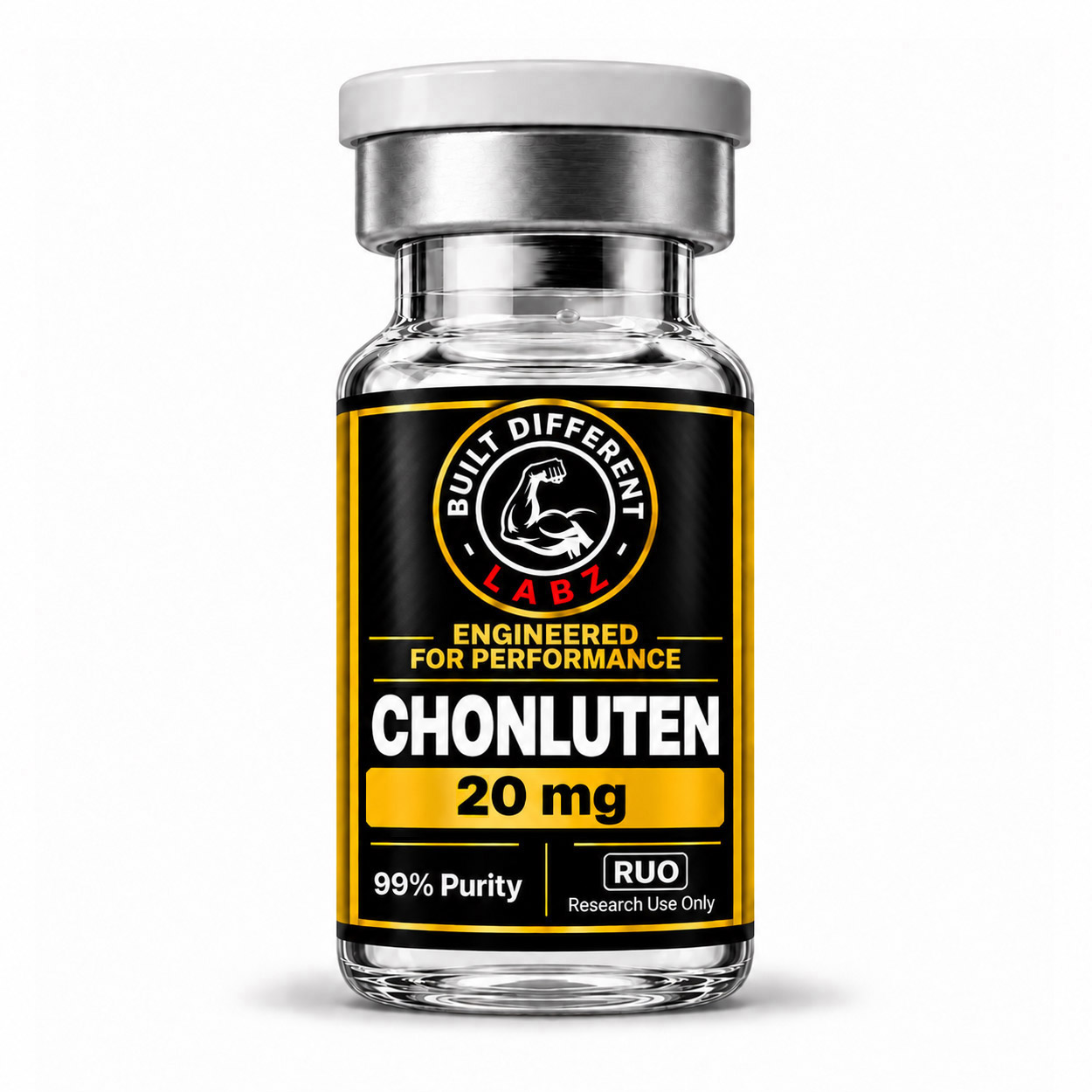
A vial labeled "Chonluten 20mg" represents a total of 20 milligrams of Chonluten in the vial. It does not mean that 20mg is an established or appropriate single human dose.
Chonluten is an experimental synthetic tripeptide primarily associated with respiratory-system research.
Its three amino acids are:
Glutamic acid
Aspartic acid
Glycine
The sequence is commonly abbreviated:
EDG
Unlike larger signaling peptides, Chonluten is extremely small.
Its proposed activity is generally discussed in terms of peptide bioregulation rather than conventional receptor agonism.
Short peptide bioregulators are small amino-acid sequences proposed to influence cellular regulation within particular tissues.
The general hypothesis is that certain short peptides may influence:
Gene expression
Protein synthesis
Cellular differentiation
Tissue maintenance
Cellular stress responses
Age-related cellular function
Chonluten is primarily associated with respiratory tissue.
This does not mean the peptide selectively travels only to the lungs or exclusively affects lung cells.
"Tissue-specific" in this context describes the research concept rather than a proven drug-targeting mechanism.
Chonluten's exact mechanism has not been established to the standards expected for a modern approved pharmaceutical.
Proposed mechanisms include effects on:
Gene expression
Protein synthesis
Respiratory epithelial cells
Cellular differentiation
Inflammatory signaling
Tissue repair
Oxidative stress
Cellular aging
Much of this research comes from the broader short-peptide bioregulator field.
These mechanisms should therefore be considered experimental.
Gene regulation is one of the central concepts behind short peptide bioregulators.
Certain very short peptides have been investigated for interactions with:
DNA
Chromatin
Histones
Regulatory proteins
Gene transcription
The hypothesis is that these interactions could influence which proteins a cell produces.
This is sometimes described as "epigenetic regulation."
However, this should not be exaggerated.
Chonluten is not gene therapy.
It does not permanently rewrite a person's DNA.
The respiratory system is Chonluten's primary research association.
Areas of interest include:
Bronchial tissue
Lung tissue
Respiratory epithelium
Airway function
Tissue repair
Inflammatory responses
Age-related respiratory changes
The respiratory epithelium is particularly important because it forms a protective interface between the body and inhaled air.
Respiratory epithelium lines much of the airway.
It performs several important functions, including:
Physical barrier protection
Mucus production
Removal of particles
Immune signaling
Protection from pathogens
Tissue repair after injury
Damage to respiratory epithelial cells can occur through:
Infection
Smoke
Environmental pollutants
Chronic inflammation
Oxidative stress
Chonluten research is often discussed in the context of supporting normal regulation of these tissues.
Chonluten is sometimes marketed as a "lung peptide."
That description needs qualification.
Experimental work has investigated respiratory tissue and functional changes, but Chonluten has not been established as a medication that increases lung capacity in healthy people.
It should not be described as proven to increase:
VO2 max
Oxygen saturation
Lung volume
Athletic endurance
The bronchi are the major airways carrying air into and through the lungs.
Bronchial health depends on:
Healthy epithelial tissue
Controlled inflammation
Appropriate mucus production
Smooth-muscle regulation
Normal immune responses
Chonluten's proposed bioregulatory effects have led to research interest in bronchial tissue and chronic respiratory conditions.
This does not establish it as a bronchodilator.
No established evidence supports treating Chonluten like a conventional bronchodilator.
It should not be compared directly with rescue medications that rapidly relax airway smooth muscle.
Chonluten's proposed effects involve longer-term cellular regulation rather than immediate opening of the airways.
Asthma involves:
Airway inflammation
Bronchial hyperresponsiveness
Smooth-muscle constriction
Mucus changes
Immune dysregulation
Because Chonluten is associated with respiratory tissue and inflammation research, it is sometimes marketed for asthma.
However, it is not an established asthma treatment.
There is insufficient modern controlled clinical evidence to show that Chonluten can replace standard asthma therapies.
COPD, or chronic obstructive pulmonary disease, commonly involves:
Chronic airway inflammation
Structural lung damage
Airflow obstruction
Mucus production
Oxidative stress
Chonluten's proposed respiratory-tissue effects make COPD an area of theoretical interest.
However, there is no strong evidence establishing Chonluten as a treatment capable of reversing COPD or emphysema.
Emphysema involves destruction of alveolar structures in the lungs.
This produces permanent structural changes.
There is no convincing evidence that Chonluten can regenerate severely destroyed human alveolar tissue.
Claims that it "rebuilds damaged lungs" therefore go beyond the available evidence.
Bronchitis involves inflammation of the bronchial airways.
Acute bronchitis is commonly associated with respiratory infections.
Chronic bronchitis is generally defined by persistent productive cough and is frequently associated with COPD.
Chonluten's anti-inflammatory and tissue-regulation research creates theoretical interest, but it is not an established bronchitis treatment.
Chonluten is not an antibiotic.
It is also not an established antiviral medication.
It should not be described as directly killing:
Bacteria
Influenza viruses
Coronaviruses
Other respiratory pathogens
Any proposed benefit would involve host tissue regulation rather than direct antimicrobial activity.
Inflammation is an important component of many respiratory disorders.
Experimental peptide-bioregulator research suggests that short peptides may influence inflammatory signaling.
Potential areas include:
Cytokine production
Cellular stress responses
Immune signaling
Tissue recovery
The degree to which EDG specifically produces clinically meaningful anti-inflammatory effects in humans remains uncertain.
Cytokines are signaling proteins used by immune cells and other tissues.
Examples include:
Interleukins
Tumor necrosis factor
Interferons
Balanced cytokine signaling is necessary.
Too much inflammatory signaling can damage tissue.
Too little immune signaling can impair defense against infection.
Chonluten is better described as a proposed bioregulator than a broad immune suppressant.
The lungs experience significant oxidative exposure because they continuously interact with atmospheric oxygen and environmental particles.
Oxidative stress can contribute to:
Cellular damage
Inflammation
Protein oxidation
Lipid damage
Mitochondrial dysfunction
Short-peptide research has explored potential regulation of cellular antioxidant and stress-response systems.
Direct clinical antioxidant effects of Chonluten remain insufficiently established.
Smoking exposes respiratory tissue to:
Oxidants
Carcinogens
Particulates
Chronic inflammation
Cellular injury
No peptide should be described as making smoking safe.
Chonluten has not been demonstrated to reverse the major risks associated with tobacco exposure.
It cannot be assumed to prevent:
Lung cancer
COPD
Emphysema
Cardiovascular disease
The same principle applies to vaping.
Potential respiratory effects from inhaled aerosols cannot be assumed to be neutralized by Chonluten.
Chonluten is not established as protection against vaping-related lung injury.
Lung function can decline with age because of changes involving:
Tissue elasticity
Respiratory muscles
Immune function
Oxidative stress
Cellular repair
Inflammation
The short-peptide bioregulator field has substantial interest in age-related changes in tissue function.
Chonluten is specifically associated with respiratory aging.
However, this does not mean it has been demonstrated to reverse biological lung aging in humans.
Chonluten sometimes appears in peptide longevity programs.
The proposed reasoning is:
Aging
Cellular regulatory changes
Reduced tissue function
Short peptide signaling
Potential normalization of cellular regulation
Improved tissue function
This is an interesting experimental model.
It is not evidence that Chonluten extends human lifespan or reverses aging.
Cellular senescence refers to cells entering a state where they stop dividing but remain metabolically active.
Senescent cells can contribute to chronic inflammation and tissue dysfunction.
Chonluten is not considered a direct senolytic.
It should therefore be distinguished from compounds such as FOXO4-DRI that are specifically researched for eliminating certain senescent cells.
Chonluten's proposed role is cellular regulation rather than selective senescent-cell destruction.
Chonluten:
Short peptide bioregulator
Respiratory tissue research
Gene-expression regulation
Cellular maintenance
FOXO4-DRI:
Experimental senolytic
FOXO4-p53 interaction
Designed to eliminate certain senescent cells
Their proposed mechanisms are fundamentally different.
Both belong to the short-peptide bioregulator category.
Chonluten:
EDG
Primarily associated with respiratory tissue.
Pinealon:
EDR
Primarily associated with brain and nervous-system function.
Only one amino acid differs between the commonly described sequences, but that difference can substantially alter biological interactions.
Epitalon is a tetrapeptide associated primarily with:
Pineal biology
Circadian function
Aging research
Telomerase-related research
Chonluten is primarily associated with:
Lung tissue
Bronchial tissue
Respiratory epithelium
They belong to related research traditions but have different proposed tissue associations.
Thymosin Alpha-1 primarily influences:
T cells
Dendritic cells
Innate immunity
Adaptive immunity
Chonluten is primarily associated with respiratory tissue regulation.
Therefore:
Thymosin Alpha-1 = immunomodulatory peptide.
Chonluten = respiratory peptide bioregulator.
KPV is an alpha-MSH-derived tripeptide primarily investigated for anti-inflammatory signaling, particularly involving:
Intestinal inflammation
Skin
NF-kappaB
Cytokines
Chonluten is also a tripeptide but has a completely different sequence and research background.
KPV:
Lys-Pro-Val
Chonluten:
Glu-Asp-Gly
They should not be treated as interchangeable anti-inflammatory peptides.
BPC-157 research primarily involves:
Gastrointestinal protection
Tendons
Ligaments
Wound healing
Tissue repair
Chonluten is more specifically associated with respiratory tissue and peptide bioregulation.
Respiratory peptides became increasingly discussed during and after the COVID-19 pandemic.
However, Chonluten should not be marketed as a proven treatment for:
COVID-19
Long COVID
Post-COVID pulmonary fibrosis
COVID-related shortness of breath
Evidence for these applications is insufficient.
Pulmonary fibrosis involves abnormal accumulation of scar tissue within the lungs.
Because fibrosis involves:
Inflammation
Fibroblast activity
Extracellular matrix remodeling
Cellular signaling
a respiratory bioregulator is theoretically interesting.
However, there is no strong evidence that Chonluten reverses established human pulmonary fibrosis.
"Regenerates the lungs" is too strong a description.
A more accurate description is:
Chonluten has been investigated for potential regulatory and protective effects involving respiratory tissue.
That is substantially different from demonstrating regeneration of destroyed human lung structures.
Healthy athletes sometimes become interested in respiratory compounds because lung function is associated with endurance.
However, there is no convincing evidence that Chonluten significantly improves:
VO2 max
Running performance
Cycling performance
Oxygen delivery
Aerobic capacity
in healthy athletes.
Chonluten is not a bodybuilding peptide.
It does not have established direct effects on:
Muscle hypertrophy
Protein synthesis
Testosterone
Growth hormone
IGF-1
Strength
Its potential relevance would primarily involve respiratory or general health research.
No established evidence indicates that Chonluten is a growth hormone secretagogue.
It should not be grouped with:
Sermorelin
Tesamorelin
Ipamorelin
CJC-1295
There is no established evidence that Chonluten meaningfully increases testosterone.
It does not primarily target the hypothalamic-pituitary-gonadal axis.
Chonluten is not known to suppress testosterone in the manner of anabolic steroids.
No traditional steroid-style post-cycle therapy is associated with Chonluten.
It is not an androgenic compound.
There is no established evidence that Chonluten directly increases fat loss.
It is not an appetite suppressant or conventional metabolic peptide.
Respiratory tissue and immune function are closely connected.
The airway epithelium participates directly in immune defense.
Potential Chonluten effects on respiratory tissue could therefore interact with:
Innate immunity
Cytokine signaling
Barrier function
Inflammatory responses
However, Chonluten should not simply be described as an "immune booster."
Healthy airway epithelium provides an important barrier against:
Pollutants
Allergens
Pathogens
Environmental particles
Damage to this barrier can promote inflammation.
Supporting normal epithelial-cell regulation is therefore one proposed area of interest for respiratory bioregulators such as Chonluten.
Direct clinical evidence demonstrating restoration of human airway barrier function remains limited.
A vial labeled:
"Chonluten 20mg"
means the supplier represents the vial as containing a total of 20 milligrams of Chonluten.
The 20mg represents total vial content.
It should not be interpreted as an established single administration amount.
There is no FDA-approved Chonluten dosing regimen.
Chonluten can be found through research suppliers as lyophilized material.
An injectable RUO research vial should not be assumed equivalent to any peptide-bioregulator product used in published research.
Differences can include:
Identity
Peptide sequence
Concentration
Purity
Sterility
Endotoxin levels
Manufacturing conditions
Stability
Short peptide bioregulators have also been marketed in oral formulations.
Because EDG contains only three amino acids, its small size makes oral-peptide research interesting.
However, reliable systemic bioavailability should not be assumed simply because a peptide is small.
Digestion, intestinal absorption, metabolism and formulation all matter.
Chonluten is primarily associated with respiratory rather than neurological research.
There is no need to assume substantial human brain penetration to explain its proposed respiratory effects.
Claims about precise human blood-brain-barrier penetration remain insufficiently established.
Modern human pharmacokinetic data for Chonluten are limited.
Because it is only three amino acids long, it may be susceptible to rapid enzymatic metabolism.
However:
Short plasma presence
does not necessarily equal
Short biological effect.
Changes in cellular signaling or gene expression could theoretically persist after the peptide itself is degraded.
The magnitude and duration of such effects in humans remain uncertain.
Chonluten does not have the type of comprehensive adverse-event database available for approved medications.
Potential adverse effects from experimental peptide products could include:
Headache
Nausea
Dizziness
Fatigue
Injection-site irritation
Redness
Swelling
Hypersensitivity reactions
This should not be interpreted as a complete established side-effect profile.
Unknown adverse effects remain possible.
Long-term safety has not been adequately established.
Important unanswered questions include:
Repeated exposure
Immune reactions
Organ-specific effects
Drug interactions
Reproductive effects
Long-term gene-expression changes
Effects in chronic disease
Effects in healthy individuals
There is insufficient evidence to claim that Chonluten either causes or prevents cancer.
Although gene regulation and cellular proliferation are relevant to cancer biology, this does not automatically imply that every peptide affecting gene expression is carcinogenic.
Likewise, claims that Chonluten prevents lung cancer are unsupported.
Quality is particularly important with short research peptides.
Potential issues include:
Incorrect sequence
Incorrect peptide identity
Incorrect vial quantity
Chemical impurities
Degradation
Endotoxins
Bacterial contamination
Poor sterility
A vial containing a very small peptide can still have significant manufacturing-quality problems.
HPLC can help evaluate chemical purity.
Mass spectrometry can help verify molecular identity.
However, a claim of 99 percent purity does not automatically establish:
Sterility
Endotoxin levels
Exact vial quantity
Correct formulation
Pharmaceutical manufacturing quality
Human effectiveness
Safety for injection
These are separate questions.
Research Use Only, or RUO, means that a particular product is marketed for laboratory or analytical research rather than as an approved medication for human treatment.
An RUO Chonluten vial should not be treated as an approved respiratory medication.
Chonluten is not an FDA-approved medication in the United States for:
Asthma
COPD
Emphysema
Bronchitis
Pulmonary fibrosis
Lung regeneration
Respiratory infections
Long COVID
Athletic endurance
Anti-aging
Lung cancer prevention
There is no FDA-approved Chonluten dosing regimen.
Identity as an EDG tripeptide:
Established within the peptide-bioregulator literature and market.
Short-peptide biological activity:
Scientifically plausible.
Gene-expression regulation:
Interesting experimental evidence within the broader short-peptide field.
Respiratory tissue regulation:
Promising experimental and regional research.
Anti-inflammatory effects:
Possible.
Respiratory epithelial support:
Promising but insufficiently established clinically.
Asthma treatment:
Not established.
COPD treatment:
Not established.
Emphysema reversal:
Not established.
Pulmonary fibrosis reversal:
Not established.
Lung regeneration:
Not established.
Improved athletic endurance:
Not established.
Anti-aging:
Not established.
Life extension:
Not established.
Long-term human safety:
Insufficiently characterized.
Chonluten is interesting because it represents an unusually simple biological concept.
It consists of only three amino acids:
Glu-Asp-Gly
Yet short peptides can potentially influence complex cellular signaling and gene-regulatory processes.
The proposed pathway can be summarized as:
Chonluten
Respiratory cellular signaling
Gene-expression and protein-synthesis regulation
Potential normalization of respiratory epithelial function
Potential tissue-protective effects
This makes Chonluten an interesting compound for respiratory aging and tissue-regulation research.
The biggest limitation is the quality and depth of the evidence.
Chonluten's reputation comes largely from the short peptide bioregulator research tradition rather than the type of large, independent, modern clinical-development program expected for an approved respiratory medication.
There is a major difference between:
"EDG demonstrates interesting biological effects in experimental respiratory models"
and:
"Chonluten repairs human lungs."
The second statement has not been established.
Chonluten is an experimental three-amino-acid peptide bioregulator with the sequence Glu-Asp-Gly, commonly abbreviated EDG.
Its primary research interests include:
Respiratory tissue
Bronchial function
Lung epithelium
Cellular regulation
Gene expression
Inflammatory signaling
Oxidative stress
Respiratory aging
"Chonluten 20mg" describes the represented total amount of peptide contained in a vial. It should not be interpreted as a recommended 20mg dose.
The most accurate description is:
Chonluten is an experimental EDG tripeptide bioregulator primarily associated with respiratory-system and lung-tissue research. Its proposed mechanisms involve cellular regulation, gene expression, protein synthesis, inflammatory signaling and maintenance of respiratory epithelial function. Although the underlying short-peptide biology is scientifically interesting, evidence does not establish Chonluten as a treatment for asthma, COPD, emphysema, pulmonary fibrosis, respiratory infection, or lung regeneration, and its long-term human safety and optimal clinical use remain insufficiently characterized.
We do not accept returns or issue refunds for any reason, beside manufacturing defects.
Feel free to contact us if you have any questions or concerns about our Return Policy.