We offer FREE SHIPPPING on all orders!
We offer FREE SHIPPPING on all orders!
| THIS PRODUCT IS INTENDED AS A RESEARCH CHEMICAL ONLY. This designation allows the use of research chemicals strictly for invitro testing and laboratory experimentation only. All product information available on this website is for educational purposes only. Bodily introduction of any kind into humans or animals is strictly prohibited by law. This product should only be handled by licensed, qualified professionals. This product is not a drug, food, or cosmetic and may not be misbranded, misused or mislabeled as a drug, food, or cosmetic. |
FOXO4-DRI is an experimental senolytic peptide designed to target senescent cells, often called "zombie cells."
Its primary research mechanism involves disrupting the interaction between the FOXO4 protein and the tumor-suppressor protein p53. In certain senescent cells, FOXO4 helps keep p53 inside the nucleus and contributes to the survival of those damaged, non-dividing cells.
FOXO4-DRI was designed to interfere with that interaction.
The basic concept is:
FOXO4-DRI
Disruption of FOXO4-p53 binding
Release and redistribution of p53
Activation of apoptosis pathways
Preferential death of certain senescent cells
Because of this mechanism, FOXO4-DRI has become one of the better-known experimental peptides in senolytic and longevity research.
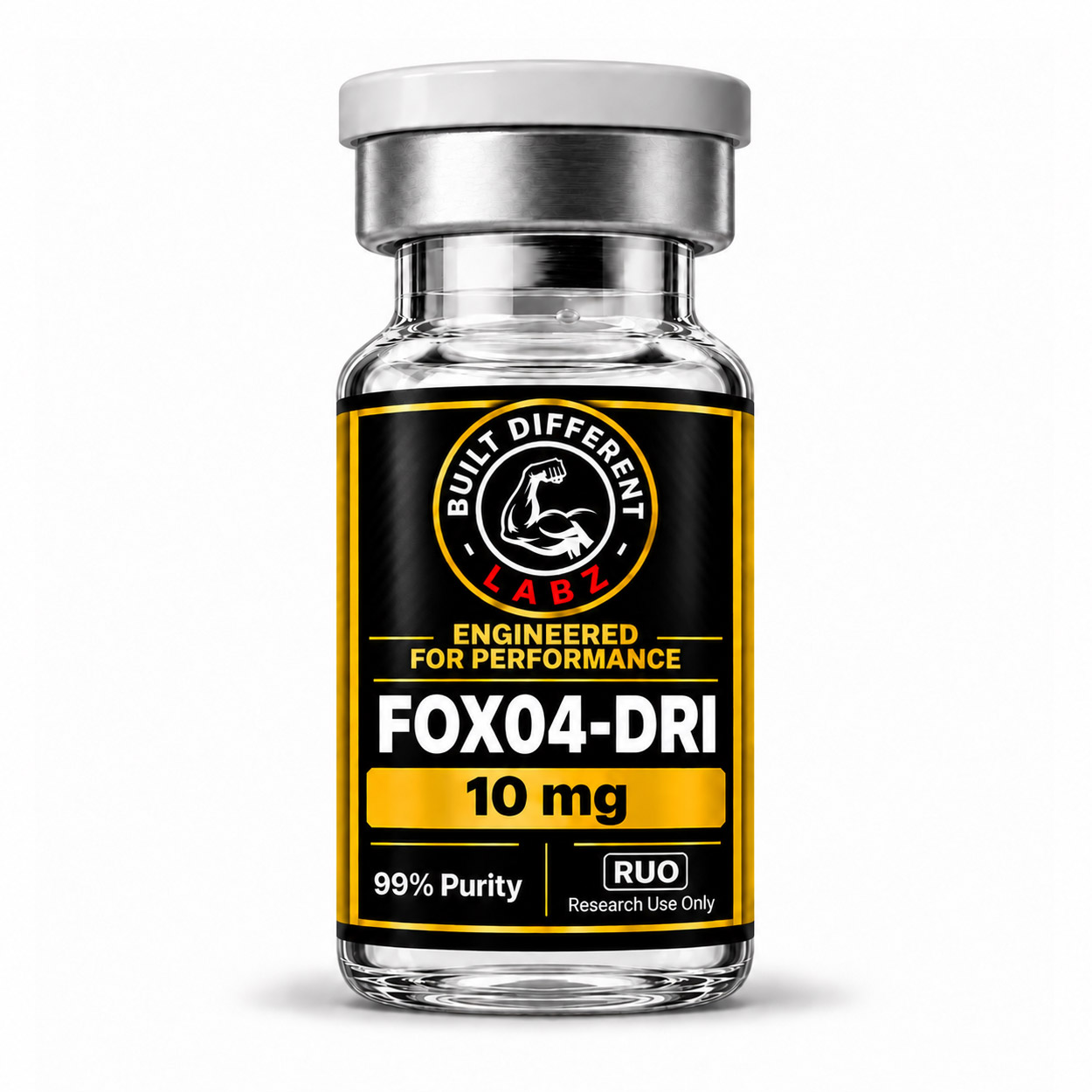
A vial labeled "FOXO4-DRI 10mg" represents a total of 10 milligrams of FOXO4-DRI in the vial. It does not mean that 10mg is an established or appropriate single human dose.
FOXO4 refers to:
Forkhead Box O4
FOXO4 is a transcription factor involved in processes such as:
Cellular stress responses
Oxidative stress
Cell survival
DNA-related signaling
Cellular senescence
DRI means:
D-Retro-Inverso
This refers to the way the peptide is constructed.
FOXO4-DRI is a modified peptide designed to imitate a region of FOXO4 while being more resistant to enzymatic degradation than an ordinary peptide composed of natural L-amino acids.
Most naturally occurring proteins are made from L-amino acids.
A D-retro-inverso peptide uses D-amino acids arranged in reverse sequence.
This design attempts to preserve important spatial features of the original peptide while making the molecule more resistant to degradation by proteolytic enzymes.
Potential advantages include:
Greater peptide stability
Increased resistance to proteases
Longer persistence than the corresponding natural peptide
Preservation of certain protein-binding properties
This is why FOXO4-DRI is not simply a natural fragment of FOXO4.
It is an engineered peptide.
Cellular senescence occurs when a cell permanently or semi-permanently stops dividing but remains metabolically active.
Senescence can develop because of:
DNA damage
Oxidative stress
Telomere dysfunction
Radiation
Chemotherapy
Cellular aging
Oncogene activation
Mitochondrial dysfunction
Senescence is not automatically harmful.
It can be beneficial in certain circumstances.
For example, senescence can help:
Prevent damaged cells from becoming cancerous
Support wound healing
Participate in embryonic development
Limit uncontrolled cell division
The problem occurs when excessive senescent cells accumulate and persist.
The popular term "zombie cells" refers to the fact that senescent cells:
No longer divide normally
Do not necessarily die
Remain metabolically active
Can release inflammatory signaling molecules
This can allow dysfunctional cells to influence neighboring tissue.
"Zombie cell" is a popular description, not a scientific cell classification.
Many senescent cells develop what is called:
Senescence-Associated Secretory Phenotype
or:
SASP
SASP can include secretion of:
Pro-inflammatory cytokines
Chemokines
Growth factors
Proteases
Other signaling molecules
These substances can affect nearby cells and tissues.
SASP has been associated with:
Chronic inflammation
Tissue dysfunction
Fibrosis
Aging-related changes
Metabolic dysfunction
This is one of the reasons researchers are interested in removing selected senescent cells.
A senolytic is a compound designed to selectively eliminate senescent cells.
The ideal senolytic would:
Recognize vulnerabilities specific to senescent cells
Trigger their death
Spare healthy functional cells
Different senolytics target different survival pathways.
Examples investigated in senolytic research include:
Dasatinib
Quercetin
Fisetin
Navitoclax
FOXO4-DRI
These compounds do not all work the same way.
One of the central findings behind FOXO4-DRI was that FOXO4 can interact with p53 in certain senescent cells.
This interaction can help retain p53 inside the nucleus.
Researchers proposed that this helps some senescent cells resist apoptosis.
FOXO4-DRI was designed to compete with natural FOXO4 for interaction with p53.
The simplified process is:
Senescent cell
FOXO4 binds p53
p53 remains retained in the nucleus
Cell avoids apoptosis
Then:
FOXO4-DRI enters the cell
FOXO4-DRI disrupts FOXO4-p53 interaction
p53 relocates
Apoptotic signaling increases
Senescent cell dies
Recent reviews still identify this FOXO4-p53 disruption mechanism as the central basis for the peptide's senolytic activity. (PubMed)
p53 is one of the most important proteins involved in protecting cells from abnormal growth.
It is sometimes called the:
"Guardian of the genome"
p53 can respond to cellular damage by causing:
Cell-cycle arrest
DNA repair
Senescence
Apoptosis
The outcome depends on the type and severity of cellular stress.
p53 is also extremely important for tumor suppression.
This is one reason manipulation of FOXO4-p53 signaling requires considerable caution.
Senescent cells often activate survival pathways that allow them to remain alive despite significant damage.
These are sometimes called:
Senescent Cell Anti-Apoptotic Pathways
or:
SCAPs
Different senescent cells can depend on different survival mechanisms.
FOXO4-p53 signaling represents one such potential vulnerability.
No.
This is an important limitation.
Senescence is not a single biological state.
Different senescent cells can have:
Different gene-expression patterns
Different survival pathways
Different tissue environments
Different responses to senolytics
A FOXO4-dependent senescent cell may respond differently from a cell relying primarily on BCL-2 family proteins or another survival pathway.
FOXO4-DRI should therefore not be described as universally eliminating all senescent cells.
The original research suggested preferential toxicity toward senescent cells compared with healthy control cells.
That selectivity is one reason the compound generated significant interest.
However, "preferential" does not mean perfectly selective.
More recent reviews emphasize that tissue selectivity, off-target effects, delivery, pharmacokinetics, and repeated-exposure safety remain unresolved. (PubMed Central (PMC))
Senescent cells accumulate in many tissues with increasing age.
This accumulation has been associated with:
Chronic low-grade inflammation
Impaired tissue repair
Reduced organ function
Fibrosis
Metabolic dysfunction
Animal experiments suggest that reducing senescent-cell burden can improve certain age-associated characteristics.
This has created enormous interest in senolytics as a possible longevity strategy.
No.
There is no evidence that FOXO4-DRI reverses human aging.
This is one of the most exaggerated claims surrounding the peptide.
Animal experiments have demonstrated improvements in certain health and functional measures.
That is very different from reversing aging.
The original FOXO4-DRI research attracted attention because treatment in aging and chemically injured mice was associated with improvements in measures such as:
Physical activity
Fur appearance
Kidney function
General fitness
The studies provided proof of concept that targeting FOXO4-p53 interactions could selectively eliminate certain senescent cells.
The findings remain preclinical.
There is not adequate evidence showing that FOXO4-DRI extends human lifespan.
Even in animal research, improved age-related health measures should not automatically be interpreted as definitive lifespan extension.
Healthspan and lifespan are different outcomes.
Healthspan refers to the period of life spent in relatively good health.
A treatment could theoretically improve:
Mobility
Organ function
Physical performance
Disease burden
without significantly increasing maximum lifespan.
Much of senolytic research is aimed at improving healthspan rather than simply increasing chronological lifespan.
Senescent cells can produce inflammatory SASP molecules.
Removing selected senescent cells could theoretically reduce this inflammatory signaling.
This has created interest in FOXO4-DRI for conditions involving chronic inflammation.
However, FOXO4-DRI is not a conventional anti-inflammatory medication.
Its proposed anti-inflammatory effect would be indirect:
Remove inflammatory senescent cells
Reduce SASP
Potentially reduce chronic inflammatory signaling
Fibrosis involves excessive deposition of connective tissue.
Senescent cells can sometimes participate in fibrotic disease.
Preclinical research has therefore investigated FOXO4-DRI in fibrosis models.
Recent literature reports experimental benefits in models involving pulmonary fibrosis and keloid-associated senescent fibroblasts. (PubMed Central (PMC))
This remains preclinical evidence.
Keloids are excessive scar formations involving abnormal fibroblast activity.
Recent laboratory research has identified senescence-related signaling within some keloid fibroblasts.
FOXO4-DRI has demonstrated the ability to induce apoptosis in these senescent fibroblast populations in experimental research.
This does not establish FOXO4-DRI as an approved treatment for keloids.
Senescent vascular cells are implicated in:
Vascular aging
Endothelial dysfunction
Arterial stiffness
Atherosclerosis
This creates theoretical interest in vascular senolytics.
However, the effects of senolytics are highly context dependent.
Importantly, recent reviews note that FOXO4-DRI worsened cardiovascular outcomes in an experimental pulmonary arterial hypertension model by promoting unfavorable vascular remodeling. (PubMed Central (PMC))
This is an important reminder that eliminating senescent cells is not automatically beneficial in every disease or tissue.
No.
Senescence can have useful physiological roles.
Senescent cells participate in:
Wound healing
Tissue remodeling
Embryonic development
Tumor suppression
Injury responses
Removing the wrong cells at the wrong time could theoretically interfere with these processes.
Therefore:
"Fewer senescent cells equals better health"
is an oversimplification.
The relationship between FOXO4-DRI and cancer is complicated.
Senescence can suppress cancer by stopping damaged cells from dividing.
However, persistent senescent cells may also create inflammatory environments that support tumor development in certain contexts.
Senolytic strategies are therefore being investigated in cancer research.
But FOXO4-DRI is not an established cancer treatment.
No.
There is no evidence establishing FOXO4-DRI as a cancer-prevention therapy.
Because FOXO4-DRI directly manipulates p53-related biology, long-term cancer safety is particularly important.
A recent 2026 review specifically identifies preservation of p53-dependent tumor surveillance as one of the major unresolved safety questions for FOXO4-DRI development. (PubMed)
There is also insufficient evidence to conclude that FOXO4-DRI causes cancer.
The appropriate conclusion is:
Long-term effects on tumor surveillance remain unknown.
That is different from saying it either causes or prevents cancer.
p53 is a central tumor-suppressor protein.
Any compound altering:
p53 localization
p53 signaling
apoptosis
cellular senescence
requires careful long-term safety evaluation.
A mechanism can be beneficial in one cell population and harmful in another.
This is one of the biggest reasons FOXO4-DRI should still be considered highly experimental.
Chemotherapy can produce therapy-induced senescence.
Some cancer cells may survive treatment in a senescent-like state.
Researchers have investigated whether senolytics could remove these cells after chemotherapy.
The original FOXO4-DRI research included models involving chemotherapy-associated cellular damage.
This is scientifically interesting but does not establish a clinical chemotherapy protocol involving FOXO4-DRI.
Doxorubicin is a chemotherapy drug that can produce significant cellular stress and senescence.
Preclinical FOXO4-DRI research demonstrated reductions in certain effects associated with doxorubicin-induced senescence.
This is part of the evidence supporting the concept of using senolytics after certain forms of cellular injury.
The original mouse research reported improvements in markers of renal function in aged animals.
This helped generate interest in FOXO4-DRI for age-related organ decline.
However:
Animal kidney improvement
does not equal
Proven treatment for human kidney disease.
FOXO4-DRI should not be represented as a kidney medication.
Skin accumulates senescent cells with age and after UV exposure.
These cells can influence:
Collagen
Inflammation
Fibroblast function
Extracellular matrix degradation
Senolytic research therefore has potential relevance to skin aging.
However, there is no established evidence that FOXO4-DRI reverses wrinkles or restores youthful skin in humans.
The original aging mouse studies reported improvements in fur density.
This finding is sometimes transformed online into claims that FOXO4-DRI regrows human hair.
That conclusion is not justified.
Mouse fur improvement does not establish treatment for human androgenetic alopecia.
Animal research has also investigated FOXO4-DRI in age-related testicular dysfunction.
Senescent Leydig cells may contribute to declining testosterone production with age.
Experimental studies in aged animals reported improvements in the testicular environment and age-associated testosterone secretion after FOXO4-DRI treatment. (PubMed Central (PMC))
This is an interesting preclinical finding.
It does not establish FOXO4-DRI as testosterone replacement or as a treatment for male hypogonadism.
Leydig cells are located in the testes.
They produce testosterone in response to luteinizing hormone.
With age, some Leydig cells can become dysfunctional or senescent.
Researchers have therefore investigated whether clearing senescent Leydig cells could improve testicular function.
It has produced testosterone-related improvements in certain aged animal models.
There is not sufficient human evidence to establish that FOXO4-DRI reliably increases testosterone in men.
It should not be grouped with Kisspeptin, HCG, or testosterone therapy.
There is no established evidence that FOXO4-DRI suppresses the reproductive hormone axis in the manner of anabolic steroids.
Traditional steroid-style post-cycle therapy is not inherently associated with FOXO4-DRI.
It does not primarily act through androgen receptors or directly replace testosterone.
Age-related muscle decline is influenced by many processes, including:
Neurological changes
Hormonal changes
Mitochondrial dysfunction
Inflammation
Cellular senescence
Removing detrimental senescent cells could theoretically improve tissue environments.
However, FOXO4-DRI is not an anabolic peptide.
No evidence establishes FOXO4-DRI as a direct muscle-building agent.
It does not directly stimulate:
Androgen receptors
Growth hormone receptors
IGF-1 receptors
Any physical-performance improvements observed in animal aging models likely reflect broader health effects rather than direct anabolic activity.
No.
FOXO4-DRI is not a growth hormone secretagogue.
It should not be grouped with:
Sermorelin
Tesamorelin
Ipamorelin
CJC-1295
FOXO4-DRI is not an established fat-loss peptide.
It does not primarily function through:
Appetite suppression
GLP-1
Amylin
Lipolysis
Growth hormone
Any metabolic changes would be secondary to altered senescent-cell biology.
Adipose tissue can accumulate senescent cells in obesity and aging.
These cells may contribute to:
Chronic inflammation
Insulin resistance
Metabolic dysfunction
Senolytic research therefore has relevance to metabolic disease.
However, there is not adequate human evidence demonstrating FOXO4-DRI as an obesity treatment.
Cellular senescence can contribute to metabolic inflammation.
Removing certain senescent cells has improved metabolic measures in some animal studies involving other senolytic strategies.
This does not establish FOXO4-DRI as an insulin-sensitizing medication.
Fisetin is a naturally occurring flavonoid investigated for senolytic activity.
Fisetin:
Small molecule
Multiple biological targets
Antioxidant and anti-inflammatory properties
Senolytic activity in some experimental models
FOXO4-DRI:
Engineered peptide
Designed specifically around FOXO4-p53 interaction
Mechanistically more targeted
Clinical evidence remains limited for senolytic applications generally, and findings with fisetin cannot automatically be transferred to FOXO4-DRI.
Dasatinib plus quercetin, often abbreviated D+Q, is one of the best-known senolytic combinations.
The mechanisms are different.
D+Q:
Targets several senescent-cell survival pathways.
FOXO4-DRI:
Specifically designed to disrupt FOXO4-p53 interaction.
Importantly, human studies involving D+Q do not prove that FOXO4-DRI works in humans.
A recent 2026 review explicitly emphasizes this distinction. (PubMed Central (PMC))
Navitoclax is a BCL-2 family inhibitor.
Some senescent cells depend heavily on BCL-2-related survival proteins.
Navitoclax can therefore have senolytic effects.
However, platelet cells also depend on BCL-XL, resulting in clinically important thrombocytopenia.
FOXO4-DRI attempts to target a different vulnerability:
FOXO4-p53.
Rapamycin is not primarily a senolytic.
It is more accurately classified as a senomorphic or geroprotective compound in many aging discussions.
Rapamycin primarily affects:
mTOR signaling.
FOXO4-DRI attempts to:
Kill selected senescent cells.
Therefore:
FOXO4-DRI = senolytic concept.
Rapamycin = primarily modifies aging-related cellular signaling.
A senomorphic is a compound that changes the harmful behavior of senescent cells without necessarily killing them.
For example, a senomorphic might reduce SASP production.
A senolytic attempts to eliminate the senescent cell itself.
Epitalon is associated with experimental:
Aging research
Telomerase
Pineal biology
Circadian signaling
FOXO4-DRI focuses on:
Cellular senescence
FOXO4
p53
Senescent-cell apoptosis
Their mechanisms are completely different.
Pinealon is a short peptide bioregulator associated with:
Neurological function
Gene regulation
Cognitive aging
FOXO4-DRI specifically targets:
Senescent-cell survival
FOXO4-p53 interaction
SS-31 targets mitochondrial cardiolipin and mitochondrial membrane function.
FOXO4-DRI targets cellular senescence.
The simplified distinction is:
SS-31 = mitochondrial bioenergetics.
FOXO4-DRI = selective senescent-cell elimination.
A vial labeled:
"FOXO4-DRI 10mg"
means that the supplier represents the vial as containing a total of 10 milligrams of FOXO4-DRI.
The 10mg represents total vial content.
It should not be interpreted as an established single dose.
There is no FDA-approved human dosing regimen for FOXO4-DRI.
There is currently no validated clinical FOXO4-DRI dosing protocol.
This is particularly important because the peptide remains preclinical.
A research vial should not be converted directly into a personal administration schedule.
This is one of the most important facts about FOXO4-DRI.
Recent 2026 scientific reviews continue to describe FOXO4-DRI as preclinical and state that it has not been clinically validated. One recent review specifically notes that FOXO4-DRI has not been evaluated in human clinical trials. (PubMed)
This makes FOXO4-DRI substantially more experimental than peptides that already have meaningful controlled human data.
Reliable human pharmacokinetic data do not exist because validated human clinical studies have not established its pharmacokinetics.
Its D-retro-inverso design should make it more resistant to enzymatic degradation than an equivalent conventional peptide.
However, that does not provide enough information to establish:
Human half-life
Bioavailability
Tissue distribution
Optimal exposure
Duration of biological activity
These remain important unanswered questions.
FOXO4-DRI was designed as a cell-penetrating peptide.
Intracellular access is necessary because the FOXO4-p53 interaction occurs inside cells.
Experimental studies demonstrate intracellular biological activity.
How efficiently and uniformly the peptide reaches different human tissues remains unknown.
There is insufficient evidence to establish reliable human penetration of FOXO4-DRI into the brain.
Claims that FOXO4-DRI clears senescent brain cells or reverses brain aging in humans are therefore highly speculative.
A reliable human side-effect profile does not exist because FOXO4-DRI lacks established human clinical trials.
Potential concerns theoretically include:
Off-target cellular apoptosis
Unwanted elimination of beneficial senescent cells
Tissue-specific toxicity
Immune reactions
Injection-site reactions
Altered tissue repair
Effects on tumor surveillance
Cardiovascular effects
Unknown organ-specific effects
These risks are not fully characterized.
Senescence is not simply biological garbage.
Temporary senescent cells can participate in:
Wound healing
Tissue regeneration
Development
Tumor suppression
Eliminating them indiscriminately could potentially interfere with normal physiology.
The goal of senolytic therapy is therefore selective removal of harmful persistent senescent cells.
Achieving that selectivity safely remains a major scientific challenge.
Cardiovascular effects deserve particular attention.
FOXO4-DRI has shown potentially beneficial activity in some vascular senescence research.
However, experimental work has also demonstrated detrimental effects in certain pulmonary hypertension models. (PubMed Central (PMC))
This highlights an important principle:
The biological consequences of senescent-cell removal depend on the tissue and disease context.
Long-term safety is unknown.
Important unresolved questions include:
Repeated exposure
Immune responses
Tumor surveillance
Tissue repair
Organ-specific toxicity
Healthy-cell effects
Reproductive effects
Cardiovascular effects
A recent 2026 review identifies long-term toxicology as one of the major requirements before FOXO4-DRI could meaningfully move toward clinical translation. (PubMed)
Research peptide quality is particularly important with an experimental compound such as FOXO4-DRI.
Potential problems include:
Incorrect sequence
Incorrect stereochemistry
Incorrect peptide identity
Incorrect vial quantity
Chemical impurities
Incomplete synthesis products
Peptide degradation
Endotoxins
Bacterial contamination
Poor sterility
With a D-retro-inverso peptide, confirming the correct molecular structure and stereochemistry is especially important.
HPLC may help assess chemical purity.
Mass spectrometry may help confirm molecular mass and identity.
However, even genuine 99 percent analytical purity does not automatically establish:
Correct stereochemistry
Sterility
Endotoxin level
Exact vial quantity
Pharmaceutical manufacturing quality
Correct formulation
Safety for injection
These require additional testing.
Research Use Only, or RUO, means the material is marketed for laboratory or analytical research rather than as an approved human medication.
This distinction is particularly important with FOXO4-DRI because there is currently no established FDA-approved pharmaceutical FOXO4-DRI product to which an RUO vial can be considered equivalent.
No.
FOXO4-DRI is not an FDA-approved medication for:
Anti-aging
Longevity
Cellular senescence
Fibrosis
Kidney disease
Cardiovascular disease
Hypogonadism
Cancer
Hair loss
Skin aging
Metabolic disease
Recent 2026 scientific reviews still characterize it as a preclinical senolytic rather than a clinically validated therapy. (PubMed)
FOXO4-p53 interaction:
Strong mechanistic evidence.
Senescent-cell survival role:
Strong experimental evidence.
Selective senolysis:
Promising preclinical evidence.
Aging mouse models:
Promising.
Chemotherapy-induced senescence:
Promising preclinical evidence.
Fibrosis:
Promising preclinical evidence.
Keloid research:
Promising laboratory evidence.
Age-related testicular dysfunction:
Promising animal evidence.
Kidney aging:
Promising animal evidence.
Human anti-aging:
Not established.
Human lifespan extension:
Not established.
Human senescent-cell clearance:
Not established.
Human testosterone improvement:
Not established.
Human fibrosis treatment:
Not established.
Human cancer treatment:
Not established.
Optimal human dosing:
Unknown.
Long-term human safety:
Unknown.
FOXO4-DRI's most interesting feature is how specifically it was designed around a molecular vulnerability of certain senescent cells.
Instead of broadly suppressing inflammation or slowing metabolism, the proposed mechanism is:
Identify a survival pathway used by senescent cells
Disrupt FOXO4-p53 interaction
Reactivate apoptosis
Remove dysfunctional cells
That makes FOXO4-DRI one of the more conceptually direct experimental senolytic strategies.
Its biggest limitation is equally important:
FOXO4-DRI remains predominantly a laboratory and animal-research compound.
There is a very large difference between:
Clearing selected senescent cells in mice
and:
Safely removing the correct senescent cells throughout a human body without interfering with wound healing, tumor suppression, cardiovascular function, or healthy tissue.
The human pharmacokinetics, dosing, tissue distribution, long-term toxicology, and clinical efficacy remain unresolved.
FOXO4-DRI is an engineered D-retro-inverso peptide designed to selectively eliminate certain senescent cells by disrupting the interaction between FOXO4 and p53.
Its primary research areas include:
Cellular senescence
Senolytic therapy
Aging biology
SASP reduction
Fibrosis
Tissue dysfunction
Chemotherapy-induced senescence
Vascular aging
Age-related organ decline
Its basic proposed mechanism is:
FOXO4-DRI -> FOXO4-p53 disruption -> p53 redistribution -> apoptosis of susceptible senescent cells
"FOXO4-DRI 10mg" describes the represented total amount of peptide contained in a vial. It should not be interpreted as a recommended 10mg dose.
The most accurate description is:
FOXO4-DRI is a highly experimental senolytic peptide designed to disrupt the FOXO4-p53 survival mechanism used by certain senescent cells. Preclinical research demonstrates compelling senolytic activity and improvements in several animal models of aging and disease, but as of 2026 it has not been clinically validated in humans. Its effects on human aging, longevity, cancer risk, cardiovascular function, optimal dosing, pharmacokinetics, and long-term safety remain unknown. (PubMed)
We do not accept returns or issue refunds for any reason, beside manufacturing defects.
Feel free to contact us if you have any questions or concerns about our Return Policy.