We offer FREE SHIPPPING on all orders!
We offer FREE SHIPPPING on all orders!
| THIS PRODUCT IS INTENDED AS A RESEARCH CHEMICAL ONLY. This designation allows the use of research chemicals strictly for invitro testing and laboratory experimentation only. All product information available on this website is for educational purposes only. Bodily introduction of any kind into humans or animals is strictly prohibited by law. This product should only be handled by licensed, qualified professionals. This product is not a drug, food, or cosmetic and may not be misbranded, misused or mislabeled as a drug, food, or cosmetic. |
SS-31, also known as Elamipretide, MTP-131, or Bendavia, is a small mitochondria-targeting peptide primarily researched for its ability to improve mitochondrial function, stabilize the inner mitochondrial membrane, reduce oxidative stress, and support cellular energy production.
Unlike peptides such as Sermorelin, Ipamorelin, or Tesamorelin, SS-31 does not primarily work through the growth hormone system.
Its main target is the mitochondria.
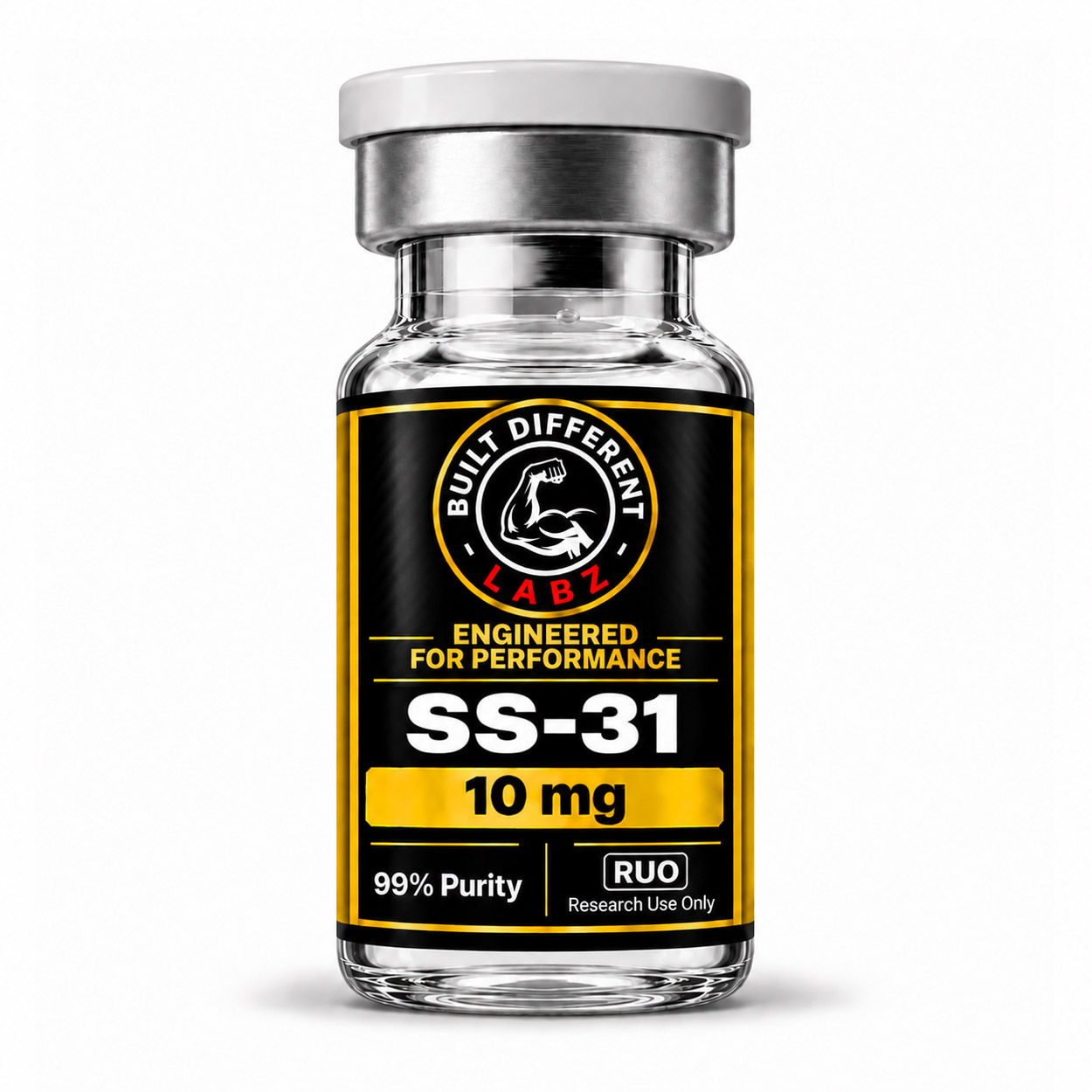
A vial labeled "SS-31 10mg" represents a total of 10 milligrams of SS-31 in the vial. It does not mean that 10mg is an established or appropriate single human dose.
SS-31 is a synthetic tetrapeptide, meaning it is composed of four amino-acid-related residues.
It is specifically designed to penetrate cells and concentrate within mitochondria.
Its sequence is commonly represented as:
D-Arg-Dmt-Lys-Phe-NH2
Dmt refers to dimethyltyrosine.
This structure gives SS-31 unusual mitochondrial-targeting properties.
The primary research interest surrounding SS-31 is mitochondrial function.
Potential effects under investigation include:
Improved mitochondrial energy production
Improved ATP production
Reduced mitochondrial oxidative stress
Stabilization of mitochondrial membranes
Improved electron transport chain efficiency
Protection from mitochondrial damage
Improved cellular energy metabolism
Protection of muscle tissue
Cardiovascular protection
Neuroprotection
Improved recovery from cellular stress
The central theme is not stimulation of hormones.
It is improving how mitochondria function.
Mitochondria are structures inside cells responsible for producing much of the energy used by the body.
They convert nutrients into ATP.
ATP stands for adenosine triphosphate.
ATP powers processes including:
Muscle contraction
Nerve activity
Protein synthesis
Cellular repair
Active transport
Metabolism
For this reason, mitochondria are often described as the powerhouses of the cell.
One of the most important areas of SS-31 research involves ATP production.
ATP is generated primarily through oxidative phosphorylation within the inner mitochondrial membrane.
When mitochondria become damaged or inefficient, ATP production can decline.
SS-31 has been investigated for its ability to improve mitochondrial bioenergetics and preserve the machinery involved in ATP production.
This does not mean SS-31 acts like a stimulant.
It does not simply make someone feel energized in the same way caffeine does.
Its proposed effect occurs at the cellular-energy level.
Cardiolipin is one of the most important concepts for understanding SS-31.
Cardiolipin is a specialized phospholipid found primarily in the inner mitochondrial membrane.
It helps maintain:
Mitochondrial structure
Cristae formation
Electron transport chain organization
ATP production
Cytochrome c function
Membrane stability
SS-31 has a strong affinity for cardiolipin.
This interaction appears to be central to its mechanism.
SS-31 accumulates at the inner mitochondrial membrane and interacts with cardiolipin.
This interaction may help:
Stabilize mitochondrial membranes
Preserve cristae structure
Improve electron transport
Reduce cardiolipin oxidation
Support ATP production
Reduce mitochondrial dysfunction
This is one of the major differences between SS-31 and almost every other peptide commonly marketed for recovery.
Cristae are folds inside the inner mitochondrial membrane.
They greatly increase the surface area available for energy production.
Important components of the electron transport chain are located within these structures.
When mitochondria become damaged, cristae can become distorted or disorganized.
SS-31 research suggests that stabilizing cardiolipin may help preserve normal cristae organization.
That may improve mitochondrial efficiency.
Mitochondria naturally produce reactive oxygen species, commonly called ROS.
Small amounts of ROS have important signaling functions.
Excessive ROS can damage:
Proteins
DNA
Cell membranes
Mitochondrial membranes
Cardiolipin
Damaged mitochondria can then generate even more oxidative stress.
This can create a damaging cycle.
SS-31 has been investigated for its ability to interrupt this process.
SS-31 was originally described largely as a mitochondria-targeted antioxidant.
That description is now considered incomplete.
Its effects appear to involve much more than simply neutralizing free radicals.
Current research suggests that SS-31 can influence:
Cardiolipin organization
Mitochondrial membrane properties
Electron transport chain organization
Mitochondrial proteins
ATP production
Oxidative phosphorylation
It is therefore more accurate to describe SS-31 as a mitochondrial membrane and bioenergetic modulator rather than simply an antioxidant.
The electron transport chain consists of protein complexes within the inner mitochondrial membrane.
These complexes transfer electrons and help generate the proton gradient required for ATP production.
Efficient organization of these complexes is important.
Cardiolipin helps organize the electron transport chain.
By interacting with cardiolipin, SS-31 may improve the structural environment needed for efficient oxidative phosphorylation.
Cytochrome c is a mitochondrial protein involved in electron transport.
Under normal conditions, it transfers electrons within the respiratory chain.
Under certain forms of mitochondrial damage, interactions between cytochrome c and oxidized cardiolipin can contribute to oxidative damage and programmed cell death.
SS-31 may help maintain cardiolipin in a healthier state and preserve normal cytochrome c function.
Mitochondria maintain an electrical gradient across their inner membrane.
This is called mitochondrial membrane potential.
The gradient is essential for ATP production.
Mitochondrial dysfunction can disrupt this potential.
SS-31 has been investigated for its ability to support membrane integrity and improve mitochondrial bioenergetics.
Skeletal muscle requires enormous amounts of ATP.
Muscle cells therefore contain large numbers of mitochondria.
Researchers have investigated SS-31 in relation to:
Muscle weakness
Mitochondrial myopathy
Age-related muscle decline
Muscle fatigue
Muscle atrophy
Exercise capacity
Improving mitochondrial efficiency could theoretically help muscle produce energy more effectively.
However, SS-31 is not an anabolic steroid and does not directly build muscle.
There is no strong evidence that SS-31 directly causes muscle hypertrophy.
It does not directly stimulate:
Testosterone
Androgen receptors
Growth hormone
IGF-1
mTOR in the manner of an anabolic agent
Potential muscle benefits would be related more to:
Mitochondrial function
Energy production
Muscle-cell health
Reduced oxidative stress
Recovery
That is very different from direct muscle growth.
Because ATP production is central to exercise, SS-31 has attracted interest for athletic performance.
The theoretical reasoning is:
Improved mitochondrial function
Improved ATP production
Potentially improved muscular energy availability
Potentially improved fatigue resistance
However, evidence in healthy athletes is limited.
Research performed in mitochondrial disease or animal models should not automatically be translated into performance-enhancing effects in healthy people.
Mitochondrial dysfunction can contribute to fatigue.
If cells cannot efficiently generate ATP, tissues with high energy requirements can be particularly affected.
These include:
Skeletal muscle
Heart
Brain
SS-31 therefore has biological plausibility as a therapy for certain mitochondrial forms of fatigue.
That does not mean it is a proven general-purpose treatment for everyday fatigue.
SS-31 is sometimes discussed as a recovery peptide.
The theoretical benefits include:
Better mitochondrial energy production
Reduced oxidative damage
Improved cellular repair environment
Improved muscle mitochondrial function
However, recovery claims in healthy athletes remain much less established than the mitochondrial mechanism itself.
Mitochondrial dysfunction is one of the biological changes associated with aging.
With age, mitochondria can develop:
Reduced energy-production efficiency
Increased oxidative stress
Changes in membrane structure
Reduced quality control
Altered mitochondrial dynamics
This has generated considerable interest in SS-31 as a potential healthy-aging compound.
No.
There is no evidence that SS-31 reverses human aging.
Research suggesting improved mitochondrial function should not be converted into claims that it:
Reverses aging
Extends lifespan
Makes cells young again
Prevents all age-related disease
These claims go beyond the evidence.
The heart is extremely dependent on mitochondrial energy production.
Heart muscle must continuously generate ATP.
This has made cardiovascular disease a major area of SS-31 research.
Experimental studies have investigated:
Heart failure
Ischemic injury
Reperfusion injury
Cardiac mitochondrial dysfunction
Heart muscle energetics
Preclinical results have often been promising.
Human results have been more mixed depending on the disease and trial.
Ischemia occurs when tissue temporarily loses adequate blood flow and oxygen.
Reperfusion occurs when blood flow returns.
Ironically, restoring oxygen can trigger a burst of oxidative stress.
This can damage mitochondria.
SS-31 has been investigated as a way to reduce mitochondrial damage during ischemia-reperfusion.
Research areas have included:
Heart attacks
Kidney injury
Stroke-related models
Organ transplantation
Much of this work remains experimental.
Mitochondrial dysfunction is common in heart failure.
Because the heart requires enormous amounts of ATP, poor mitochondrial function can worsen cardiac performance.
SS-31 has been tested clinically for heart failure.
Results have not established it as a standard heart-failure therapy.
This is an important example where strong biological plausibility does not always translate into a clearly successful clinical treatment.
The brain also requires very large amounts of energy.
Neurons depend heavily on mitochondrial ATP.
Mitochondrial dysfunction has therefore been investigated in disorders such as:
Alzheimer's disease
Parkinson's disease
Stroke
Traumatic brain injury
Neurodegeneration
SS-31 has shown neuroprotective effects in various preclinical models.
However, it is not an established treatment for these neurological diseases.
Potential neuroprotective mechanisms include:
Preserving mitochondrial function
Reducing oxidative stress
Supporting ATP production
Protecting mitochondrial membranes
Reducing cellular injury
Much of the strongest evidence remains preclinical.
Kidneys require substantial mitochondrial energy.
SS-31 has been investigated in models involving:
Acute kidney injury
Ischemia-reperfusion injury
Chronic kidney disease
Metabolic kidney damage
Results in animal models have suggested potential kidney-protective effects.
Clinical effectiveness remains less established.
Retinal cells have extremely high energy requirements.
Mitochondrial dysfunction contributes to several retinal and optic disorders.
SS-31 has been investigated in areas involving:
Age-related macular degeneration
Retinal disease
Mitochondrial eye disorders
This remains an active research area.
Barth syndrome is a rare genetic disorder involving abnormal cardiolipin metabolism.
Because SS-31 interacts directly with cardiolipin, Barth syndrome became one of its most important clinical-development targets.
Barth syndrome can involve:
Cardiomyopathy
Muscle weakness
Exercise intolerance
Growth abnormalities
Mitochondrial dysfunction
Clinical research has investigated whether Elamipretide can improve symptoms and mitochondrial function in these patients.
Primary mitochondrial myopathy refers to muscle disorders caused by mitochondrial dysfunction.
Typical symptoms can include:
Muscle weakness
Exercise intolerance
Fatigue
Reduced endurance
Elamipretide has undergone clinical trials in people with mitochondrial myopathy.
Results have been mixed, emphasizing that improving mitochondrial biology does not necessarily produce dramatic clinical improvement in every condition.
Mitochondrial dysfunction is associated with metabolic disorders including:
Insulin resistance
Obesity
Diabetes
Fatty liver disease
SS-31 has demonstrated interesting effects in experimental metabolic models.
However, it is not an established weight-loss medication.
No strong evidence supports describing SS-31 as a direct fat-burning peptide.
It does not primarily suppress appetite like:
Cagrilintide
Semaglutide
It does not primarily stimulate GH-related lipolysis like:
Tesamorelin
Sermorelin
Its primary action concerns mitochondrial function.
Weight loss is not an established primary effect of SS-31.
Any improvements in metabolism would not necessarily produce substantial weight reduction.
It should not be marketed as an obesity peptide.
Mitochondrial health is related to insulin sensitivity.
Experimental studies have investigated whether improving mitochondrial function can improve glucose metabolism.
However, SS-31 is not an established diabetes treatment.
Mitochondrial dysfunction can contribute to inflammatory signaling.
Damaged mitochondria can release signals that activate immune responses.
By improving mitochondrial stability, SS-31 may indirectly reduce certain inflammatory pathways.
This does not make SS-31 a conventional anti-inflammatory drug.
Apoptosis is programmed cell death.
Mitochondria play a central role in apoptosis.
When mitochondrial membranes become severely damaged, proteins such as cytochrome c can participate in triggering cell death.
By stabilizing mitochondrial membranes and cardiolipin, SS-31 may influence pathways involved in cellular survival.
This is one reason it has been studied in ischemic and degenerative diseases.
Both SS-31 and NAD-related therapies are frequently discussed in mitochondrial-health circles.
However, their mechanisms are different.
SS-31 primarily targets:
Cardiolipin
Mitochondrial membranes
Mitochondrial bioenergetics
NAD-related approaches primarily target:
Cellular redox reactions
NAD-dependent enzymes
Sirtuins
Energy metabolism
They should not be considered interchangeable.
MOTS-c is another peptide associated with mitochondrial biology.
However, the two are very different.
SS-31:
Synthetic mitochondrial-targeting peptide
Directly interacts with cardiolipin
Supports mitochondrial membrane function
MOTS-c:
Mitochondrial-derived peptide
Associated with metabolic signaling
Investigated for glucose metabolism and cellular stress responses
SS-31 works much more directly at the mitochondrial membrane.
Sermorelin:
GHRH analogue
Stimulates growth hormone
Can increase IGF-1
SS-31:
Targets mitochondria
Interacts with cardiolipin
Influences ATP production and oxidative stress
SS-31 does not primarily stimulate growth hormone.
Ipamorelin activates the ghrelin receptor and stimulates GH release.
SS-31 targets mitochondrial membranes.
Their mechanisms are completely different.
BPC-157 is primarily researched for:
Tissue repair
Tendons
Ligaments
Gastrointestinal protection
SS-31 is primarily researched for:
Mitochondrial function
ATP production
Oxidative stress
Cellular energetics
There may be some overlap in tissue-protection research, but the mechanisms are very different.
TB-500-related research focuses on:
Actin
Cell migration
Angiogenesis
Tissue repair
SS-31 focuses on:
Cardiolipin
Mitochondrial structure
Oxidative phosphorylation
Cellular energy
GHK-Cu primarily relates to:
Collagen
Skin
Hair
Fibroblasts
Tissue remodeling
SS-31 primarily relates to:
Mitochondria
Cellular energy
Oxidative stress
SS-31 is not primarily a testosterone-modifying peptide.
It does not directly stimulate androgen receptors or the reproductive hormone axis.
There is no established evidence that SS-31 suppresses natural testosterone production in the manner of anabolic steroids.
Traditional steroid-style post-cycle therapy is not generally associated with SS-31.
It does not primarily act through androgen pathways.
SS-31 is not a growth hormone secretagogue.
It should not be grouped with:
Sermorelin
Tesamorelin
Ipamorelin
CJC-1295
Its mechanism is mitochondrial rather than pituitary.
A vial labeled:
"SS-31 10mg"
means the supplier represents the vial as containing a total of 10 milligrams of SS-31.
It does not mean the entire 10mg vial represents a single established administration.
Research vial content and clinically studied exposure are separate concepts.
Elamipretide has been investigated clinically using injectable formulations, including subcutaneous administration.
However, a research vial sold online is not automatically equivalent to the pharmaceutical material used in clinical trials.
There can be major differences involving:
Purity
Concentration
Sterility
Endotoxin levels
Excipients
Stability
Manufacturing controls
SS-31 does not require prolonged circulation to exert mitochondrial effects.
It enters cells and localizes to mitochondrial membranes.
Its interaction with mitochondrial cardiolipin and downstream bioenergetic effects are more important than simply measuring how long it remains free in plasma.
Human pharmacokinetic behavior can also differ depending on route and formulation.
Different biological effects occur on different timelines.
Mitochondrial interaction:
Can occur relatively quickly.
ATP and bioenergetic effects:
Potentially relatively rapid at the cellular level.
Changes in physical function:
Would generally require longer.
Changes in chronic disease:
May require weeks or months and depend heavily on the underlying condition.
A person should not assume that feeling more energetic immediately proves improved mitochondrial function.
Clinical studies of Elamipretide have reported adverse effects including:
Injection-site reactions
Redness
Pain
Itching
Swelling
Headache
Fatigue
Nausea
Injection-site reactions have been among the more commonly reported issues in clinical development.
SS-31 is not primarily a blood-pressure medication.
Because mitochondrial function affects cardiovascular physiology, cardiovascular parameters have been monitored in clinical research.
There is insufficient evidence to describe SS-31 as a reliable treatment for hypertension or hypotension.
SS-31 is not primarily a glucose-lowering drug.
Experimental studies suggest mitochondrial improvement may influence metabolic health, but it should not be treated as a replacement for established diabetes medications.
Mitochondria are deeply involved in cancer-cell metabolism.
However, there is not adequate evidence to conclude that SS-31 either causes or prevents cancer.
Claims in either direction would be premature.
People with active cancer or complex medical conditions should not assume mitochondrial-targeting compounds are harmless simply because they are not anabolic hormones.
Elamipretide has undergone considerably more formal human clinical testing than many research peptides.
However, long-term safety across healthy people using it for performance, recovery, or anti-aging has not been adequately established.
Clinical safety information from people with specific mitochondrial diseases cannot automatically be generalized to healthy users.
Research peptide quality remains an important concern.
Potential problems include:
Incorrect peptide identity
Incorrect concentration
Chemical impurities
Peptide degradation
Bacterial contamination
Endotoxins
Poor sterility
Improper storage
A vial labeled:
"SS-31 10mg - 99 percent purity"
does not independently establish pharmaceutical quality.
When properly tested, peptide purity can be assessed with methods such as HPLC.
Mass spectrometry can help confirm molecular identity.
However, analytical purity does not automatically prove:
Sterility
Low endotoxin levels
Exact quantity in the vial
Correct formulation
Safety for injection
These are separate quality-control issues.
Research Use Only, or RUO, generally means the product is marketed for laboratory or analytical research rather than as an approved human medication.
An RUO SS-31 vial should not be assumed to be equivalent to clinical-trial Elamipretide.
SS-31, or Elamipretide, has undergone substantial clinical development for mitochondrial diseases.
However, its regulatory status has evolved through an investigational drug-development pathway and should not be generalized from research use to ordinary wellness, bodybuilding, fatigue, or anti-aging use.
A research vial labeled SS-31 10mg is not automatically an FDA-approved pharmaceutical product.
Mitochondrial targeting:
Strong.
Cardiolipin interaction:
Strong mechanistic evidence.
Mitochondrial membrane stabilization:
Strong preclinical and mechanistic evidence.
ATP and bioenergetic improvement:
Strong experimental evidence.
Oxidative-stress reduction:
Strong experimental evidence.
Barth syndrome:
Substantial clinical research.
Primary mitochondrial myopathy:
Human clinical research exists, with mixed results.
Heart failure:
Human studies exist, but it is not established as standard treatment.
Neuroprotection:
Promising preclinical evidence.
Kidney protection:
Promising preclinical evidence.
General anti-aging:
Not established.
Healthy-athlete performance enhancement:
Not established.
Direct muscle building:
Not established.
Fat loss:
Not established.
Life extension:
Not established.
The most interesting feature of SS-31 is how directly it targets mitochondrial structure.
Many compounds claim to "support mitochondria" indirectly.
SS-31 actually accumulates at the inner mitochondrial membrane and interacts with cardiolipin, one of the most important structural lipids required for mitochondrial function.
The basic concept is:
SS-31
Cardiolipin interaction
Improved mitochondrial membrane organization
Improved electron transport
Improved ATP production
Reduced oxidative stress
Improved cellular bioenergetics
That is a very distinctive mechanism.
The biggest limitation is the gap between improving mitochondrial biology and proving meaningful benefits in healthy people.
It is reasonable to say:
"SS-31 targets mitochondria and can improve mitochondrial bioenergetics in experimental systems."
It is much less established to say:
"SS-31 increases energy, improves athletic performance, reverses aging, builds muscle, and extends lifespan."
Those broader claims require substantially more clinical evidence.
SS-31, also known as Elamipretide, is a synthetic four-residue mitochondria-targeting peptide primarily associated with:
Cardiolipin binding
Mitochondrial membrane stabilization
Improved mitochondrial bioenergetics
ATP production
Reduced oxidative stress
Preservation of cristae structure
Muscle mitochondrial function
Cardiovascular research
Neurological research
Mitochondrial disease research
Its mechanism is fundamentally different from growth hormone secretagogues and tissue-repair peptides.
Rather than stimulating a hormone receptor, SS-31 directly targets the inner mitochondrial membrane and interacts with cardiolipin.
"SS-31 10mg" describes the represented total amount of peptide contained in a vial. It should not be interpreted as a recommended 10mg dose.
The most accurate description is:
SS-31 is an experimental mitochondria-targeting peptide that interacts with cardiolipin and can improve mitochondrial structure, ATP production, and bioenergetic efficiency in experimental systems. It has undergone meaningful human clinical research for mitochondrial disorders, but claims involving general anti-aging, bodybuilding, fat loss, athletic performance, or lifespan extension remain unproven.
We do not accept returns or issue refunds for any reason, beside manufacturing defects.
Feel free to contact us if you have any questions or concerns about our Return Policy.