We offer FREE SHIPPPING on all orders!
We offer FREE SHIPPPING on all orders!
| THIS PRODUCT IS INTENDED AS A RESEARCH CHEMICAL ONLY. This designation allows the use of research chemicals strictly for invitro testing and laboratory experimentation only. All product information available on this website is for educational purposes only. Bodily introduction of any kind into humans or animals is strictly prohibited by law. This product should only be handled by licensed, qualified professionals. This product is not a drug, food, or cosmetic and may not be misbranded, misused or mislabeled as a drug, food, or cosmetic. |
Semax is a synthetic peptide primarily researched for potential effects involving cognitive function, neuroprotection, memory, learning, attention, neurological recovery, and cellular responses to brain injury.
It is best known as a nootropic and neuroprotective peptide rather than a growth hormone, reproductive, muscle-building, or fat-loss peptide.
Semax is derived from a short fragment of adrenocorticotropic hormone, commonly called ACTH, but it was designed to retain neurological activity without producing the conventional adrenal-stimulating effects associated with ACTH.
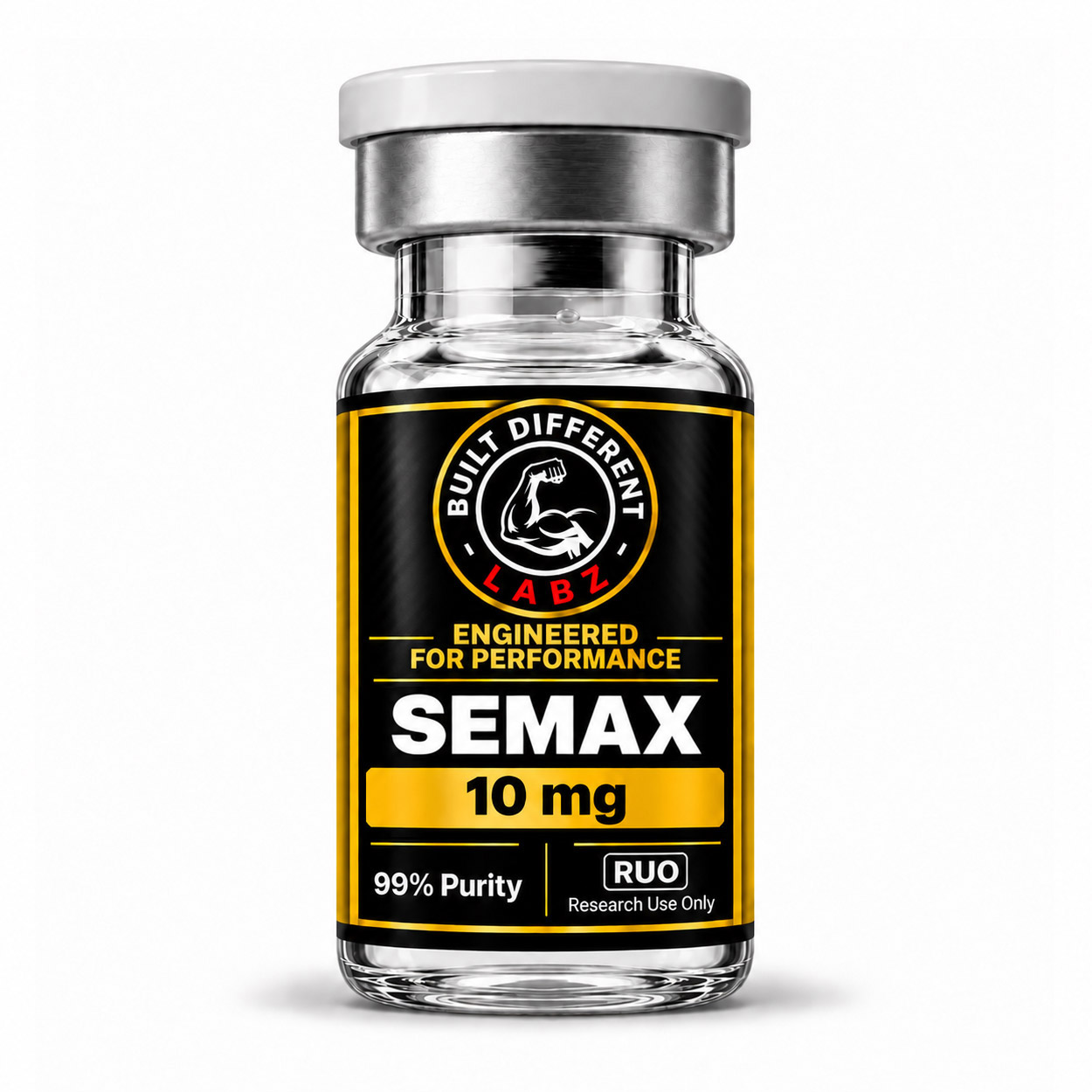
A vial labeled "Semax 10mg" represents a total of 10 milligrams of Semax in the vial. It does not mean that 10mg is an established or appropriate single human dose.
Semax is a synthetic heptapeptide consisting of seven amino acids.
Its sequence is:
Met-Glu-His-Phe-Pro-Gly-Pro
It was developed from the ACTH 4-7 fragment with the addition of a Pro-Gly-Pro sequence.
The resulting peptide has been investigated for effects involving:
Cognitive function
Memory
Learning
Attention
Neuroprotection
Brain-derived neurotrophic factor
Neurological recovery
Oxidative stress
Inflammatory signaling
Cerebral blood flow
Cellular stress resistance
Semax has a substantially different mechanism from peptides such as Sermorelin, Kisspeptin, BPC-157, or SS-31.
Semax does not appear to have one simple mechanism.
Research suggests potential interactions involving:
BDNF signaling
Neurotrophic pathways
Dopamine
Serotonin
Neuroplasticity
Oxidative stress
Inflammatory signaling
Gene expression
Neuronal survival
The exact importance of each mechanism in humans remains incompletely established.
BDNF stands for brain-derived neurotrophic factor.
It is one of the most important proteins involved in nervous-system health.
BDNF participates in:
Neuronal survival
Synaptic plasticity
Learning
Memory
Formation of neural connections
Adaptation to neurological stress
Semax research has reported changes in BDNF-related signaling and expression.
This is one of the major reasons Semax became popular in nootropic and neuroprotection discussions.
Neuroplasticity is the nervous system's ability to modify and reorganize its connections.
It is important for:
Learning
Memory
Skill acquisition
Recovery following neurological injury
Adaptation to environmental changes
BDNF is closely involved in these processes.
Semax's potential influence on neurotrophic signaling therefore creates interest in neuroplasticity.
However, it should not be claimed that Semax dramatically "rewires the brain."
Memory is one of the major areas of Semax research.
Experimental research has investigated potential effects on:
Memory formation
Memory consolidation
Memory retrieval
Learning
Some studies and regional clinical experience suggest possible cognitive benefits.
However, the modern evidence base is much smaller than that available for established neurological medications.
Semax has demonstrated potentially beneficial effects on learning in experimental models.
Possible mechanisms include:
Neurotrophic signaling
Dopamine modulation
Improved neuronal resilience
Neuroplasticity
Protection from oxidative damage
This does not establish Semax as an intelligence-enhancing drug.
Semax is commonly discussed as a potential cognitive-performance peptide.
Reported areas of interest include:
Concentration
Focus
Mental clarity
Attention
Cognitive endurance
It is not a conventional stimulant.
Therefore, any cognitive effect would be expected to differ from caffeine or amphetamine-type medications.
Not in the traditional pharmacological sense.
Semax does not primarily work by producing broad central nervous system stimulation.
It is better described as a neuroactive peptide with potential effects on neurotrophic and neurotransmitter signaling.
Some people may perceive increased alertness or focus, but that does not make it equivalent to conventional stimulants.
Dopamine plays important roles in:
Motivation
Attention
Movement
Reward
Learning
Semax has been investigated for potential effects on dopaminergic signaling.
These effects appear to be regulatory rather than equivalent to directly administering a strong dopamine agonist.
That would be an oversimplification.
Experimental evidence suggests Semax can influence dopamine-related pathways.
It does not mean Semax produces the large acute dopamine elevations associated with powerful stimulants or recreational drugs.
Serotonin is involved in:
Mood
Anxiety
Sleep
Appetite
Emotional regulation
Research suggests Semax may influence serotonergic signaling under certain experimental conditions.
However, Semax is not a selective serotonin reuptake inhibitor and should not be described as an antidepressant equivalent to established medications.
Neuroprotection is one of Semax's most important research areas.
Potential mechanisms include:
Increased neurotrophic signaling
Reduced oxidative stress
Reduced inflammatory damage
Improved cellular survival
Stabilization of neuronal function
Modulation of gene expression
These effects have generated particular interest in conditions involving reduced blood flow or neurological injury.
Semax has a history of research involving ischemic stroke.
An ischemic stroke occurs when blood flow to part of the brain is blocked.
This causes:
Oxygen deprivation
Energy failure
Oxidative stress
Inflammation
Neuronal damage
Semax has been investigated as a neuroprotective agent in this setting, particularly in Russian and Eastern European clinical literature.
It should not be interpreted as an alternative to emergency stroke treatment.
Ischemia means inadequate blood supply to tissue.
When brain tissue becomes ischemic, neurons experience severe metabolic stress.
Potential Semax effects studied in this setting include:
Supporting neuronal survival
Modulating inflammatory responses
Influencing neurotrophic factors
Reducing oxidative damage
This is one of the more scientifically interesting aspects of Semax.
Because traumatic brain injury can involve:
Neuroinflammation
Oxidative stress
Neuronal damage
Mitochondrial dysfunction
Semax has attracted interest as a potential neuroprotective compound.
However, evidence is insufficient to establish Semax as a standard treatment for concussion or traumatic brain injury.
Neurological recovery involves several processes:
Neuronal survival
Formation of new neural connections
Neuroplasticity
Synaptic remodeling
Restoration of blood flow
Reduction of excessive inflammation
Semax may potentially influence some of these mechanisms.
That does not guarantee functional neurological recovery.
Some Semax research has investigated cerebral circulation and ischemic injury.
Improved neuronal survival during reduced blood flow could theoretically help protect vulnerable brain tissue.
Semax is not an established blood-pressure or vascular medication, however.
The brain is particularly vulnerable to oxidative damage because it:
Uses substantial oxygen
Has high metabolic activity
Contains lipid-rich membranes
Semax has demonstrated antioxidant and cytoprotective effects in experimental research.
These effects may contribute to its proposed neuroprotective activity.
Neurological injury frequently produces inflammation.
Excessive neuroinflammation can contribute to additional neuronal damage.
Semax research suggests possible modulation of inflammatory signaling.
This does not make Semax a conventional anti-inflammatory medication.
Semax has been investigated for effects on gene expression in brain tissue.
Researchers have reported changes involving genes related to:
Neurotrophic factors
Immune responses
Vascular function
Cellular signaling
Neuroprotection
Gene-expression changes do not mean Semax permanently modifies DNA.
It is not gene therapy.
Nerve growth factor, or NGF, is another neurotrophic protein important for certain neurons.
Some experimental Semax research suggests effects on neurotrophic systems beyond BDNF.
This contributes to its broader neuroprotection research profile.
Semax is sometimes discussed for anxiety, but anxiety reduction is not its primary research identity.
Selank has a stronger association with anxiolytic research.
Semax is more commonly associated with:
Focus
Cognition
Neuroprotection
Mental performance
Individual responses may vary.
These two peptides are frequently compared.
Semax:
Cognition
Attention
Neuroprotection
BDNF-related signaling
Mental performance
Neurological recovery
Selank:
Anxiety
Stress
GABA-related signaling
Emotional regulation
Cognitive effects
A simplified distinction is:
Semax = cognitive and neuroprotective emphasis.
Selank = anxiolytic and stress-regulation emphasis.
Both remain experimental from a U.S. regulatory perspective.
Pinealon is a three-amino-acid peptide bioregulator associated primarily with:
Cognitive aging
Gene regulation
Neuroprotection
Cellular stress
Semax has a broader research profile involving:
BDNF
Neuroplasticity
Attention
Memory
Stroke research
Dopamine signaling
Both are experimental neurological peptides, but they are distinct compounds.
DSIP is primarily researched for:
Sleep
Stress
Neuroendocrine regulation
Semax is primarily researched for:
Cognition
Focus
Neuroprotection
Memory
Learning
Semax is not primarily a sleep-inducing peptide.
SS-31 primarily targets:
Mitochondrial membranes
Cardiolipin
ATP production
Cellular bioenergetics
Semax primarily affects:
Neurotrophic signaling
Neurotransmitter systems
Neuroprotection
Cognitive function
Both may be relevant to neuronal health, but their mechanisms are fundamentally different.
BPC-157 is primarily associated with experimental research involving:
Tissue protection
Tendons
Ligaments
Gastrointestinal tissue
Wound healing
Semax is primarily associated with the nervous system.
The two should not be considered interchangeable.
Semax was derived from the ACTH 4-7 sequence.
ACTH normally stimulates the adrenal cortex and contributes to cortisol production.
Semax was specifically developed to retain neurological activity without functioning like full ACTH.
This is an important distinction.
Semax should not be treated as equivalent to ACTH.
Although its structure originated from an ACTH fragment, it does not reproduce the full hormonal activity of ACTH.
Its research profile is predominantly neurological rather than adrenal.
Semax may influence the brain's response to stress through several potential mechanisms:
Neurotransmitter regulation
Neurotrophic signaling
Cellular stress resistance
Neuroprotection
However, it should not be described as a proven treatment for chronic stress.
There is experimental interest in Semax's effects on:
Dopamine
Serotonin
BDNF
Neuroplasticity
These pathways are relevant to depression.
However, Semax is not an established antidepressant and should not be considered a substitute for proven depression treatments.
Semax is sometimes promoted online as a nootropic for ADHD because of potential effects on:
Attention
Dopamine
Cognitive performance
There is insufficient high-quality evidence to establish Semax as an ADHD treatment.
Semax's neuroprotective and neurotrophic properties have generated interest in neurodegenerative diseases.
However, Semax is not an established treatment for Alzheimer's disease.
Claims that it prevents or reverses dementia go beyond current evidence.
Because dopamine and neuronal survival are relevant to Parkinson's disease, Semax has theoretical research interest.
There is insufficient evidence to establish it as a Parkinson's treatment.
Age-related cognitive decline can involve:
Reduced neuroplasticity
Mitochondrial dysfunction
Oxidative stress
Neuroinflammation
Changes in neurotrophic signaling
Semax potentially interacts with several of these systems.
This makes it interesting for healthy-aging research.
It does not establish Semax as an anti-aging therapy.
No.
There is no evidence that Semax reverses biological aging or extends human lifespan.
Potential improvements in cognitive function or neuroprotection should not be converted into claims of age reversal.
Semax is not primarily a sleep peptide.
Some people may experience changes in:
Alertness
Sleep quality
Dream intensity
Because neurological responses vary, some individuals could potentially find it activating.
It should not be treated as an established insomnia treatment.
Semax is not primarily a physical performance peptide.
Athletic interest generally involves:
Focus
Reaction
Mental performance
Cognitive endurance
Stress tolerance
There is insufficient evidence demonstrating meaningful improvements in athletic performance in healthy athletes.
No strong evidence supports Semax as a direct muscle-building peptide.
It does not directly activate:
Androgen receptors
Growth hormone receptors
GHRH receptors
Its primary effects are neurological.
No.
Semax is not an established fat-loss peptide.
It does not primarily work through appetite suppression or lipolysis.
Semax is not primarily a reproductive hormone peptide.
There is no established evidence that it meaningfully increases testosterone in healthy people.
Semax is not known to suppress natural testosterone production in the manner of anabolic steroids or exogenous testosterone.
Traditional steroid-style post-cycle therapy is not generally associated with Semax.
Its primary mechanisms are neurological rather than androgenic.
Semax is not a conventional growth hormone secretagogue.
It should not be grouped with:
Sermorelin
Tesamorelin
Ipamorelin
CJC-1295
Long-term tolerance and adaptation are not sufficiently characterized.
The nervous system can adapt to many forms of repeated signaling.
There is not enough high-quality evidence to claim that Semax never produces tolerance or that cycling is scientifically necessary.
A vial labeled:
"Semax 10mg"
means that the supplier represents the vial as containing a total of 10 milligrams of Semax.
It does not mean that the entire 10mg vial represents one established administration.
There is no FDA-approved Semax dosing regimen in the United States.
Semax is particularly associated with intranasal research and pharmaceutical use in some countries.
The nasal route is of interest because the nasal cavity provides potential pathways for neuroactive compounds to reach systemic circulation and potentially interact with the central nervous system.
However, intranasal absorption is variable and formulation dependent.
Semax may also be sold by research suppliers as lyophilized powder.
An injectable RUO vial should not be assumed to have the same formulation, safety profile, or pharmacokinetics as regulated intranasal preparations used in clinical research.
There is no FDA-approved injectable Semax product in the United States.
Semax's neurological activity has generated significant interest in how the peptide and its metabolites interact with the central nervous system.
It is overly simplistic to say that every administered Semax molecule simply crosses the blood-brain barrier intact.
Intranasal delivery, peptide metabolism, active fragments, and downstream signaling may all contribute to its effects.
Semax can be enzymatically broken down into shorter peptide fragments.
Some of these fragments may retain biological activity.
This is important because the effects of a peptide can sometimes continue through active metabolites even as the original molecule is being degraded.
Semax itself is relatively short acting at the molecular level.
However, downstream biological effects involving:
Gene expression
BDNF
Neurotransmitter regulation
Cellular signaling
may persist beyond the presence of the original peptide.
Therefore, plasma half-life and duration of biological activity are not necessarily identical.
Different effects could occur on different timelines.
Neurotransmitter-related effects:
Potentially relatively quickly.
Subjective focus or alertness:
Potentially noticeable sooner, although highly variable.
Gene-expression and neurotrophic changes:
Potentially longer.
Neurological recovery:
Would occur over much longer periods and depend heavily on the underlying injury or disease.
Immediate subjective effects do not prove long-term neuroprotection.
Semax appears to have been reasonably tolerated in much of the published regional research, but comprehensive modern safety data remain limited.
Potential effects may include:
Headache
Dizziness
Fatigue
Increased alertness
Restlessness
Changes in sleep
Nasal irritation with intranasal formulations
Nausea
Injection-site irritation with injectable research products
Individual neurological responses may vary.
Long-term safety in healthy people using Semax specifically for nootropic or performance purposes has not been adequately characterized.
Important unanswered questions include:
Long-term neurotransmitter adaptation
Chronic neurotrophic signaling
Tolerance
Interaction with psychiatric medications
Effects from prolonged repeated exposure
The absence of obvious short-term toxicity does not establish long-term safety.
Because Semax may influence neurological signaling, caution is reasonable when considering combinations with drugs that affect:
Dopamine
Serotonin
Anxiety
Mood
Stimulation
Sleep
Formal interaction studies are limited.
This means an absence of documented interaction should not automatically be interpreted as proof that no interaction exists.
Research peptide quality is an important issue.
Potential problems include:
Incorrect peptide identity
Incorrect concentration
Chemical impurities
Peptide degradation
Bacterial contamination
Endotoxins
Poor sterility
Improper storage
A vial labeled:
"Semax 10mg - 99 percent purity"
does not independently establish pharmaceutical quality.
When properly performed, HPLC can help determine chemical purity.
Mass spectrometry can help confirm molecular identity.
However, even genuine 99 percent analytical purity does not automatically establish:
Sterility
Endotoxin levels
Exact vial quantity
Correct formulation
Pharmaceutical manufacturing quality
Safety for injection
Those are separate quality-control requirements.
Research Use Only, or RUO, means a product is marketed for laboratory or analytical research rather than as an approved medication for human treatment.
An RUO Semax vial should not be assumed to be equivalent to a regulated pharmaceutical formulation.
Semax is not FDA approved in the United States for:
Cognitive enhancement
Memory improvement
ADHD
Stroke
Traumatic brain injury
Alzheimer's disease
Parkinson's disease
Depression
Anxiety
Anti-aging
Athletic performance
There is no FDA-approved U.S. Semax dosing regimen.
Semax has a history of medical and pharmaceutical use in Russia and some surrounding markets, but that is separate from FDA approval in the United States.
Neurobiological activity:
Strong experimental evidence.
Neuroprotective effects:
Promising preclinical evidence.
BDNF and neurotrophic signaling:
Promising experimental evidence.
Gene-expression effects:
Promising experimental evidence.
Memory and learning:
Promising but limited evidence.
Attention and focus:
Possible, but insufficient high-quality modern clinical evidence.
Ischemic stroke:
Meaningful regional research, but not established as standard U.S. treatment.
Traumatic brain injury:
Not established.
ADHD:
Not established.
Depression:
Not established.
Alzheimer's disease:
Not established.
Parkinson's disease:
Not established.
General nootropic use in healthy adults:
Not established.
Muscle growth:
Not established.
Fat loss:
Not established.
Anti-aging:
Not established.
Long-term safety:
Insufficiently characterized.
Semax's most interesting characteristic is the combination of cognitive and neuroprotective mechanisms being investigated.
The proposed pathway can be simplified as:
Semax
Neurotrophic and neurotransmitter signaling
BDNF-related activity
Improved neuronal resilience
Neuroplasticity and cellular protection
Potential effects on cognition and neurological recovery
This makes Semax considerably different from simple stimulants that primarily produce temporary increases in alertness.
The biggest limitation is the quality and geographic concentration of the evidence.
Semax has a substantial history of experimental and regional clinical research, but considerably less large-scale, independently replicated, modern clinical evidence than established neurological medications.
It is reasonable to say:
"Semax is a biologically active neuropeptide with promising neuroprotective and cognitive research."
It is much less appropriate to say:
"Semax dramatically increases intelligence, repairs brain damage, prevents dementia, treats ADHD, or reverses brain aging."
Those broader claims have not been established.
Semax is a synthetic seven-amino-acid neuroactive peptide primarily associated with research involving:
BDNF
Neuroprotection
Neuroplasticity
Memory
Learning
Attention
Dopamine-related signaling
Oxidative stress
Neuroinflammation
Gene expression
Ischemic brain injury
Neurological recovery
It is fundamentally different from growth hormone peptides such as Sermorelin and Tesamorelin, reproductive peptides such as Kisspeptin, and tissue-repair peptides such as BPC-157.
"Semax 10mg" describes the represented total amount of peptide contained in a vial. It should not be interpreted as a recommended 10mg dose.
The most accurate description is:
Semax is an experimental ACTH-derived neuroactive peptide investigated for neuroprotective, neurotrophic, and cognitive effects. Its influence on BDNF-related signaling, neuronal function, and neurological stress is scientifically interesting, but evidence remains insufficient to establish it as an FDA-approved treatment for cognitive enhancement, ADHD, dementia, traumatic brain injury, or general neurological optimization in the United States.
We do not accept returns or issue refunds for any reason, beside manufacturing defects.
Feel free to contact us if you have any questions or concerns about our Return Policy.