We offer FREE SHIPPPING on all orders!
We offer FREE SHIPPPING on all orders!
| THIS PRODUCT IS INTENDED AS A RESEARCH CHEMICAL ONLY. This designation allows the use of research chemicals strictly for invitro testing and laboratory experimentation only. All product information available on this website is for educational purposes only. Bodily introduction of any kind into humans or animals is strictly prohibited by law. This product should only be handled by licensed, qualified professionals. This product is not a drug, food, or cosmetic and may not be misbranded, misused or mislabeled as a drug, food, or cosmetic. |
L-Carnitine is a naturally occurring amino-acid-derived compound that plays an essential role in energy metabolism, particularly the transport of long-chain fatty acids into mitochondria where they can be oxidized for energy.
Unlike many products sold alongside research peptides, L-Carnitine is not a peptide, anabolic steroid, growth hormone secretagogue, or hormone.
The body naturally produces L-Carnitine primarily from the amino acids:
Lysine
Methionine
Its major biological and research interests include:
Fatty-acid transport
Mitochondrial energy production
Fat oxidation
Exercise metabolism
Muscle function
Recovery
Carnitine deficiency
Cardiovascular metabolism
Male reproductive biology
Neurological metabolism
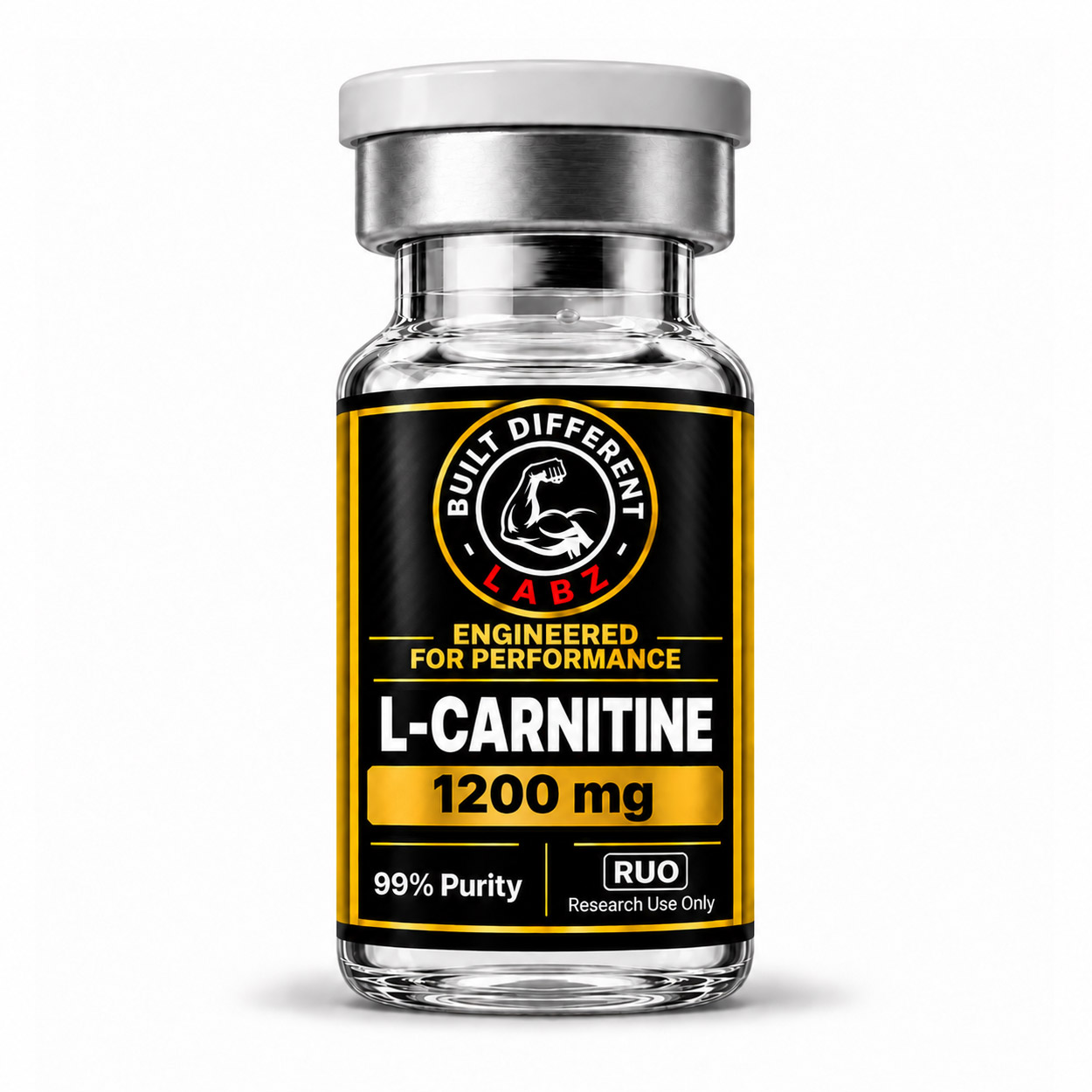
A vial labeled "L-Carnitine 1200mg" represents a total of 1,200 milligrams, or 1.2 grams, of represented L-Carnitine in the vial. The vial amount should not automatically be interpreted as a single administration amount.
L-Carnitine is a naturally occurring quaternary ammonium compound found throughout the human body.
Approximately 95 percent of the body's carnitine is stored in skeletal and cardiac muscle.
These tissues have enormous energy requirements and rely heavily on fatty-acid metabolism.
Carnitine's best-established function is helping transport long-chain fatty acids into mitochondria.
Mitochondria are cellular structures responsible for producing much of the body's:
ATP
ATP stands for:
Adenosine Triphosphate.
ATP is the primary energy currency used by cells.
Muscle contraction, cellular repair, nerve signaling, and countless other processes require ATP.
Long-chain fatty acids cannot simply move freely into the mitochondrial matrix where beta-oxidation occurs.
They require a transport mechanism.
Carnitine is an essential part of this system.
The simplified pathway is:
Stored or circulating fat
Fatty acids
Fatty acyl-CoA
Carnitine shuttle
Mitochondria
Beta-oxidation
ATP production
This is known as the:
Carnitine shuttle.
The carnitine shuttle involves several important proteins and enzymes.
These include:
CPT-I
Carnitine-acylcarnitine translocase
CPT-II
CPT stands for:
Carnitine Palmitoyltransferase.
Together, these systems allow long-chain fatty acids to cross mitochondrial membranes.
CPT-I is located on the outer mitochondrial membrane.
It helps transfer a fatty-acid group from fatty acyl-CoA onto carnitine.
This produces:
Acylcarnitine.
Acylcarnitine can then be transported farther into the mitochondrion.
This transporter moves acylcarnitine across the inner mitochondrial membrane.
Once inside, CPT-II participates in transferring the fatty-acid group back to CoA.
The fatty acid can then enter:
Beta-oxidation.
Beta-oxidation is the process through which fatty acids are broken down inside mitochondria.
This generates molecules that feed into cellular energy-production pathways.
The simplified process is:
Fatty acids
Beta-oxidation
Acetyl-CoA
Citric acid cycle
Electron transport chain
ATP
Carnitine is therefore essential for the body's ability to use long-chain fatty acids as fuel.
This question requires an important distinction.
L-Carnitine is absolutely involved in fat metabolism.
That does not mean consuming additional L-Carnitine automatically causes substantial body-fat loss.
The body already maintains a large carnitine pool, especially in skeletal muscle.
If muscle carnitine availability is already adequate, simply increasing circulating L-Carnitine does not necessarily cause mitochondria to burn unlimited additional fat.
Therefore:
L-Carnitine is essential for fatty-acid oxidation.
But:
L-Carnitine is not automatically a powerful weight-loss drug.
Human studies examining L-Carnitine supplementation and body weight have produced variable results.
Some analyses suggest modest effects under certain circumstances.
However, the magnitude is generally much smaller than the dramatic fat-loss claims sometimes made in performance marketing.
L-Carnitine should not be compared directly with modern obesity medications that strongly suppress appetite.
Cagrilintide primarily works through:
Amylin signaling
Appetite reduction
Increased satiety
Reduced food intake
L-Carnitine primarily works through:
Fatty-acid transport
Mitochondrial metabolism
Therefore, their mechanisms are completely different.
GLP-1 receptor agonists can substantially alter:
Appetite
Satiety
Food intake
Gastric emptying
Glucose regulation
L-Carnitine does not primarily suppress appetite.
Its role is metabolic rather than appetite-driven.
Skeletal muscle contains the majority of the body's carnitine.
This makes L-Carnitine highly relevant to muscle metabolism.
Potential areas of research include:
Energy production
Fatty-acid metabolism
Exercise recovery
Muscle damage
Blood flow
Metabolic flexibility
However, L-Carnitine is not directly anabolic in the same manner as testosterone.
L-Carnitine does not directly activate the androgen receptor.
It is not comparable to:
Testosterone
Anabolic steroids
SARMs
IGF-1 LR3
Some research has examined L-Carnitine in relation to exercise recovery and muscle metabolism, but dramatic direct hypertrophy should not be expected.
Bodybuilding interest typically centers around:
Fat metabolism
Mitochondrial function
Exercise recovery
Muscle metabolism
Potential androgen-receptor-related effects
The last category requires additional explanation.
Some human exercise research involving L-Carnitine L-tartrate has reported changes in skeletal-muscle androgen-receptor content.
This finding generated considerable bodybuilding interest.
However, it does not mean L-Carnitine functions like testosterone.
Increasing or influencing androgen-receptor biology is not equivalent to directly activating those receptors with an androgen.
L-Carnitine is not testosterone.
It does not primarily stimulate:
GnRH
LH
FSH
and should not be considered testosterone replacement therapy.
Some studies have investigated relationships between carnitine and male reproductive function, but L-Carnitine does not reliably produce steroid-like increases in circulating testosterone.
L-Carnitine is not known to cause the classic hypothalamic-pituitary-gonadal suppression associated with anabolic steroids.
No.
Traditional post-cycle therapy is not associated with L-Carnitine.
It is not an androgen, anabolic steroid, or SARM.
L-Carnitine is not a growth hormone secretagogue.
It does not work like:
GHRP-2
GHRP-6
Ipamorelin
CJC-1295
Sermorelin
Tesamorelin
Its primary mechanism involves mitochondrial fatty-acid transport.
IGF-1 LR3:
Directly activates IGF-1 receptor growth signaling.
L-Carnitine:
Participates in mitochondrial fatty-acid transport and cellular energy metabolism.
L-Carnitine therefore lacks the potent systemic growth-factor activity associated with IGF-1 LR3.
Researchers have investigated L-Carnitine for potential effects on:
Exercise metabolism
Fat utilization
Glycogen utilization
Recovery
Muscle soreness
Oxygen metabolism
Endurance
Results depend strongly on factors such as:
Baseline carnitine status
Formulation
Duration
Diet
Training status
It should not be described as a guaranteed performance enhancer.
Because fatty acids represent a major energy source during prolonged exercise, increasing muscle carnitine has theoretically attractive implications for endurance.
However, getting additional carnitine into skeletal muscle is more complicated than simply increasing blood carnitine.
This is one reason performance studies have produced mixed results.
This distinction is extremely important.
Increasing circulating L-Carnitine does not necessarily mean skeletal-muscle carnitine immediately increases by the same amount.
Muscle carnitine uptake is tightly regulated.
Therefore:
Higher blood carnitine
does not automatically equal
dramatically higher muscle carnitine.
Insulin appears to influence skeletal-muscle carnitine transport.
This interaction has been studied as a potential way of increasing muscle carnitine availability.
However, this does not establish a reason to manipulate insulin without medical supervision. Insulin can cause life-threatening hypoglycemia.
L-Carnitine L-tartrate has been investigated for exercise recovery.
Research has examined:
Muscle soreness
Markers of muscle damage
Oxidative stress
Recovery following resistance exercise
Some studies have reported potentially beneficial effects.
The evidence is more credible for modest recovery-related effects than for dramatic muscle-building claims.
Some research suggests L-Carnitine L-tartrate may reduce certain biochemical markers associated with exercise-induced muscle damage.
This could potentially influence post-exercise soreness or recovery.
However, responses vary.
Carnitine is fundamentally connected to mitochondrial metabolism.
Its roles include:
Fatty-acid transport
Acyl-group balance
Energy metabolism
Metabolic flexibility
This makes L-Carnitine especially important in tissues with high energy demands.
Both are associated with mitochondrial biology, but in very different ways.
L-Carnitine:
Natural human metabolite
Fatty-acid transport
Carnitine shuttle
Energy metabolism
SS-31:
Experimental mitochondrial peptide
Cardiolipin interaction
Inner mitochondrial membrane research
L-Carnitine has a fundamental established physiological role.
L-Carnitine participates in cellular energy production.
However, it is not a stimulant.
It does not function like:
Caffeine
Amphetamine
Ephedrine
People with carnitine deficiency may experience substantial metabolic consequences, but additional L-Carnitine does not necessarily produce an immediate energy rush in people with normal status.
Carnitine deficiency can contribute to:
Muscle weakness
Fatigue
Metabolic dysfunction
Certain clinical populations can benefit substantially from carnitine replacement.
This should be distinguished from taking extra carnitine despite normal carnitine status.
Primary systemic carnitine deficiency is a rare genetic disorder involving impaired carnitine transport.
It can result in extremely low intracellular carnitine.
Potential consequences include:
Muscle weakness
Cardiomyopathy
Hypoglycemia
Liver dysfunction
Metabolic decompensation
L-Carnitine has genuine medical importance in this context.
Carnitine deficiency can also occur secondary to certain:
Genetic metabolic disorders
Kidney conditions
Medications
Nutritional circumstances
Therefore, L-Carnitine has established clinical applications beyond sports supplementation.
Cardiac muscle relies heavily on fatty acids for energy.
The heart therefore contains substantial carnitine.
Research has investigated carnitine in:
Cardiac metabolism
Ischemia
Heart failure
Energy production
However, L-Carnitine should not be considered a replacement for established cardiovascular treatment.
Standard L-Carnitine and Acetyl-L-Carnitine differ in their neurological characteristics.
Acetyl-L-Carnitine is especially associated with nervous-system research because the acetylated form has different pharmacokinetic properties and CNS relevance.
L-Carnitine:
Primarily associated with fatty-acid transport and peripheral energy metabolism.
Acetyl-L-Carnitine:
Carries an acetyl group and is particularly associated with neurological and cognitive research.
They are related but should not be treated as identical products.
L-Carnitine L-tartrate is a salt form frequently used in sports nutrition.
It has been investigated extensively in relation to:
Exercise
Muscle recovery
Androgen-receptor biology
Muscle damage
A product labeled simply L-Carnitine should not automatically be assumed to contain L-Carnitine L-tartrate.
Carnitine concentrations are high within the male reproductive tract, particularly the epididymis.
Research has investigated L-Carnitine and Acetyl-L-Carnitine in relation to:
Sperm motility
Sperm metabolism
Oxidative stress
Male infertility
Some clinical evidence supports improvements in certain semen parameters in selected populations.
This does not mean L-Carnitine universally treats infertility.
Sperm require substantial energy for movement.
Carnitine's role in energy metabolism provides a plausible mechanism for its relationship with sperm motility.
This is one of the more established non-athletic areas of carnitine research.
The liver participates in carnitine metabolism and fatty-acid handling.
L-Carnitine has been investigated in metabolic and liver-related conditions.
It should not simply be described as a "liver detox."
Its actual function involves energy and fatty-acid metabolism.
These compounds participate in different aspects of cellular metabolism.
Glutathione:
Antioxidant defense
Redox regulation
Detoxification reactions
L-Carnitine:
Fatty-acid transport
Mitochondrial metabolism
Energy production
Both can influence cellular responses to metabolic stress, but their primary mechanisms are different.
The kidneys play an important role in conserving and regulating carnitine.
Dialysis can alter carnitine status, which is one reason L-Carnitine has been studied and used in selected dialysis-related circumstances.
This is a medical application and should not be extrapolated to healthy individuals.
Oral L-Carnitine is widely available as a nutritional supplement.
Absorption from supplemental oral doses is limited compared with absorption from normal dietary amounts.
The body also regulates carnitine through:
Intestinal absorption
Kidney reabsorption
Tissue transport
Therefore, taking a large oral quantity does not mean the entire quantity enters skeletal muscle.
Injectable L-Carnitine bypasses gastrointestinal absorption.
Pharmaceutical levocarnitine products exist for specific medical indications.
However, this does not mean every online L-Carnitine vial is pharmaceutical-grade or approved for bodybuilding, fat loss, or performance enhancement.
Important quality factors include:
Correct identity
Concentration
Sterility
Endotoxin levels
Particulate contamination
Manufacturing quality
Container integrity
Levocarnitine is another name for biologically active L-Carnitine.
The "L" configuration is important.
D-Carnitine is not interchangeable with L-Carnitine and can interfere with normal carnitine metabolism.
A vial labeled:
"L-Carnitine 1200mg"
means the supplier represents the vial as containing a total of:
1,200 milligrams
or:
1.2 grams
of L-Carnitine.
This represents the total vial amount.
It should not automatically be interpreted as an appropriate single administration amount.
For liquid products, concentration also matters. A total amount such as 1200mg does not by itself tell you the concentration unless the vial's total volume is also known.
For example:
Total milligrams and milligrams per milliliter are two different specifications.
One area of ongoing research involves:
Trimethylamine N-oxide
or:
TMAO.
Certain intestinal bacteria can metabolize carnitine into trimethylamine, which the liver can subsequently convert into TMAO.
Higher circulating TMAO has been associated in observational research with cardiovascular risk.
However, the relationship is complicated by:
Kidney function
Diet
Gut microbiome composition
Existing cardiovascular disease
Metabolic health
Association does not automatically prove that supplemental L-Carnitine causes cardiovascular disease.
Different people have different intestinal bacteria.
This means the amount of TMAO generated from carnitine can vary substantially between individuals.
Dietary patterns can also influence microbiome composition.
This is an example of how the biological effects of a nutrient can depend on the individual consuming it.
Potential adverse effects of L-Carnitine can include:
Nausea
Vomiting
Abdominal cramps
Diarrhea
Gastrointestinal discomfort
Headache
A characteristic fishy body odor can sometimes occur.
This is associated with trimethylamine metabolism.
Injectable products introduce additional risks involving:
Injection-site reactions
Infection
Contamination
Hypersensitivity
There have historically been concerns regarding seizures in susceptible individuals, including reports involving people with seizure disorders.
Anyone with a seizure disorder or taking anticonvulsant medication should discuss L-Carnitine use with a qualified clinician rather than assuming high-dose use is harmless.
L-Carnitine is a naturally occurring human metabolite and has a substantially larger medical and nutritional evidence base than most experimental research peptides.
However:
Naturally occurring
does not mean
unlimited amounts are automatically beneficial.
Long-term effects depend on:
Amount
Route
Medical conditions
Kidney function
Diet
Microbiome
Other medications
For an injectable-style L-Carnitine product, purity alone is not enough.
Important quality characteristics include:
Correct L-isomer
Chemical identity
Concentration
Fill quantity
Sterility
Endotoxin levels
Particulate matter
Stability
Chemical purity testing can help determine whether most detected material corresponds to L-Carnitine.
It does not automatically establish:
Sterility
Endotoxin levels
Correct concentration
Exact vial quantity
Pharmaceutical manufacturing quality
Human safety
These are separate characteristics.
This requires an important distinction.
Levocarnitine has legitimate pharmaceutical uses and FDA-approved drug products exist for specific medical indications involving carnitine deficiency.
That does not mean every L-Carnitine product is FDA approved.
It also does not mean L-Carnitine is FDA approved specifically for:
Bodybuilding
Muscle growth
General fat loss
Athletic enhancement
Anti-aging
General wellness
Approval applies to a specific pharmaceutical product, formulation, route, and indication.
L-Carnitine's role in fatty-acid transport:
Very strong.
Carnitine shuttle biology:
Very strong.
Role in mitochondrial beta-oxidation:
Very strong.
Importance in skeletal and cardiac muscle:
Very strong.
Treatment of specific carnitine-deficiency conditions:
Strong and clinically established.
Exercise recovery:
Some supportive human evidence.
Reduction of certain muscle-damage markers:
Some supportive evidence.
Male fertility and sperm parameters:
Moderate evidence in selected populations.
Major direct muscle growth:
Not established.
Major fat loss in healthy individuals:
Not established.
Large performance enhancement:
Not established.
Testosterone-like anabolic effects:
Not established.
Anti-aging or lifespan extension:
Not established.
L-Carnitine's biggest advantage is that its core biological mechanism is exceptionally well established.
The fundamental pathway is:
Long-chain fatty acids
Carnitine shuttle
Mitochondrial entry
Beta-oxidation
Cellular energy production
This is not merely a proposed mechanism from experimental peptide research.
Carnitine is genuinely required for normal human fatty-acid metabolism.
The biggest limitation is the assumption that because carnitine is required for fat oxidation, adding more carnitine must automatically produce more fat loss.
The body does not work that simply.
Muscle carnitine stores are tightly regulated, and increasing circulating carnitine does not necessarily produce a proportional increase in muscle carnitine or fat oxidation.
Therefore:
"L-Carnitine is essential for fat metabolism"
is strongly established.
"L-Carnitine produces dramatic fat loss"
is not.
L-Carnitine is a naturally occurring amino-acid-derived compound that plays an essential role in transporting long-chain fatty acids into mitochondria for beta-oxidation and cellular energy production.
Its major biological and research areas include:
Fatty-acid transport
Mitochondrial function
Energy metabolism
Fat oxidation
Skeletal-muscle metabolism
Exercise recovery
Cardiac metabolism
Carnitine deficiency
Male reproductive biology
"L-Carnitine 1200mg" describes a represented total vial content of 1,200 milligrams, or 1.2 grams. It should not automatically be interpreted as a single administration amount, and total milligrams should not be confused with concentration in milligrams per milliliter.
The most accurate description is:
L-Carnitine is an essential naturally occurring component of human energy metabolism that enables long-chain fatty acids to enter mitochondria for beta-oxidation. Its fundamental role in fat metabolism is exceptionally well established, and pharmaceutical levocarnitine has legitimate medical applications for specific carnitine-deficiency conditions. However, being essential for fat oxidation does not mean additional L-Carnitine automatically produces dramatic fat loss, muscle growth, or athletic enhancement in individuals who already have adequate carnitine status. Its strongest scientific foundation remains mitochondrial fatty-acid transport and energy metabolism, while bodybuilding and performance claims require substantially more qualification.
We do not accept returns or issue refunds for any reason, beside manufacturing defects.
Feel free to contact us if you have any questions or concerns about our Return Policy.