We offer FREE SHIPPPING on all orders!
We offer FREE SHIPPPING on all orders!
| THIS PRODUCT IS INTENDED AS A RESEARCH CHEMICAL ONLY. This designation allows the use of research chemicals strictly for invitro testing and laboratory experimentation only. All product information available on this website is for educational purposes only. Bodily introduction of any kind into humans or animals is strictly prohibited by law. This product should only be handled by licensed, qualified professionals. This product is not a drug, food, or cosmetic and may not be misbranded, misused or mislabeled as a drug, food, or cosmetic. |
Adamax is a highly experimental compound marketed in the research-peptide and nootropic community as a modified relative of Semax.
It is generally promoted for research involving:
Cognitive function
Focus and attention
Memory
Neuroprotection
Neuroplasticity
BDNF-related signaling
Mental performance
Neurological stress resistance
However, Adamax requires a much stronger qualification than Semax: there is essentially no peer-reviewed compound-specific research establishing Adamax's structure, pharmacology, effectiveness, pharmacokinetics, or safety. Current sources also disagree about exactly what molecule the name "Adamax" represents. (BioBoost Research)
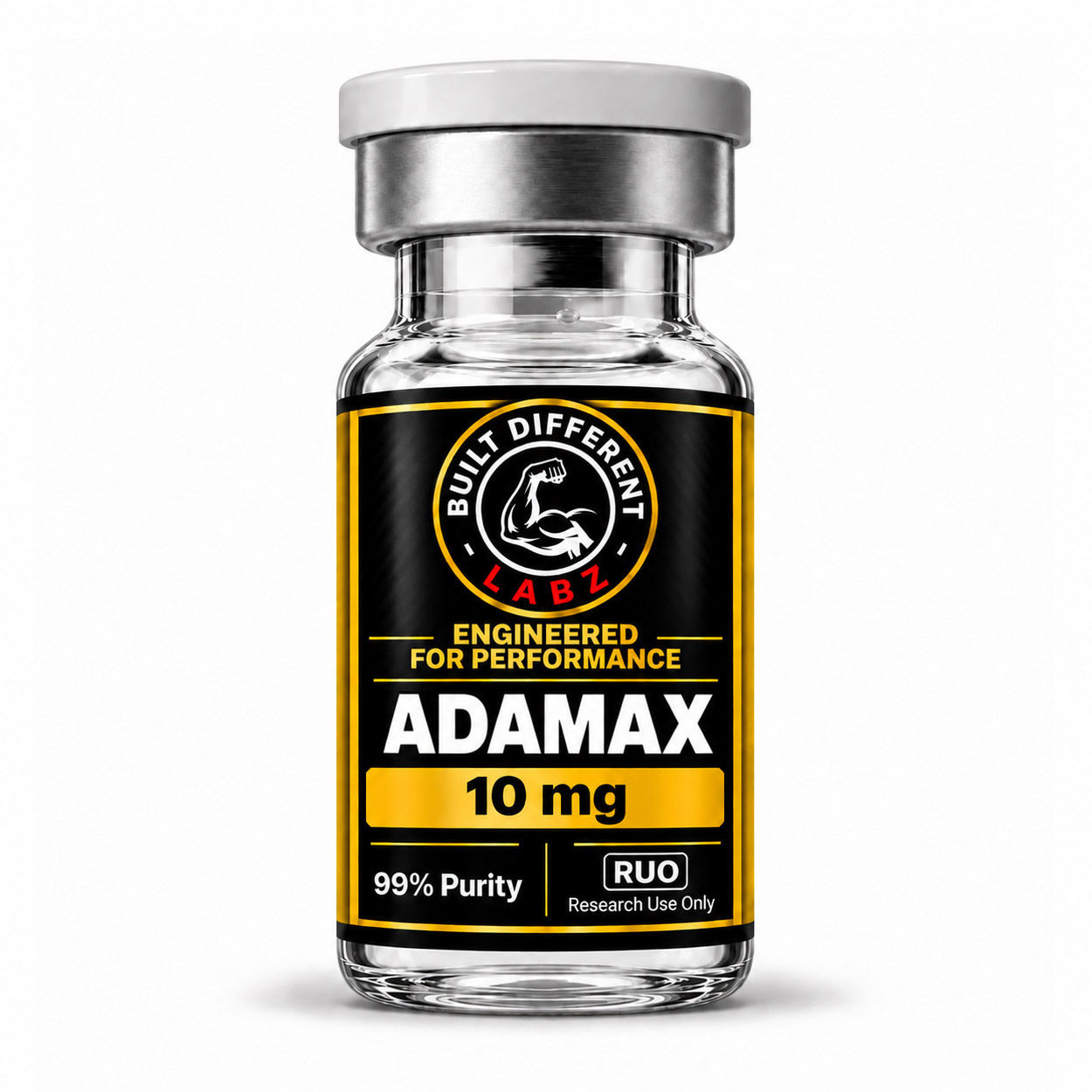
A vial labeled "Adamax 10mg" represents a supplier's stated total of 10 milligrams of the material in the vial. It does not mean that 10mg is an established or appropriate single human dose.
Adamax is generally described by research suppliers as an experimental Semax-derived nootropic compound.
Semax itself is a seven-amino-acid peptide derived from the ACTH 4-10 region:
Met-Glu-His-Phe-Pro-Gly-Pro
Adamax is commonly claimed to modify this basic scaffold to improve characteristics such as:
Stability
Resistance to enzymatic degradation
Lipophilicity
Central nervous system exposure
The major problem is that these Adamax-specific properties have not been demonstrated in published scientific studies.
As of 2026, searches of scientific and chemical databases do not reveal an established body of peer-reviewed Adamax research. (Peptide Bible)
No.
Adamax should not simply be described as another name for Semax.
Semax is an identifiable peptide with a substantial history of experimental and regional clinical research.
Adamax is a much newer research-market compound generally described as being derived from or inspired by Semax.
The distinction is:
Semax = scientifically characterized peptide with published research.
Adamax = experimental derivative or related compound with little to no independently published characterization.
This is one of the most common descriptions.
Some suppliers describe Adamax as an adamantane-modified Semax analogue intended to improve stability and potentially increase brain penetration.
However, this description originates primarily from research-product vendors and community sources rather than an established peer-reviewed scientific record. Different sources even provide conflicting structural descriptions. (Disclosed Labs)
Therefore, the most accurate wording is:
"Adamax is marketed as an adamantane-modified Semax-related compound."
It is less appropriate to state the proposed structure as settled scientific fact.
Adamantane is a highly stable, cage-like hydrocarbon structure.
Adamantane-related chemistry has been used in several pharmaceutical compounds because it can substantially change characteristics such as:
Lipophilicity
Membrane interaction
Metabolic stability
Pharmacokinetics
Examples of medications containing an adamantane-related structure include amantadine and memantine.
However, those medications should not be used as evidence that Adamax has equivalent properties.
The theoretical reasoning would be to modify the peptide's physical and pharmacological properties.
Potential goals could include:
Greater resistance to degradation
Increased lipophilicity
Improved membrane interaction
Increased stability
Potentially improved central nervous system exposure
These are plausible medicinal-chemistry objectives.
The important distinction is that they remain largely theoretical for Adamax because Adamax-specific pharmacokinetic studies have not established them.
There is no experimentally established mechanism of action for Adamax.
Most proposed mechanisms are extrapolated from Semax.
Semax research involves pathways associated with:
BDNF
NGF
Dopamine
Serotonin
Neuroplasticity
Neuroprotection
Gene expression
Because Adamax is marketed as a Semax-related compound, similar effects are frequently attributed to Adamax.
That extrapolation should not be confused with direct evidence.
The theoretical pathway commonly proposed is:
Adamax
Semax-related neurological activity
Neurotrophic signaling
BDNF and related pathways
Neuroplasticity
Potential cognitive effects
But this pathway has not been validated specifically for Adamax.
BDNF stands for:
Brain-Derived Neurotrophic Factor
BDNF is extremely important for nervous-system function.
It participates in:
Neuronal survival
Synaptic plasticity
Memory
Learning
Formation of neural connections
Adaptation to neurological stress
Semax has meaningful experimental evidence involving BDNF-related signaling.
Adamax is frequently claimed to influence BDNF because of its proposed relationship to Semax.
However:
Semax affects BDNF
does not automatically mean:
Adamax affects BDNF.
There is currently insufficient direct Adamax research to establish this.
Neuroplasticity refers to the nervous system's ability to reorganize and modify neural connections.
It is important for:
Learning
Memory
Skill acquisition
Adaptation
Recovery from neurological injury
Because Adamax is marketed as a Semax-related nootropic, neuroplasticity is one of its most frequently claimed areas of interest.
This remains theoretical rather than clinically demonstrated.
Adamax is commonly marketed for memory enhancement.
Potential claimed effects include:
Memory formation
Memory consolidation
Recall
Learning
However, there are currently no established human trials demonstrating that Adamax improves memory.
There also does not appear to be a meaningful published animal literature specifically testing Adamax for memory. (PepGuru)
Semax has experimental research involving learning and memory.
Adamax is often assumed to produce stronger or longer-lasting versions of these effects.
That claim has not been demonstrated.
It is therefore more appropriate to describe Adamax as being researched or marketed for cognitive applications rather than stating that it improves learning.
Focus and attention are among the most common reasons Adamax appears in nootropic discussions.
Reported or marketed areas include:
Mental clarity
Concentration
Attention
Motivation
Cognitive endurance
These claims are largely anecdotal.
There are no established controlled human studies demonstrating improved attention from Adamax.
Adamax is not established as a conventional stimulant.
It should not automatically be compared with:
Amphetamine
Methylphenidate
Caffeine
Traditional stimulants have well-characterized pharmacological mechanisms.
Adamax does not.
If Adamax produces subjective stimulation, the molecular basis has not been adequately established.
Semax has research involving dopaminergic signaling.
Because Adamax is marketed as a Semax derivative, it is sometimes claimed to influence dopamine.
Potential theoretical effects could involve:
Motivation
Attention
Reward signaling
Cognitive performance
However, there is no established Adamax-specific evidence showing how strongly it affects dopamine in humans.
Similar claims exist regarding serotonin.
Semax research has demonstrated interactions with several neurotransmitter systems.
There is insufficient evidence to determine whether Adamax produces equivalent effects.
Adamax should not be described as a serotonin medication or antidepressant.
NGF stands for:
Nerve Growth Factor
NGF participates in:
Neuronal survival
Nerve development
Cellular signaling
Neural maintenance
Because Semax has been investigated for neurotrophic effects, NGF is sometimes included in Adamax marketing.
Again, direct Adamax evidence is lacking.
Neuroprotection is another major claimed application.
Potential theoretical mechanisms include:
Neurotrophic signaling
Reduced oxidative stress
Improved neuronal survival
Improved cellular stress resistance
Neurotransmitter regulation
These mechanisms are largely extrapolated from Semax and general neurobiology.
Adamax has not been clinically demonstrated to protect the human brain from neurological injury.
Oxidative stress occurs when reactive molecules overwhelm cellular antioxidant systems.
Excessive oxidative stress can damage:
Cell membranes
Proteins
DNA
Mitochondria
Semax has experimental neuroprotective research involving oxidative stress.
Adamax is sometimes claimed to produce similar or stronger effects.
There is insufficient compound-specific evidence to establish this.
Semax has a history of research involving ischemic stroke.
Adamax does not have equivalent clinical evidence.
It would therefore be inappropriate to transfer Semax's stroke literature directly to Adamax.
Adamax is not an established treatment for stroke.
The same limitation applies to traumatic brain injury.
Neuroprotection and neuroplasticity are theoretically relevant to brain injury.
However, there is no established evidence that Adamax improves concussion or traumatic brain injury outcomes.
Adamax is sometimes promoted in longevity and cognitive-aging communities.
Potential theoretical areas include:
Memory preservation
Neuronal resilience
Neuroplasticity
Neurotrophic signaling
There is no established evidence that Adamax prevents age-related cognitive decline.
There is no established evidence that Adamax:
Prevents Alzheimer's disease
Slows Alzheimer's disease
Reverses dementia
Removes amyloid plaques
Its proposed nootropic properties should not be converted into Alzheimer's treatment claims.
Because dopamine is central to Parkinson's disease, compounds associated with dopaminergic signaling sometimes become discussed in this context.
There is no evidence establishing Adamax as a Parkinson's treatment.
Adamax is sometimes discussed as a potential attention-enhancing nootropic.
However, there is no established clinical evidence demonstrating that Adamax treats ADHD.
It should not be considered equivalent to approved ADHD medications.
Theoretical effects involving:
BDNF
Dopamine
Serotonin
Neuroplasticity
could make Adamax interesting for mood research.
But Adamax has not been established as an antidepressant.
Adamax is not primarily marketed as an anxiolytic peptide.
Selank has a substantially stronger research association with anxiety and stress regulation.
Adamax's profile is generally marketed toward cognition and neurological performance.
This is the most important comparison.
Semax:
Known peptide sequence
Published experimental research
Animal studies
Human research
Regional pharmaceutical history
BDNF and neurotrophic research
Stroke and neurological research
Adamax:
Marketed as a modified Semax-related compound
Exact public structural characterization is inconsistent
Essentially no peer-reviewed compound-specific research
No established human clinical trials
No established pharmacokinetics
No validated human dosing
Therefore, Adamax should be considered significantly more experimental than Semax.
There is no scientific basis for confidently saying that Adamax is stronger than Semax.
Claims such as:
"Adamax is 5 times stronger than Semax"
or:
"Adamax crosses the blood-brain barrier much better"
require direct comparative pharmacological evidence.
That evidence has not been established.
This is frequently claimed.
The proposed adamantane-related modification is often said to increase lipophilicity and therefore improve central nervous system penetration.
Chemically, that is a plausible design concept.
But there are no established Adamax pharmacokinetic studies demonstrating how much intact Adamax reaches the human brain.
Therefore:
"Designed or claimed to improve brain penetration"
is much more accurate than:
"Adamax easily crosses the blood-brain barrier."
Adamax:
Experimental cognitive compound
Semax-related claims
Focus and neuroplasticity interest
BDNF-related claims
Selank:
Anxiety and stress research
GABA-related signaling
Cognitive research
Considerably more published scientific history
Selank is much better characterized scientifically.
Pinealon is a short peptide bioregulator associated with:
Cognitive aging
Neuroprotection
Gene regulation
Adamax is marketed more specifically around:
Nootropic effects
Semax-like activity
Neurotrophic signaling
Focus and cognition
Neither should be considered an established cognitive-enhancement medication.
DSIP is primarily associated with:
Sleep
Stress
Neuroendocrine regulation
Adamax is primarily marketed toward:
Cognition
Focus
Mental performance
Neuroprotection
Their proposed purposes are very different.
SS-31 has a defined mitochondrial mechanism involving:
Cardiolipin
Mitochondrial membranes
Electron transport
ATP production
Adamax is marketed around neurological and neurotrophic pathways.
SS-31 also has substantially more formal scientific and clinical research.
Adamax is not primarily a physical-performance compound.
Potential athletic interest would theoretically involve:
Focus
Concentration
Motivation
Reaction time
Mental endurance
There is no controlled evidence demonstrating improved athletic performance.
No evidence establishes Adamax as a muscle-building compound.
It is not known to directly activate:
Androgen receptors
Growth hormone receptors
IGF-1 receptors
There is no established evidence that Adamax directly increases fat loss.
It should not be grouped with compounds specifically affecting:
GLP-1
Amylin
Lipolysis
Growth hormone
Adamax is not a reproductive hormone peptide.
There is no established evidence that it meaningfully increases testosterone.
There is no evidence demonstrating steroid-like suppression of endogenous testosterone.
However, the absence of research also means that its complete endocrine profile is unknown.
There is no scientific basis for associating Adamax with traditional steroid-style post-cycle therapy.
It is not known to function through androgen receptors or testosterone replacement.
There is no established evidence that Adamax is a growth hormone secretagogue.
It should not be grouped with:
Sermorelin
Tesamorelin
Ipamorelin
CJC-1295
A vial labeled:
"Adamax 10mg"
means that the supplier represents the vial as containing a total of 10 milligrams of Adamax.
The 10mg represents total vial content.
It should not be interpreted as an established single administration amount.
There is no validated Adamax human dosing protocol.
There is essentially no meaningful published human dosing literature for Adamax. (PepGuru)
Therefore, an RUO vial should not be converted directly into a personal administration protocol.
This is especially important for Adamax because even its pharmacokinetics and compound identity are not adequately established in independent literature.
Adamax is frequently associated with intranasal nootropic use because Semax is strongly associated with intranasal formulations.
However, there is no established Adamax-specific clinical literature defining:
Intranasal bioavailability
Absorption
Optimal formulation
Dose-response relationship
Human pharmacokinetics
It should not simply inherit Semax's intranasal data.
Adamax is also sold as lyophilized research material.
There is no FDA-approved injectable Adamax product.
A lyophilized RUO vial does not establish safety for human injection.
The human half-life is unknown.
Claims that Adamax has a dramatically longer half-life than Semax are theoretical unless supported by compound-specific pharmacokinetic testing.
Current reference sources continue to list its half-life as not established. (PepGuru)
There is no scientifically established onset.
Anecdotal reports cannot reliably determine pharmacokinetics.
Without controlled research, there is no validated timeline for:
Cognitive effects
Peak activity
Duration
Neurotrophic changes
A reliable human side-effect profile does not exist.
Potential effects sometimes associated with neuroactive research compounds could theoretically include:
Headache
Dizziness
Nausea
Restlessness
Fatigue
Changes in sleep
Changes in mood
Nasal irritation with intranasal formulations
Injection-site reactions with injectable research materials
These should not be presented as a complete established side-effect list.
Unknown adverse effects are a significant part of Adamax's risk profile.
Long-term safety is unknown.
There are no adequate human studies establishing the consequences of repeated Adamax exposure.
Unknown areas include:
Neurotransmitter adaptation
Cardiovascular effects
Endocrine effects
Neurological effects
Immune responses
Organ toxicity
Reproductive effects
Carcinogenicity
Drug interactions
There is insufficient evidence to determine whether Adamax meaningfully affects cancer risk.
Claims that Adamax either causes or prevents cancer would be unsupported.
This issue is more significant for Adamax than for established peptides.
Different research suppliers provide inconsistent descriptions of Adamax's:
Sequence
Molecular weight
Chemical modification
Molecular formula
Independent references have specifically highlighted these discrepancies. (BioBoost Research)
Therefore, the word "Adamax" on a vial does not provide the same level of scientifically established identity as names such as Semax or Thymosin Alpha-1.
A research supplier may provide testing such as:
HPLC
LC-MS
Mass spectrometry
Net peptide content
Sterility testing
Endotoxin testing
These can provide useful information about a specific tested batch.
However, even a certificate reporting high purity does not create clinical evidence for the compound.
Analytical testing can potentially answer:
"Is this batch chemically consistent with the supplier's reference material?"
It cannot answer:
"Is Adamax safe and effective in humans?"
Those are completely different questions.
HPLC may help assess chemical purity.
Mass spectrometry may help characterize molecular identity.
However, 99 percent analytical purity does not automatically establish:
Human safety
Clinical effectiveness
Correct biological activity
Sterility
Endotoxin level
Exact vial quantity
Pharmaceutical-grade manufacturing
These require separate evidence.
Research Use Only, or RUO, indicates that the material is intended for laboratory or analytical research rather than approved human treatment.
With Adamax, this distinction is particularly important because there is no established pharmaceutical Adamax product with a validated human indication.
No.
Adamax is not an FDA-approved medication for:
Cognitive enhancement
Memory
ADHD
Depression
Anxiety
Stroke recovery
Traumatic brain injury
Alzheimer's disease
Parkinson's disease
Neuroprotection
Anti-aging
Athletic performance
There is no FDA-approved Adamax dosing regimen.
Semax relationship:
Claimed, but Adamax's exact structure is inconsistently documented.
Adamax-specific mechanism:
Not established.
BDNF enhancement:
Theoretical extrapolation from Semax.
NGF enhancement:
Theoretical.
Dopamine modulation:
Theoretical.
Neuroprotection:
Not established for Adamax.
Memory enhancement:
Not established.
Focus enhancement:
Not established.
ADHD:
Not established.
Stroke recovery:
Not established.
Traumatic brain injury:
Not established.
Anti-aging:
Not established.
Athletic performance:
Not established.
Human clinical evidence:
Essentially absent.
Animal evidence:
Essentially absent under the Adamax name.
Human pharmacokinetics:
Unknown.
Human half-life:
Unknown.
Long-term safety:
Unknown.
The theoretical advantage of Adamax is the concept behind its design.
If a Semax-related compound could be modified to improve:
Stability
Resistance to enzymatic degradation
Central nervous system exposure
while retaining beneficial neurotrophic properties, it could potentially produce a more durable neuroactive compound.
That is an interesting medicinal-chemistry hypothesis.
But it remains a hypothesis until directly tested.
The biggest limitation is straightforward:
There is almost no compound-specific scientific evidence.
Adamax should not be presented as though it has the same evidence base as Semax.
There is a major difference between:
"A modified Semax compound could theoretically have improved properties."
and:
"Adamax has been proven to have improved stability, brain penetration, BDNF activity, memory effects and neuroprotection."
The second statement has not been demonstrated.
Adamax is an extremely experimental research-market compound generally described as a modified Semax-related nootropic.
Its commonly proposed research areas include:
Cognition
Focus
Memory
Neuroprotection
BDNF
Neuroplasticity
Dopamine signaling
Mental performance
However, unlike Semax, Adamax currently lacks meaningful compound-specific animal studies, controlled human trials, validated pharmacokinetics, established dosing, and a well-defined safety profile. Even its precise chemical structure is inconsistently described across available sources. (BioBoost Research)
"Adamax 10mg" describes the supplier's represented total amount of material contained in the vial. It should not be interpreted as a recommended 10mg dose.
The most accurate description is:
Adamax is a highly experimental compound marketed as a modified Semax-related nootropic, with theoretical interest in cognitive and neurotrophic research. Claims involving improved BDNF, memory, focus, neuroprotection, stability, or brain penetration are currently based primarily on extrapolation from Semax and the proposed chemical design rather than direct Adamax research. Its human pharmacology, effectiveness, optimal exposure, and long-term safety remain unknown.
We do not accept returns or issue refunds for any reason, beside manufacturing defects.
Feel free to contact us if you have any questions or concerns about our Return Policy.