We offer FREE SHIPPPING on all orders!
We offer FREE SHIPPPING on all orders!
| THIS PRODUCT IS INTENDED AS A RESEARCH CHEMICAL ONLY. This designation allows the use of research chemicals strictly for invitro testing and laboratory experimentation only. All product information available on this website is for educational purposes only. Bodily introduction of any kind into humans or animals is strictly prohibited by law. This product should only be handled by licensed, qualified professionals. This product is not a drug, food, or cosmetic and may not be misbranded, misused or mislabeled as a drug, food, or cosmetic. |
Cortagen is an experimental synthetic tetrapeptide most commonly associated with research involving the brain, cerebral cortex, nervous system, nerve regeneration, cellular stress, and gene-expression regulation.
Its amino-acid sequence is:
Ala-Glu-Asp-Pro
or:
AEDP
Cortagen belongs to the family of short peptide bioregulators associated with the research of Vladimir Khavinson and collaborators. Unlike many larger neuropeptides, Cortagen contains only four amino acids.
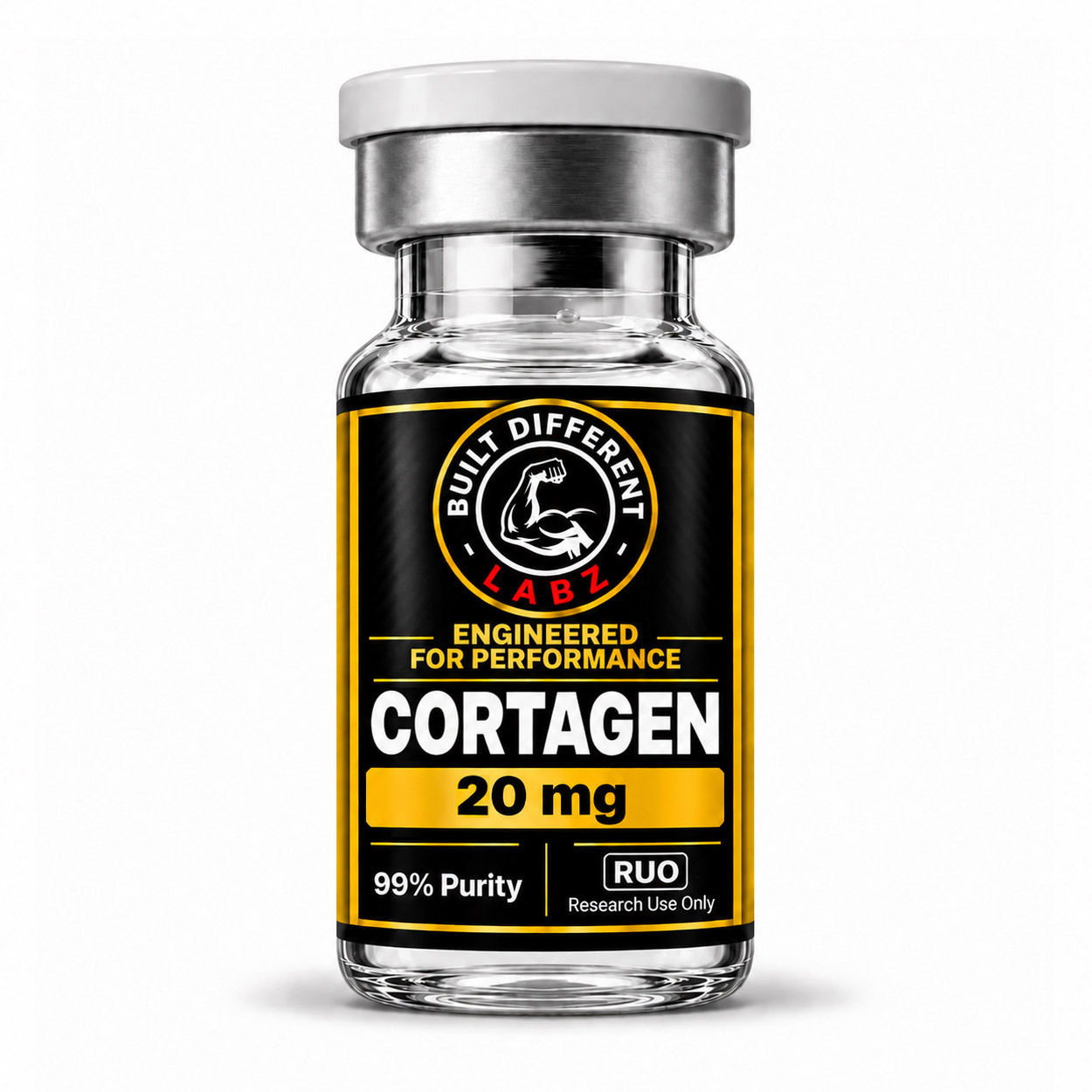
A vial labeled "Cortagen 20mg" represents a total of 20 milligrams of Cortagen in the vial. It does not mean that 20mg is an established or appropriate single human dose.
Cortagen is a synthetic four-amino-acid peptide originally developed from research involving peptide components of cerebral cortex tissue.
Its sequence consists of:
Alanine
Glutamic acid
Aspartic acid
Proline
This produces the abbreviation:
AEDP
Its primary research association is the nervous system, particularly the cerebral cortex and peripheral nerve tissue.
These are frequently confused.
Cortagen is:
A single defined synthetic tetrapeptide, AEDP.
Cortexin is:
A complex mixture of polypeptides originally derived from animal cerebral cortex tissue.
Cortagen was developed through research examining peptide components associated with Cortexin, but the two substances are not equivalent.
Research involving Cortexin cannot automatically be attributed to Cortagen.
Short peptide bioregulators are very small amino-acid sequences proposed to influence cellular regulation.
Research in this field has investigated potential effects involving:
Gene expression
Protein synthesis
Cellular differentiation
Tissue maintenance
Oxidative stress
Cellular aging
Tissue-specific signaling
Cortagen is generally categorized as a nervous-system or cerebral-cortex peptide bioregulator.
There is currently no single validated human receptor mechanism explaining Cortagen's effects.
The proposed mechanism differs from peptides that activate a clearly identified receptor.
For example:
Ipamorelin activates GHS-R1a.
CJC-1295 activates the GHRH receptor.
PT-141 activates melanocortin receptors.
Cortagen is instead studied primarily through the short-peptide bioregulation model.
Proposed mechanisms include:
Changes in gene transcription
DNA and chromatin interactions
Regulation of protein synthesis
Cellular stress responses
Antioxidant-related pathways
Neuronal repair signaling
Neuroprotective activity
These mechanisms remain experimental.
Gene-expression regulation is one of the most interesting areas of Cortagen research.
Experimental studies have reported changes in expression of multiple genes following exposure to Cortagen.
The general hypothesis is:
Cortagen
Cellular interaction
Changes in chromatin or transcriptional regulation
Changes in gene expression
Changes in protein production
Potential changes in cellular function
However, demonstrating changes in gene expression does not automatically demonstrate a therapeutic benefit.
Not in the sense of gene editing.
Gene expression and DNA sequence are different concepts.
Gene editing changes the underlying genetic code.
Gene-expression regulation changes how strongly particular genes are being used by a cell.
Therefore, Cortagen should not be described as:
Gene therapy
CRISPR
Genetic engineering
Permanent DNA modification
Its proposed effects are regulatory rather than genetic rewriting.
Chromatin is the combination of DNA and proteins that organizes genetic material inside the nucleus.
Chromatin structure influences whether particular genes are relatively accessible or inaccessible to the cellular machinery responsible for transcription.
Short peptide research has investigated whether peptides such as AEDP can influence chromatin organization and gene activity.
This is an interesting experimental mechanism, but its significance in living humans remains uncertain.
The cerebral cortex is Cortagen's primary tissue association.
The cortex participates in:
Memory
Attention
Language
Sensory processing
Decision-making
Voluntary movement
Learning
Executive function
Because Cortagen originated from cerebral-cortex peptide research, it is frequently marketed as a "brain bioregulator."
That description should not be interpreted as proof that it improves cognition in healthy humans.
Neuroprotection refers to protecting neurons from injury or degeneration.
Experimental Cortagen research has examined situations involving:
Nerve injury
Ischemia
Oxidative stress
Cellular damage
Age-related nervous-system changes
Preclinical findings have generated interest in possible neuroprotective properties.
However, Cortagen has not been established as a neuroprotective medication in humans.
One of the more notable areas of direct Cortagen research involves peripheral nerve injury.
Animal experiments have investigated recovery following sciatic nerve damage.
Some findings suggested enhanced regenerative processes.
This makes peripheral nerve regeneration one of the more interesting research areas for AEDP.
However:
Improved nerve regeneration in an animal model
does not equal
proven regeneration of damaged human nerves.
The sciatic nerve is one of the largest peripheral nerves.
It runs from the lower back through the buttocks and into the legs.
Animal sciatic-nerve injury models are commonly used to investigate:
Nerve regeneration
Axonal growth
Functional recovery
Neuropathic injury
Cortagen's appearance in this type of research contributes to its reputation as a nerve-repair peptide.
That has not been established in humans.
A more accurate statement is:
Cortagen has demonstrated potentially interesting effects in experimental models of peripheral nerve regeneration.
That is considerably different from claiming that it can repair severe human nerve injuries.
Neurons are specialized cells responsible for transmitting electrical and chemical signals throughout the nervous system.
Healthy neuronal function depends on:
Mitochondrial energy production
Neurotransmitter signaling
Protein synthesis
Axonal transport
Antioxidant defenses
Membrane integrity
Gene regulation
Cortagen research is particularly interested in regulatory processes that could influence neuronal survival and function.
Ischemia occurs when tissue receives insufficient blood flow and oxygen.
Brain ischemia can produce:
Energy failure
Oxidative stress
Excitotoxicity
Inflammation
Neuronal injury
Preclinical research has investigated Cortagen and related peptide preparations in models of cerebral ischemia.
These findings do not establish Cortagen as a treatment for stroke.
Cortagen should not be considered an emergency stroke medication.
A suspected stroke requires immediate medical evaluation.
There is insufficient evidence demonstrating that Cortagen improves clinical stroke outcomes in humans.
Oxidative stress occurs when reactive oxygen species exceed the capacity of cellular antioxidant defenses.
The nervous system can be particularly vulnerable because of its:
High oxygen consumption
High metabolic activity
Lipid-rich membranes
Complex mitochondrial requirements
Experimental Cortagen research has explored relationships with antioxidant-related cellular pathways.
Neurons require substantial amounts of ATP.
Mitochondria therefore play a critical role in:
Neuronal energy production
Calcium regulation
Oxidative stress
Cellular survival
Cortagen is not primarily classified as a mitochondria-targeting peptide.
Any mitochondrial benefits would likely be secondary to broader cellular-regulatory effects.
SS-31 directly targets mitochondrial biology, particularly interactions involving cardiolipin and the inner mitochondrial membrane.
Cortagen is primarily associated with:
Gene regulation
Cerebral cortex
Nervous-system tissue
Nerve regeneration
Therefore:
SS-31 = mitochondria-focused peptide.
Cortagen = nervous-system peptide bioregulator.
Neuroinflammation plays an important role in numerous neurological disorders.
Potential inflammatory mechanisms include:
Cytokines
Activated microglia
Oxidative stress
Immune signaling
Cellular injury
Experimental work involving peptide bioregulators has investigated inflammatory and immune-related pathways.
However, Cortagen should not be considered a conventional anti-inflammatory drug.
Cortagen is frequently marketed for cognitive support.
Potential areas of interest include:
Memory
Learning
Attention
Mental clarity
Age-related cognitive function
However, there are no robust modern human clinical trials demonstrating that Cortagen meaningfully improves cognition in healthy people.
This is one of the largest gaps between Cortagen marketing and Cortagen evidence.
Memory formation involves:
Synaptic plasticity
Neurotransmitters
Gene expression
Protein synthesis
Hippocampal activity
Cortical networks
Because Cortagen is associated with neuronal gene regulation, memory is a plausible research area.
But direct evidence for significant human memory enhancement remains insufficient.
The same limitation applies to learning.
Experimental neuroprotection and cellular-regulation findings do not establish Cortagen as a clinically proven learning enhancer.
Cortagen is frequently grouped with nootropics because of its brain and nervous-system research.
However, scientifically it is more accurately described as:
An experimental short peptide bioregulator.
Calling it a proven nootropic would imply a level of demonstrated human cognitive enhancement that the evidence does not support.
No.
Cortagen is not a conventional central nervous system stimulant.
It should not be expected to work like:
Caffeine
Amphetamine
Methylphenidate
Its proposed effects involve cellular regulation rather than acute stimulant neurotransmission.
There is insufficient evidence that Cortagen acts primarily by directly increasing dopamine.
It should not be described as a dopaminergic stimulant.
Any effects on neurotransmitter systems would likely be secondary to broader nervous-system regulation.
Likewise, Cortagen is not an SSRI or conventional serotonergic medication.
There is insufficient evidence demonstrating that serotonin elevation is its principal mechanism.
BDNF, or brain-derived neurotrophic factor, is involved in:
Neuronal survival
Synaptic plasticity
Learning
Memory
Neurogenesis-related processes
Neurotrophic signaling is relevant to Cortagen's research area.
However, claims that Cortagen reliably produces major increases in human BDNF are not established.
NGF stands for nerve growth factor.
NGF contributes to:
Neuronal survival
Axonal growth
Peripheral nerve biology
Because Cortagen has been investigated in nerve-regeneration models, neurotrophic pathways are of considerable interest.
However, Cortagen should not simply be described as an NGF replacement.
Neuroplasticity is the nervous system's ability to adapt structurally and functionally.
It includes changes involving:
Synapses
Neural networks
Gene expression
Protein synthesis
Learning
Cortagen's proposed gene-regulatory activity creates theoretical interest in neuroplasticity.
Direct evidence demonstrating substantial enhancement of human neuroplasticity remains limited.
Age-related nervous-system changes can include:
Altered gene expression
Mitochondrial dysfunction
Oxidative stress
Neuroinflammation
Reduced repair capacity
Changes in synaptic function
The peptide bioregulator field was developed partly around the hypothesis that short peptides could help normalize age-related changes in cellular regulation.
Cortagen is the cerebral-cortex-associated member of this research concept.
Cortagen is sometimes included in longevity or anti-aging peptide discussions.
However, it has not been demonstrated to:
Reverse human aging
Extend human lifespan
Prevent dementia
Prevent neurodegenerative disease
Its anti-aging reputation comes primarily from the broader peptide-bioregulator research framework.
Cortagen is not classified as a senolytic.
It is not designed specifically to eliminate senescent cells.
This distinguishes it from experimental compounds such as FOXO4-DRI.
Cortagen's proposed role is cellular regulation rather than selective senescent-cell destruction.
This is one of the most relevant comparisons.
Cortagen:
Sequence AEDP
Four amino acids
Associated with cerebral cortex and nerve tissue
Gene-expression and nerve-regeneration research
Pinealon:
Sequence EDR
Three amino acids
Associated with brain function and neuroprotection
Cognitive and aging research
Both belong to the short peptide bioregulator field, but they are distinct molecules.
Semax is a synthetic neuropeptide derived from an ACTH-related sequence.
Semax research involves:
BDNF
Neuroprotection
Cognition
Dopamine-related signaling
Stroke research
Cortagen is a much smaller peptide primarily associated with gene regulation and nervous-system tissue bioregulation.
Semax has a different structure and proposed mechanism.
Selank is primarily associated with:
Anxiety
Stress
GABA-related signaling
Mood
Cognition
Cortagen is more strongly associated with:
Cerebral cortex
Nerve regeneration
Cellular regulation
Gene expression
Selank therefore has a more neuropsychological research profile, while Cortagen has a more tissue-regulation profile.
Cerebrolysin is a complex mixture of low-molecular-weight peptides and amino acids.
Cortagen is one defined four-amino-acid peptide.
Evidence from Cerebrolysin cannot be transferred directly to Cortagen.
Again, these should not be confused.
Cortexin:
Complex cerebral-cortex-derived polypeptide preparation.
Cortagen:
Synthetic AEDP tetrapeptide.
Cortagen's precise chemical identity is one of its advantages as a research molecule because researchers know the exact amino-acid sequence being studied.
Epitalon is another short peptide associated with the Khavinson research tradition.
Epitalon is primarily associated with:
Pineal biology
Aging
Circadian regulation
Telomerase-related research
Cortagen is primarily associated with:
Brain cortex
Peripheral nerves
Neuronal regulation
Nerve regeneration
Peripheral nerve injuries can involve:
Axonal damage
Myelin damage
Inflammation
Loss of motor function
Loss of sensation
Because animal research has examined Cortagen following peripheral nerve damage, nerve injury is one of its most scientifically interesting applications.
However, severe human nerve damage can require:
Surgical repair
Physical rehabilitation
Neurological evaluation
Cortagen has not been established as a replacement for these treatments.
Neuropathy can have many causes, including:
Diabetes
Trauma
Autoimmune disease
Chemotherapy
Vitamin deficiencies
Compression injuries
Cortagen's nerve-regeneration research creates theoretical interest.
However, there is insufficient clinical evidence establishing it as a treatment for human neuropathy.
There is no established evidence that Cortagen treats diabetic neuropathy.
Diabetic nerve injury involves complex metabolic and vascular mechanisms that cannot automatically be corrected by a peptide demonstrating nerve effects in an animal injury model.
Cortagen's neuroprotective research makes traumatic brain injury an area of theoretical interest.
However, there is insufficient evidence demonstrating that Cortagen improves outcomes after human traumatic brain injury.
Cortagen has not been established as a treatment for Alzheimer's disease.
Alzheimer's involves complex mechanisms including:
Amyloid pathology
Tau pathology
Neuroinflammation
Synaptic dysfunction
Neuronal loss
General neuroprotective or gene-regulatory effects do not establish disease-modifying activity.
There is likewise insufficient evidence to establish Cortagen as a Parkinson's treatment.
Parkinson's disease involves progressive dysfunction and loss of dopaminergic neurons along with numerous additional pathological processes.
Cortagen is not an established treatment for multiple sclerosis.
Multiple sclerosis involves immune-mediated damage to myelin and nervous-system tissue.
Experimental neuroprotection does not establish control of the underlying autoimmune disease.
There is insufficient evidence that Cortagen treats major depressive disorder.
It is not an established antidepressant.
Unlike Selank, anxiety is not one of Cortagen's primary research areas.
There is insufficient evidence supporting Cortagen as an anxiolytic medication.
Cortagen is not primarily a sleep peptide.
It does not have the same research association with sleep as DSIP.
Any changes in sleep would be secondary rather than its primary proposed mechanism.
Cortagen is not a muscle-building peptide.
It does not primarily stimulate:
Growth hormone
IGF-1
Testosterone
Androgen receptors
Muscle protein synthesis
Cortagen is not a fat-loss peptide.
It is not known to significantly increase:
Lipolysis
Metabolic rate
Appetite suppression
No established evidence indicates that Cortagen is a growth hormone secretagogue.
It should not be grouped with:
CJC-1295
Sermorelin
Tesamorelin
Ipamorelin
There is no established evidence that Cortagen meaningfully increases testosterone.
It does not primarily target the reproductive hormone axis.
Cortagen is not known to suppress natural testosterone production in the manner of anabolic steroids.
No traditional steroid-style post-cycle therapy is associated with Cortagen.
It is not an androgenic compound.
There is insufficient evidence demonstrating that Cortagen improves:
Strength
Speed
Endurance
Muscle growth
VO2 max
Any athletic interest would be indirect and primarily related to experimental nervous-system or nerve-recovery research.
A vial labeled:
"Cortagen 20mg"
means the supplier represents the vial as containing a total of 20 milligrams of Cortagen.
The 20mg represents total vial content.
It should not be interpreted as an established single administration amount.
There is no FDA-approved Cortagen dosing regimen.
Cortagen is available from research suppliers as lyophilized material.
An injectable-style research vial does not establish that the product is an approved injectable medication.
Important quality considerations include:
Correct AEDP sequence
Peptide identity
Chemical purity
Vial quantity
Sterility
Endotoxins
Stability
Manufacturing conditions
Reliable human pharmacokinetic information is lacking.
There is no well-established human:
Half-life
Peak concentration
Bioavailability
Clearance profile
Effective duration
Claims giving extremely precise Cortagen pharmacokinetic numbers should therefore be treated cautiously.
Cortagen does not have a sufficiently developed human clinical database to establish a reliable adverse-effect profile.
Potential concerns with experimental peptide products could include:
Headache
Dizziness
Fatigue
Nausea
Injection-site irritation
Redness
Hypersensitivity reactions
These should not be interpreted as a complete or well-characterized side-effect profile.
Unknown adverse effects remain possible.
Long-term human safety has not been established.
Important unanswered questions include:
Chronic neurological effects
Immune reactions
Drug interactions
Reproductive effects
Organ effects
Long-term gene-expression changes
Effects in neurological disease
This uncertainty is particularly important because direct human clinical evidence for Cortagen is extremely limited.
There is insufficient evidence to conclude that Cortagen either causes or prevents cancer.
Changes in gene expression do not automatically mean carcinogenic activity.
Likewise, gene-regulatory effects should not be interpreted as evidence of cancer prevention.
Research peptide quality can vary considerably.
Potential problems include:
Incorrect peptide sequence
Incorrect identity
Incorrect vial quantity
Chemical impurities
Degradation products
Endotoxins
Microbial contamination
Poor sterility
For a four-amino-acid peptide, confirming the actual molecular identity is especially important.
HPLC can help assess chemical purity.
Mass spectrometry can help confirm molecular identity.
However, a claim of 99 percent purity does not automatically establish:
Sterility
Endotoxin levels
Exact vial quantity
Pharmaceutical manufacturing
Human safety
Clinical effectiveness
These are separate characteristics.
Research Use Only, or RUO, means a product is marketed for laboratory or analytical research rather than as an approved medication for human treatment.
An RUO Cortagen vial should not be treated as an approved neurological medication.
No.
Cortagen is not FDA approved for:
Cognitive enhancement
Memory improvement
Nerve regeneration
Neuropathy
Stroke
Alzheimer's disease
Parkinson's disease
Traumatic brain injury
Depression
Anxiety
Anti-aging
Longevity
There is no FDA-approved human dosing protocol for Cortagen.
Chemical identity as AEDP:
Well defined.
Short-peptide biological activity:
Scientifically plausible.
Gene-expression effects:
Demonstrated in experimental models.
Peripheral nerve regeneration:
Promising animal research.
Neuroprotective activity:
Interesting preclinical evidence.
Human cognitive enhancement:
Not established.
Human memory improvement:
Not established.
Human neuropathy treatment:
Not established.
Human nerve regeneration:
Not established.
Stroke treatment:
Not established.
Neurodegenerative disease treatment:
Not established.
Anti-aging:
Not established.
Lifespan extension:
Not established.
Human pharmacokinetics:
Poorly characterized.
Long-term human safety:
Insufficiently characterized.
The direct Cortagen evidence base remains largely preclinical, and modern independent human trials are lacking. (Open Assay)
Cortagen is interesting because it represents an extremely small and chemically defined approach to nervous-system regulation.
The molecule contains only four amino acids:
Ala-Glu-Asp-Pro
Yet experimental research suggests that short peptides may influence surprisingly complex processes involving:
Gene expression
Cellular stress
Neuronal function
Nerve regeneration
The theoretical pathway can be summarized as:
Cortagen
Cellular and nuclear interactions
Gene-expression regulation
Changes in protein synthesis and cellular signaling
Potential neuroprotective and regenerative effects
This makes AEDP an interesting research molecule despite its extremely small size.
The biggest limitation is the evidence base.
Cortagen has interesting laboratory and animal research, particularly involving gene expression and peripheral nerve regeneration.
But there is a major difference between:
"Cortagen influenced nervous-system biology in experimental models"
and:
"Cortagen improves human memory or repairs damaged human nerves."
The second statement has not been established.
Much of the published research originates from the same Russian peptide-bioregulator research tradition, with little independent clinical replication and no robust modern human clinical development program. (Open Assay)
Cortagen is an experimental synthetic tetrapeptide with the sequence Ala-Glu-Asp-Pro, abbreviated AEDP.
Its primary research areas include:
Cerebral cortex
Nervous-system regulation
Peripheral nerve regeneration
Neuroprotection
Gene expression
Cellular stress
Oxidative balance
Age-related neurological changes
"Cortagen 20mg" describes the represented total amount of peptide contained in a vial. It should not be interpreted as a recommended 20mg dose.
The most accurate description is:
Cortagen is an experimental AEDP short peptide bioregulator primarily associated with cerebral-cortex and nervous-system research. Preclinical studies have investigated its effects on gene expression, cellular regulation, neuroprotection and peripheral nerve regeneration. However, evidence remains predominantly laboratory and animal based, with no robust human clinical evidence establishing Cortagen as a treatment for cognitive decline, neuropathy, nerve injury, stroke, neurodegenerative disease, or aging. Its precise human pharmacokinetics, clinical effectiveness and long-term safety remain insufficiently characterized.
We do not accept returns or issue refunds for any reason, beside manufacturing defects.
Feel free to contact us if you have any questions or concerns about our Return Policy.