We offer FREE SHIPPPING on all orders!
We offer FREE SHIPPPING on all orders!
| THIS PRODUCT IS INTENDED AS A RESEARCH CHEMICAL ONLY. This designation allows the use of research chemicals strictly for invitro testing and laboratory experimentation only. All product information available on this website is for educational purposes only. Bodily introduction of any kind into humans or animals is strictly prohibited by law. This product should only be handled by licensed, qualified professionals. This product is not a drug, food, or cosmetic and may not be misbranded, misused or mislabeled as a drug, food, or cosmetic. |
Epithalon, also commonly spelled Epitalon or Epithalone, is an experimental synthetic tetrapeptide primarily associated with research involving aging, telomeres, telomerase, pineal-gland function, melatonin production, circadian rhythms, cellular protection, and longevity.
Its amino-acid sequence is:
Ala-Glu-Asp-Gly
or:
AEDG
Epithalon was developed from research involving Epithalamin, a peptide-rich extract derived from the pineal gland. Modern research distinguishes the defined AEDG tetrapeptide from the much more complex Epithalamin extract. (PubMed Central (PMC))
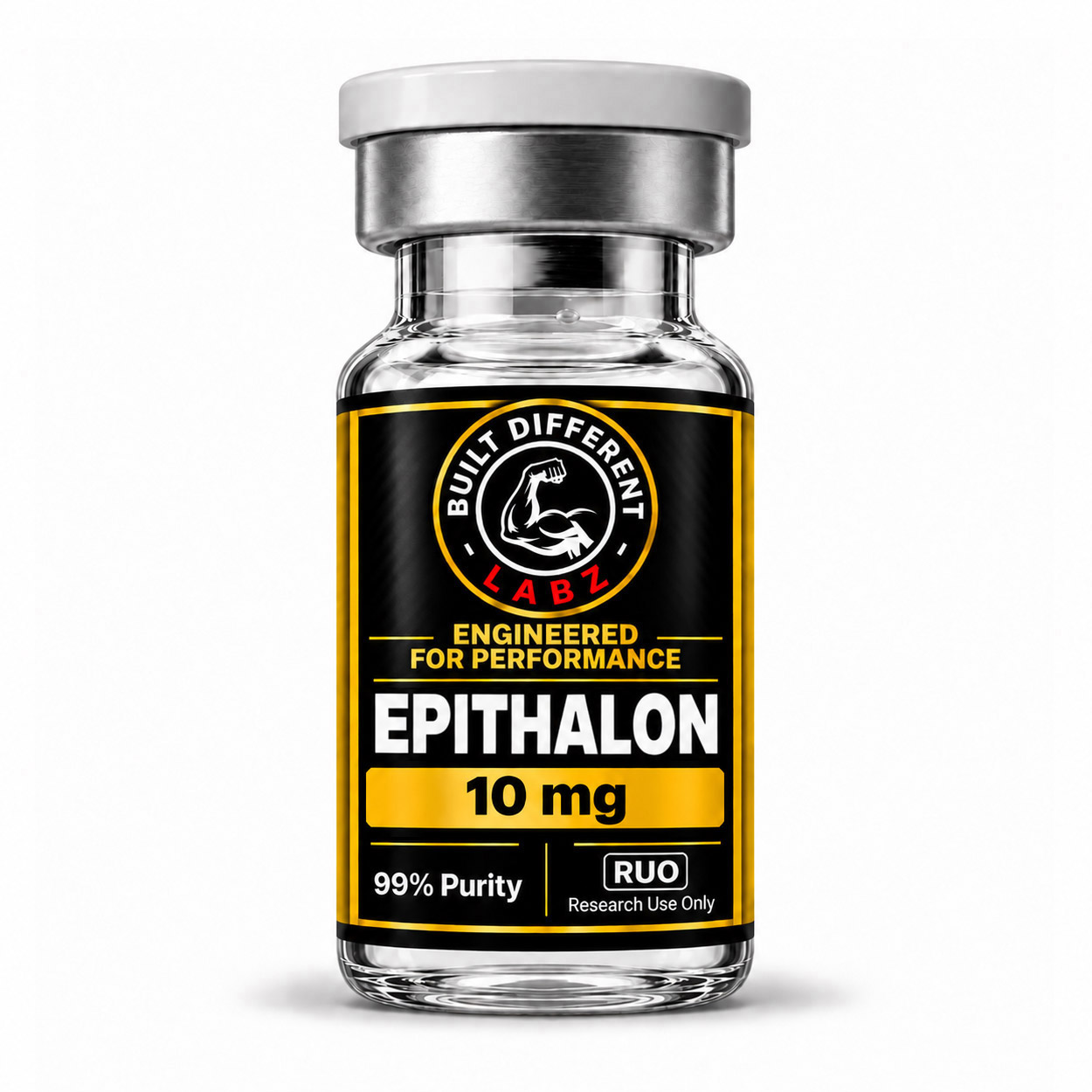
A vial labeled "Epithalon 10mg" represents a total of 10 milligrams of Epithalon in the vial. It does not mean that 10mg is an established or appropriate single human dose.
Epithalon is an extremely small peptide consisting of only four amino acids:
Alanine
Glutamic acid
Aspartic acid
Glycine
This produces the abbreviation:
AEDG
Despite its very small size, Epithalon has attracted considerable attention because experimental research has reported effects involving:
Telomerase
Telomeres
Melatonin
Circadian biology
Oxidative stress
Gene expression
Cellular aging
Neuroendocrine function
A 2025 scientific review identified telomerase activity, melatonin synthesis, antioxidant activity, neuroprotection and gene-expression effects among its major areas of investigation, while emphasizing that its precise mechanism remains unresolved. (PubMed Central (PMC))
These names generally refer to the same AEDG tetrapeptide.
Common spellings include:
Epithalon
Epitalon
Epithalone
Epitalone
AEDG peptide
Epitalon is particularly common in scientific literature.
Epithalon is extremely common in the research-peptide marketplace.
These should not be treated as identical.
Epithalamin:
A complex peptide preparation originally derived from animal pineal tissue.
Epithalon:
A chemically defined synthetic tetrapeptide with the sequence AEDG.
This distinction is particularly important when evaluating older human studies.
Research performed with Epithalamin cannot automatically be used as evidence that synthetic Epithalon produces the same clinical effects.
The pineal gland is a small endocrine structure located in the brain.
It is particularly important for production of:
Melatonin.
Melatonin participates in regulation of:
Sleep-wake cycles
Circadian rhythms
Seasonal biological rhythms
Neuroendocrine signaling
Because Epithalon emerged from pineal-peptide research, circadian and melatonin biology became major areas of investigation.
There is no single fully validated mechanism explaining all of Epithalon's reported biological effects.
Proposed mechanisms include:
Telomerase activation
Telomere regulation
Melatonin synthesis
Gene-expression regulation
Antioxidant activity
Neuroendocrine regulation
Cellular stress responses
Protein synthesis
Enzyme regulation
The molecule therefore appears considerably more complex biologically than its four-amino-acid structure might suggest.
Telomerase is the mechanism responsible for much of Epithalon's popularity in longevity research.
Telomerase is an enzyme capable of adding repetitive DNA sequences to the ends of chromosomes.
These chromosome ends are called:
Telomeres.
Experimental studies using cultured human cells have reported increased telomerase activity following Epithalon exposure. (PubMed Central (PMC))
This is scientifically interesting.
However:
Telomerase activation in cultured cells
does not equal
proven human life extension.
Telomeres are protective repetitive DNA structures located at the ends of chromosomes.
A useful analogy is the plastic cap at the end of a shoelace.
The cap helps prevent the shoelace from unraveling.
Telomeres similarly help protect chromosome ends.
During repeated cellular division, telomeres generally become progressively shorter.
Eventually, critically shortened telomeres can contribute to:
Cellular senescence
Reduced replication
Genomic instability
Altered tissue function
This is why telomere biology has become an important area of aging research.
Laboratory experiments involving cultured human cells have reported increased telomerase activity and changes consistent with telomere elongation.
This is one of Epithalon's most interesting experimental findings.
But there is an important limitation:
These findings were primarily produced in cells grown in laboratory conditions.
There is no robust evidence demonstrating that Epithalon reliably lengthens telomeres throughout the human body or that doing so produces meaningful life extension.
That has not been established in humans.
The scientifically appropriate statement is:
Epithalon has demonstrated telomerase-related and telomere-related effects in experimental cellular models.
The claim:
"Epithalon reverses human telomere aging"
goes substantially beyond the evidence.
Cellular senescence occurs when cells stop dividing while remaining metabolically active.
Senescent cells can accumulate with age and potentially contribute to:
Chronic inflammation
Tissue dysfunction
Altered cellular signaling
Epithalon is not considered a direct senolytic.
It does not primarily work by killing senescent cells.
Its research instead focuses more heavily on:
Telomere biology
Cellular regulation
Gene expression
Neuroendocrine function
These compounds represent very different approaches to aging research.
Epithalon:
Telomerase research
Telomere biology
Pineal function
Melatonin
Gene regulation
FOXO4-DRI:
Experimental senolytic
FOXO4-p53 interaction
Selective elimination of certain senescent cells
Therefore:
Epithalon = cellular longevity and regulatory research.
FOXO4-DRI = experimental senescent-cell elimination.
Longevity is the primary reason Epithalon became widely known.
Animal experiments have reported increased lifespan in certain experimental models.
However, lifespan results from animal studies cannot automatically be extrapolated to humans.
There is currently no robust evidence demonstrating that Epithalon extends human lifespan.
This has not been demonstrated.
The distinction is extremely important.
Research has reported:
Telomerase effects in cells
Telomere-related effects
Lifespan effects in some animal models
Neuroendocrine effects
Melatonin-related effects
But there has never been a large, modern human trial demonstrating that people receiving Epithalon live longer.
Epithalon is frequently described as an "anti-aging peptide."
Scientifically, a better description is:
An experimental peptide investigated in several biological processes associated with aging.
Those processes include:
Telomere shortening
Oxidative stress
Circadian disruption
Neuroendocrine aging
Gene-expression changes
Influencing an aging-related mechanism does not necessarily mean aging itself has been reversed.
Melatonin is another important area of Epithalon research.
Experimental studies have reported effects on melatonin synthesis and pineal function. (PubMed Central (PMC))
Melatonin is produced primarily during darkness and helps coordinate the body's circadian clock.
This provides a biological rationale for studying Epithalon in:
Sleep
Circadian rhythms
Age-related melatonin decline
Neuroendocrine regulation
Experimental research suggests Epithalon can influence melatonin synthesis.
However, the magnitude, reliability and clinical significance of this effect in healthy humans remain insufficiently established.
It should not be assumed that Epithalon simply functions as a long-lasting melatonin supplement.
Because of its association with pineal function and melatonin, Epithalon is frequently discussed in relation to sleep.
Potential research interests include:
Sleep-wake timing
Circadian rhythm
Sleep quality
Age-related sleep changes
However, Epithalon is not an established insomnia medication.
Melatonin:
Is an actual hormone involved directly in circadian signaling.
Epithalon:
Is a peptide proposed to influence pineal and neuroendocrine regulation, potentially including melatonin production.
Therefore, Epithalon does not simply replace melatonin.
Circadian rhythms are approximately 24-hour biological cycles controlling numerous physiological processes.
These include:
Sleep
Hormone secretion
Body temperature
Metabolism
Immune function
Alertness
Melatonin is one of the major signals coordinating these rhythms.
Epithalon's reported effects on pineal biology make circadian regulation an important research area.
Epithalon originated from pineal-related peptide research but has also been investigated for broader neuroendocrine and neurological effects.
Potential areas include:
Neuronal protection
Oxidative stress
Gene regulation
Age-related neurological changes
It should not, however, be considered an established treatment for neurological disease.
Laboratory studies have investigated potential neuroprotective effects of AEDG.
Reported areas include:
Reduced oxidative damage
Neuronal morphology
Cellular stress responses
Gene regulation
A recent review also summarized experimental evidence suggesting effects on neuronal structure and oxidative DNA damage. (PubMed Central (PMC))
Human neuroprotection remains unproven.
There is insufficient evidence demonstrating that Epithalon significantly improves memory in healthy humans.
Its proposed neuroprotective effects make cognition scientifically interesting, but it should not be marketed as a proven memory enhancer.
There is currently insufficient evidence demonstrating that Epithalon prevents age-related cognitive decline.
It is not an established treatment for:
Mild cognitive impairment
Alzheimer's disease
Dementia
Epithalon should not be described as an Alzheimer's treatment.
Alzheimer's disease involves multiple pathological processes including:
Amyloid
Tau
Neuroinflammation
Synaptic dysfunction
Neuronal loss
General anti-aging or neuroprotective findings do not establish disease-modifying activity.
There is likewise insufficient evidence demonstrating that Epithalon treats Parkinson's disease.
It is not an established dopaminergic medication.
Oxidative stress occurs when reactive oxygen species exceed the body's antioxidant defenses.
Oxidative damage can affect:
DNA
Proteins
Cell membranes
Mitochondria
Experimental Epithalon research has reported antioxidant-related effects and changes involving antioxidant enzymes. (PubMed Central (PMC))
This contributes to its broader geroprotective research profile.
Mitochondria produce much of the ATP required for cellular energy.
Mitochondrial dysfunction is strongly associated with aging.
Recent experimental research has investigated Epithalon in relation to:
Mitochondrial health
Reactive oxygen species
SIRT1
PGC-1 alpha
Mitochondrial transcription factors
These findings are interesting but predominantly preclinical. (PubMed Central (PMC))
SS-31:
Primarily targets mitochondrial cardiolipin and mitochondrial membrane function.
Epithalon:
Primarily associated with telomeres, pineal function, gene regulation and aging biology.
Therefore:
SS-31 = mitochondria-targeting peptide.
Epithalon = broader longevity and peptide-bioregulator research.
Like several short peptide bioregulators, Epithalon has been investigated for effects on gene expression.
Potential mechanisms include interactions involving:
DNA
Chromatin
Transcription factors
Gene promoters
These effects could potentially alter production of proteins involved in:
Antioxidant defense
Cellular survival
Metabolism
Neuroendocrine function
Epithalon should not be confused with gene editing.
Gene expression means changing how actively particular genes are transcribed.
It does not necessarily change the underlying DNA sequence.
Therefore:
Epithalon is not CRISPR.
It is not gene therapy.
It does not permanently rewrite a person's genetic code.
SIRT1 is a cellular regulatory protein frequently associated with:
Metabolism
Mitochondrial function
Cellular stress
Aging research
Recent experimental studies have reported changes in SIRT1-related pathways following Epithalon exposure.
This provides another potential connection between AEDG and cellular aging biology.
However, this does not establish Epithalon as a clinically validated SIRT1 therapy.
This is one of the most complicated areas of Epithalon research.
Telomerase immediately raises cancer-related questions because many cancer cells use telomerase to maintain their telomeres and continue dividing.
This does not automatically mean that a compound increasing telomerase activity causes cancer.
Some animal research involving Epithalon has actually reported reduced tumor incidence or other potentially protective findings.
However, neither direction is sufficiently established in humans.
It is inappropriate to claim that Epithalon:
Causes cancer
Prevents cancer
Treats cancer
Long-term human safety remains insufficiently characterized.
Telomerase represents a biological tradeoff.
In normal cells:
Telomerase could potentially help maintain telomeres.
In malignant cells:
Telomerase can help support continued cellular replication.
Therefore, "more telomerase is always better" is not scientifically correct.
The relationship between telomeres, aging and cancer is considerably more complex.
Experimental research has reported effects involving immune signaling, including changes involving interleukin-related pathways.
This has led to interest in:
Immune aging
Thymic function
Inflammatory regulation
However, Epithalon should not simply be described as an "immune booster."
Chronic low-grade inflammation frequently increases with age.
This phenomenon is sometimes called:
Inflammaging.
Epithalon's reported effects on cellular stress and immune signaling make inflammation relevant to its longevity research.
Direct clinical anti-inflammatory effects in humans remain insufficiently established.
Aging affects:
Blood vessels
Endothelial function
Blood pressure
Mitochondria
Oxidative stress
Because Epithalon has been investigated in broad aging models, cardiovascular effects are theoretically interesting.
However, it is not an established cardiovascular medication.
Some experimental studies have investigated peptide bioregulators and age-related reproductive changes.
However, Epithalon is not an established fertility medication or hormone-replacement treatment.
Epithalon does not primarily target:
GnRH
LH
FSH
Testosterone
There is no strong evidence that Epithalon significantly increases testosterone in healthy humans.
Epithalon is not known to suppress testosterone production in the manner of anabolic steroids.
No traditional steroid-style post-cycle therapy is associated with Epithalon.
It is not an androgenic compound.
Epithalon is not a conventional growth hormone secretagogue.
It should not be grouped mechanistically with:
CJC-1295
Sermorelin
Tesamorelin
Ipamorelin
Its primary research mechanisms involve pineal, cellular and longevity-related biology rather than direct pituitary GH stimulation.
Epithalon is not a muscle-building peptide.
It does not have established direct anabolic activity comparable with:
Testosterone
HGH
IGF-1
Anabolic steroids
Epithalon is not a conventional fat-loss peptide.
It is not known to produce major direct effects on:
Appetite suppression
Lipolysis
GLP-1 signaling
Amylin signaling
Claims of dramatic Epithalon-induced fat loss are not supported.
Epithalon sometimes appears in bodybuilding longevity programs.
Its proposed role is usually related to:
Sleep
Recovery
Cellular aging
General wellness
rather than direct muscle growth.
There is insufficient evidence demonstrating meaningful improvements in bodybuilding performance.
There is no strong evidence that Epithalon significantly improves:
Strength
Speed
Endurance
VO2 max
Muscle hypertrophy
in healthy athletes.
Both are short peptide bioregulators.
Epithalon:
AEDG
Four amino acids
Pineal and longevity research
Telomeres
Melatonin
Pinealon:
EDR
Three amino acids
Brain and neurological research
Cognition
Neuroprotection
They should not be treated as interchangeable.
Cortagen:
AEDP
Cerebral cortex and nervous-system research
Nerve regeneration
Gene expression
Epithalon:
AEDG
Pineal and aging research
Telomerase
Telomeres
Melatonin
Interestingly, their sequences differ by only the final amino acid.
Cortagen ends in:
Proline.
Epithalon ends in:
Glycine.
Small sequence differences can produce substantially different biological behavior.
Chonluten:
EDG
Respiratory-system bioregulator
Lung and bronchial tissue research
Epithalon:
AEDG
Pineal and aging bioregulator
Telomere and circadian research
Again, similar-looking short sequences should not be assumed to produce identical biological effects.
NAD-related longevity strategies primarily focus on:
Cellular metabolism
Redox reactions
Sirtuins
Mitochondrial function
Epithalon focuses more heavily on:
Telomeres
Telomerase
Pineal function
Melatonin
Gene regulation
There may be overlap in downstream aging biology, but their proposed primary mechanisms differ.
A vial labeled:
"Epithalon 10mg"
means the supplier represents the vial as containing a total of 10 milligrams of Epithalon.
The 10mg represents total vial content.
It should not be interpreted as an established single administration amount.
There is no FDA-approved Epithalon dosing regimen for longevity, anti-aging, sleep, telomere maintenance or general wellness.
Research suppliers commonly provide Epithalon as lyophilized material.
The fact that a product comes in an injectable-style vial does not establish that it is an approved injectable medication.
Quality considerations include:
Correct AEDG sequence
Chemical identity
Purity
Vial quantity
Sterility
Endotoxins
Stability
Manufacturing conditions
Because Epithalon consists of only four amino acids, oral administration has received some research interest.
However, oral peptide effectiveness depends on:
Digestion
Enzymatic degradation
Intestinal absorption
Formulation
Bioavailability
The existence of oral products does not establish predictable systemic exposure.
Reliable modern human pharmacokinetic information is limited.
There is no sufficiently established human profile defining:
Precise circulating half-life
Peak concentration
Bioavailability
Tissue distribution
Effective duration
Therefore, highly precise pharmacokinetic claims made by research-product suppliers should be treated cautiously.
Epithalon does not have the extensive adverse-event database expected for an approved pharmaceutical.
Potential adverse effects reported or theoretically possible with experimental peptide products include:
Headache
Dizziness
Fatigue
Nausea
Sleep changes
Changes in dream intensity
Injection-site irritation
Redness
Hypersensitivity reactions
This should not be interpreted as a complete established side-effect profile.
This is particularly important for a peptide marketed around longevity.
There is insufficient long-term human evidence establishing the consequences of repeated Epithalon exposure.
Important unanswered questions include:
Long-term telomerase effects
Cancer-related implications
Immune effects
Endocrine effects
Reproductive effects
Neurological effects
Drug interactions
Effects on abnormal cells
A recent gerontology review similarly characterizes Epitalon as unapproved, supported by small clinical studies, and lacking long-term safety data and large Western randomized trials. (PubMed Central (PMC))
Research peptide quality can vary considerably.
Potential problems include:
Incorrect sequence
Incorrect peptide identity
Incorrect vial quantity
Chemical impurities
Degradation products
Endotoxins
Bacterial contamination
Poor sterility
With a four-amino-acid peptide, confirming the precise AEDG sequence is especially important.
HPLC can help evaluate chemical purity.
Mass spectrometry can help confirm molecular identity.
However, a claim of 99 percent purity does not automatically establish:
Sterility
Endotoxin levels
Exact vial quantity
Pharmaceutical manufacturing quality
Human safety
Clinical effectiveness
These are separate characteristics.
Research Use Only, or RUO, means a particular product is marketed for laboratory or analytical research rather than as an approved medication for human treatment.
An RUO Epithalon vial should not be treated as an FDA-approved longevity medication.
No.
Epithalon is not FDA approved for:
Anti-aging
Longevity
Telomere extension
Telomerase activation
Sleep improvement
Circadian disorders
Cognitive enhancement
Cancer prevention
Neuroprotection
General wellness
There is no FDA-approved Epithalon human dosing regimen.
Chemical identity as AEDG:
Well defined.
Effects on telomerase in cultured cells:
Promising experimental evidence.
Telomere-related cellular effects:
Promising experimental evidence.
Melatonin and pineal biology:
Interesting experimental evidence.
Antioxidant activity:
Promising preclinical evidence.
Neuroprotective effects:
Preclinical evidence.
Animal longevity:
Interesting but not directly transferable to humans.
Human telomere extension:
Not established.
Human aging reversal:
Not established.
Human lifespan extension:
Not established.
Cancer prevention:
Not established.
Cognitive enhancement:
Not established.
Athletic enhancement:
Not established.
Long-term human safety:
Insufficiently characterized.
The evidence base is unusual because Epithalon has accumulated a considerable amount of experimental literature, but much of it originates from a relatively concentrated research tradition and lacks the large independent clinical replication expected for a modern longevity therapy. (PubMed Central (PMC))
Epithalon is interesting because it targets several biological processes strongly associated with aging rather than simply influencing one conventional hormone receptor.
The theoretical model is:
Epithalon
Pineal and cellular regulatory signaling
Telomerase and telomere effects
Melatonin and circadian regulation
Antioxidant and gene-expression effects
Potential influence on age-related cellular function
This combination explains why AEDG has remained interesting to longevity researchers for decades.
The biggest limitation is the gap between fascinating cellular biology and demonstrated human longevity.
It is reasonable to say:
Epithalon has produced interesting telomerase, telomere, melatonin, antioxidant and longevity-related findings in experimental research.
It is not reasonable to say:
Epithalon has been proven to reverse human aging or extend human lifespan.
Those are fundamentally different claims.
Even the recent comprehensive scientific literature continues to describe Epithalon's exact mechanism as incompletely understood, with significant gaps remaining in its structural, pharmacological and clinical characterization. (PubMed Central (PMC))
Epithalon, also known as Epitalon, is an experimental four-amino-acid peptide with the sequence Ala-Glu-Asp-Gly, abbreviated AEDG.
Its primary research areas include:
Telomerase
Telomeres
Cellular aging
Longevity
Pineal-gland function
Melatonin
Circadian rhythms
Gene expression
Oxidative stress
Neuroendocrine regulation
"Epithalon 10mg" describes the represented total amount of peptide contained in a vial. It should not be interpreted as a recommended 10mg dose.
The most accurate description is:
Epithalon is an experimental AEDG tetrapeptide derived from pineal peptide research and studied extensively for potential effects on telomerase, telomere biology, melatonin synthesis, circadian regulation, oxidative stress and cellular aging. Laboratory and animal findings make it an interesting longevity-research peptide, but they do not establish that Epithalon reverses human aging, prevents age-related disease, or extends human lifespan. Human clinical evidence remains limited, its long-term safety is insufficiently characterized, and Epithalon is not an FDA-approved anti-aging or longevity treatment.
We do not accept returns or issue refunds for any reason, beside manufacturing defects.
Feel free to contact us if you have any questions or concerns about our Return Policy.