We offer FREE SHIPPPING on all orders!
We offer FREE SHIPPPING on all orders!
| THIS PRODUCT IS INTENDED AS A RESEARCH CHEMICAL ONLY. This designation allows the use of research chemicals strictly for invitro testing and laboratory experimentation only. All product information available on this website is for educational purposes only. Bodily introduction of any kind into humans or animals is strictly prohibited by law. This product should only be handled by licensed, qualified professionals. This product is not a drug, food, or cosmetic and may not be misbranded, misused or mislabeled as a drug, food, or cosmetic. |
VIP stands for:
Vasoactive Intestinal Peptide.
VIP is a naturally occurring 28-amino-acid neuropeptide found throughout the human body. Despite the word "intestinal" in its name, VIP is not limited to the gastrointestinal tract. It functions as an important signaling molecule in the:
Nervous system
Lungs and airways
Gastrointestinal tract
Cardiovascular system
Immune system
Pancreas
Blood vessels
Reproductive system
VIP is particularly interesting because it combines several biological activities within one peptide, including:
Vasodilation
Smooth-muscle relaxation
Bronchodilation
Immune modulation
Anti-inflammatory signaling
Intestinal secretion
Neurotransmission
Circadian signaling
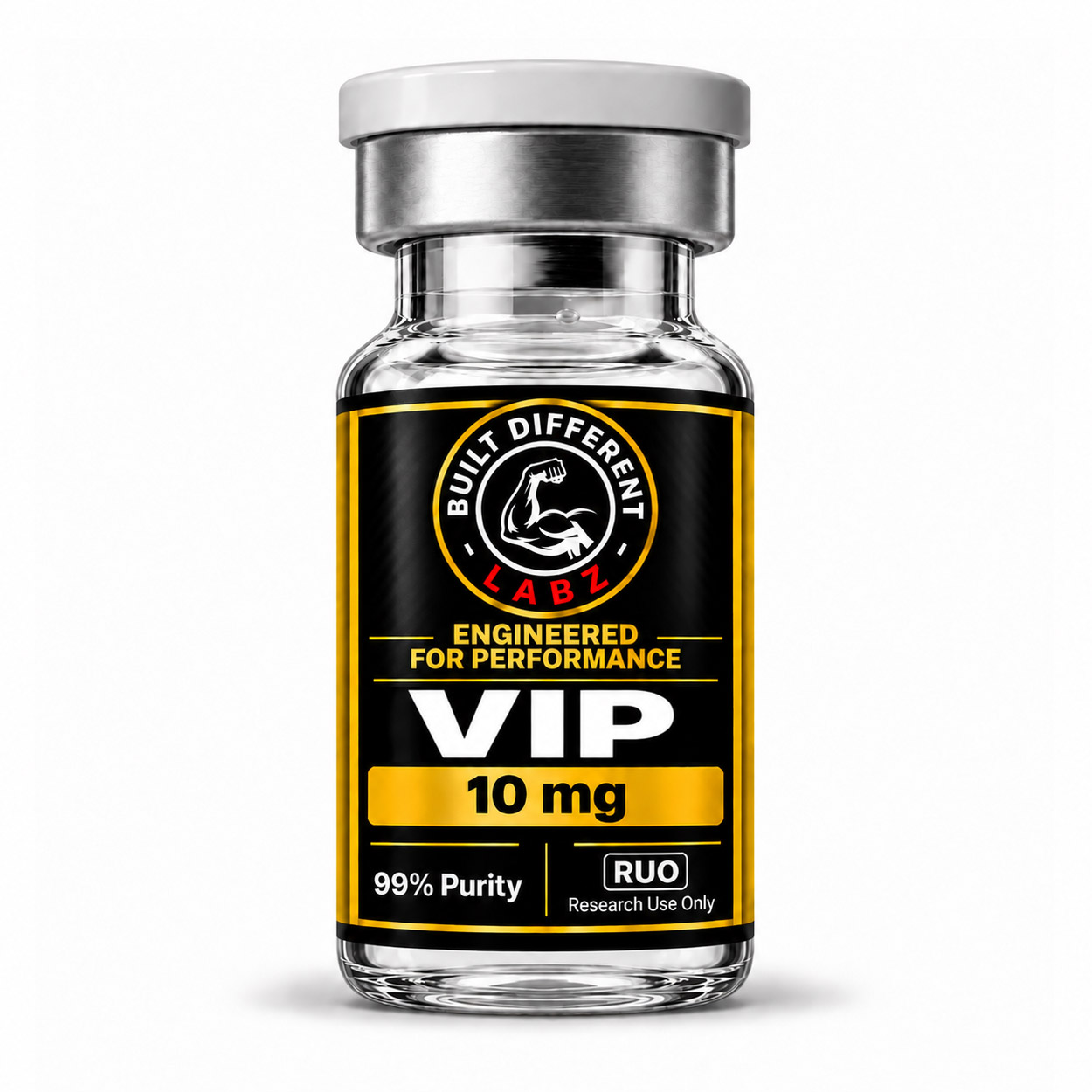
A vial labeled "VIP 10mg" represents a total of 10 milligrams of represented VIP material in the vial. It does not mean that 10mg is an established or appropriate single human dose.
VIP was originally identified because of its ability to produce powerful vascular and intestinal effects.
It was subsequently discovered throughout the nervous system and numerous organs.
VIP functions as both:
A neuropeptide
and:
A signaling hormone.
It belongs to a peptide family that includes molecules such as:
PACAP
Secretin
Glucagon
GLP-related peptides
These peptides share certain structural and evolutionary relationships but have distinct receptor profiles and physiological roles.
Human VIP contains:
28 amino acids.
Its biological activity depends on its specific amino-acid sequence and three-dimensional interactions with its receptors.
Because natural VIP is rapidly degraded in the body, its relatively short biological persistence has historically been an important limitation in pharmaceutical development.
VIP primarily activates two G-protein-coupled receptors:
VPAC1
and:
VPAC2.
It can also interact less strongly with:
PAC1.
The simplified pathway is:
VIP
VPAC1 or VPAC2
G-protein signaling
Adenylyl cyclase activation
Increased cyclic AMP
Protein kinase A and downstream signaling
Changes in smooth muscle, blood vessels, immune cells and other tissues.
cAMP stands for:
Cyclic Adenosine Monophosphate.
It is an important intracellular second messenger.
A receptor on the outside of a cell can detect a signal such as VIP.
The receptor then causes changes inside the cell through molecules such as cAMP.
This allows a relatively small extracellular signal to produce substantial cellular effects.
VPAC1 receptors are found in numerous tissues, including:
Gastrointestinal tract
Immune cells
Lungs
Liver
Various peripheral tissues
VPAC1 signaling is particularly relevant to:
Immune regulation
Intestinal function
Smooth-muscle activity
VPAC2 receptors are also widely distributed.
They have important roles involving:
Circadian rhythms
Smooth muscle
Lungs
Pancreas
Immune signaling
Central nervous system
VPAC2 is especially interesting in relation to the body's biological clock.
The word:
Vasoactive
reflects one of VIP's most important properties.
VIP is a powerful vasodilatory peptide.
Vasodilation means:
Relaxation and widening of blood vessels.
This can increase blood flow and decrease vascular resistance.
VIP can increase cAMP in vascular smooth-muscle cells.
This promotes smooth-muscle relaxation.
The simplified effect is:
VIP receptor activation
Increased cAMP
Smooth-muscle relaxation
Blood-vessel dilation
Reduced vascular resistance.
This is one reason excessive systemic VIP activity can potentially produce:
Low blood pressure.
Because VIP can dilate blood vessels, systemic exposure can potentially reduce blood pressure.
Possible symptoms associated with excessive vasodilation can include:
Dizziness
Lightheadedness
Flushing
Weakness
Rapid heartbeat
Fainting
This makes cardiovascular monitoring particularly relevant when VIP is studied systemically.
VIP is widely distributed within the respiratory system.
It participates in regulation of:
Airway smooth muscle
Pulmonary blood vessels
Inflammation
Mucus
Immune responses
These properties have generated significant interest in VIP-related respiratory research.
Bronchodilation means:
Relaxation of airway smooth muscle.
VIP can relax bronchial smooth muscle through receptor-mediated cAMP signaling.
This gives VIP legitimate biological relevance to airway physiology.
However, research-market VIP should not be treated as a replacement for established rescue inhalers or other approved respiratory medications.
VIP can also influence pulmonary vascular tone.
This has generated research interest in conditions involving abnormal pressure in pulmonary blood vessels.
However, native VIP's short half-life creates pharmaceutical challenges.
VIP is frequently described as an anti-inflammatory peptide.
A more precise description is:
Immunomodulatory.
VIP can influence immune-cell behavior and inflammatory signaling.
Potentially affected cells include:
T cells
Macrophages
Dendritic cells
Monocytes
VIP-related signaling can influence production of cytokines.
Experimental research has investigated effects involving inflammatory mediators such as:
TNF-alpha
IL-6
IL-12
and regulatory or anti-inflammatory signaling such as:
IL-10.
The exact effect depends on:
Cell type
Receptor expression
Disease state
Tissue
Concentration
VIP therefore should not simply be described as turning inflammation "off."
VIP can influence the balance between different immune responses.
This has generated research involving:
Autoimmune disease
Inflammatory disorders
Sepsis
Pulmonary inflammation
Gastrointestinal inflammation
However, broad immune modulation can have both beneficial and undesirable effects.
Suppressing excessive inflammation may be beneficial in one situation while weakening appropriate immune responses could be undesirable in another.
VIP has been investigated experimentally in models involving autoimmune and inflammatory conditions.
These include research relevant to:
Rheumatoid arthritis
Inflammatory bowel disease
Multiple sclerosis-related models
Autoimmune inflammation
These findings do not establish research VIP as an approved treatment for these diseases.
VIP has extensive physiological functions within the GI tract.
It can influence:
Intestinal smooth muscle
Water secretion
Electrolyte secretion
Pancreatic secretion
Blood flow
Sphincter relaxation
Gut motility
This explains the "intestinal" portion of its name.
VIP can stimulate intestinal secretion of:
Water
Electrolytes
At physiological levels, this participates in normal digestive function.
Excessive VIP signaling can produce substantial diarrhea.
VIP's biological potency is dramatically illustrated by a rare neuroendocrine tumor called:
VIPoma.
VIPomas can produce excessive amounts of VIP.
This can cause a syndrome characterized by:
Severe watery diarrhea
Low potassium
Dehydration
Reduced stomach acid
This is sometimes referred to as:
WDHA syndrome.
WDHA stands for:
Watery Diarrhea
Hypokalemia
Achlorhydria.
VIPoma demonstrates that excessive VIP activity can be medically serious.
Severe VIP-driven diarrhea can cause major electrolyte losses.
One particularly important electrolyte is:
Potassium.
Very low potassium can potentially cause:
Weakness
Muscle problems
Abnormal heart rhythms
This illustrates why VIP should not be considered a harmless wellness peptide simply because it occurs naturally in the body.
VIP can influence pancreatic function and gastrointestinal secretions.
It interacts with metabolic and digestive signaling systems.
However, VIP is not primarily an obesity or diabetes medication.
VIP can influence pancreatic endocrine activity experimentally.
However, it should not be confused with:
Insulin
GLP-1
GIP
VIP does not have the same established metabolic role as semaglutide or tirzepatide.
Semaglutide primarily activates:
GLP-1 receptors.
VIP primarily activates:
VPAC1 and VPAC2 receptors.
Semaglutide:
Appetite
Satiety
Glucose regulation
Obesity treatment
VIP:
Vasodilation
Smooth-muscle relaxation
Immune modulation
Pulmonary signaling
GI secretion
Neurotransmission
They are fundamentally different peptides.
VIP functions as a neuropeptide within the central nervous system.
It participates in:
Neuronal signaling
Circadian rhythms
Neuroendocrine regulation
Learning and memory-related processes
Stress signaling
One particularly important area is the biological clock.
VIP is an important signaling molecule within the:
Suprachiasmatic nucleus.
The suprachiasmatic nucleus, or SCN, is located in the hypothalamus.
It acts as one of the body's principal circadian clocks.
VIP helps synchronize individual neurons within the SCN.
Different biological-clock neurons need to coordinate with each other.
VIP signaling helps synchronize these cellular clocks.
The simplified concept is:
Light information
SCN
VIP signaling
Synchronization of circadian neurons
Coordinated daily biological rhythm.
This makes VIP important to fundamental circadian biology.
Because VIP participates in circadian signaling, it has an indirect relationship with:
Sleep timing
Wake timing
Hormonal rhythms
Daily physiological cycles
However, VIP is not a conventional sleeping medication.
Administering VIP should not automatically be expected to improve insomnia.
Melatonin and VIP both participate in circadian biology but perform different functions.
VIP:
Helps coordinate neuronal signaling within the biological clock.
Melatonin:
Provides a hormonal signal associated strongly with darkness and nighttime.
They are not interchangeable.
VIP has attracted experimental interest involving:
Neuronal survival
Neuroinflammation
Brain injury
Neuroprotective signaling
Some related research involves VIP-derived or VIP-related compounds designed to improve stability or tissue targeting.
These findings remain separate from proving native research VIP as a neurological therapy.
PACAP stands for:
Pituitary Adenylate Cyclase-Activating Polypeptide.
VIP and PACAP belong to the same broader peptide family.
They share receptor interactions.
VIP strongly activates:
VPAC1 and VPAC2.
PACAP activates:
PAC1
as well as:
VPAC receptors.
The two peptides overlap biologically but are not identical.
VIP can influence:
Heart rate
Vascular tone
Coronary blood flow
Autonomic signaling
Its vasodilatory effects can indirectly change cardiac workload.
Excessive systemic vasodilation may produce compensatory:
Tachycardia.
Tachycardia means an abnormally elevated heart rate.
Because VIP can relax smooth muscle and increase blood flow, it has been investigated in erectile physiology.
VIP participates in signaling within erectile tissue.
However, it works differently from PDE5 inhibitors such as sildenafil.
Sildenafil inhibits:
PDE5.
This increases cGMP signaling in erectile smooth muscle.
VIP primarily activates:
VPAC receptors
and increases:
cAMP.
Therefore, both can influence smooth-muscle relaxation through different signaling systems.
VIP is not simply a peptide version of sildenafil.
VIP receptors are found throughout reproductive tissues.
Research has investigated roles involving:
Sexual physiology
Reproductive signaling
Smooth-muscle activity
Hormonal regulation
However, VIP is not primarily a fertility medication or testosterone enhancer.
VIP does not primarily target:
GnRH
LH
FSH
Androgen receptors
It should not be classified as a testosterone-boosting peptide.
VIP is not known for the classic hypothalamic-pituitary-gonadal suppression associated with anabolic steroids.
Long-term high-exposure systemic human data remain limited.
No traditional steroid-style post-cycle therapy is inherently associated with VIP.
It is not an anabolic steroid or SARM.
VIP is not primarily a growth hormone secretagogue.
It does not work like:
CJC-1295
Sermorelin
Ipamorelin
GHRP-2
GHRP-6
Its principal receptors are VPAC1 and VPAC2.
VIP should not be classified as a direct anabolic muscle-building peptide.
It does not primarily activate:
Androgen receptors
GH receptors
IGF-1 receptors
Any influence on muscle physiology would be secondary to broader:
Blood-flow
Neural
Inflammatory
Metabolic
effects.
VIP participates in metabolic signaling and adipose-tissue biology, but it is not an established weight-loss medication.
It does not have the clinical obesity evidence associated with:
Semaglutide
Tirzepatide
and it should not be marketed as a direct fat-burning peptide.
VIP receptors and nerve fibers are present in skin.
VIP can influence:
Blood flow
Immune signaling
Inflammation
Skin-cell communication
However, VIP does not have the same collagen-focused cosmetic research profile as:
GHK-Cu.
VIP:
28-amino-acid neuropeptide with vascular, pulmonary, gastrointestinal, neural and immune effects.
KPV:
Three-amino-acid alpha-MSH-derived peptide investigated primarily for inflammatory, gastrointestinal and skin-related effects.
Both have immunomodulatory research, but their receptor biology and broader physiology are very different.
Thymosin Alpha-1:
Primarily an immunomodulatory peptide associated with T-cell, dendritic-cell and innate/adaptive immune function.
VIP:
Neuropeptide with immune effects plus substantial vascular, pulmonary, GI and neurological activity.
VIP therefore has much broader acute physiological effects on blood vessels and smooth muscle.
LL-37:
Naturally occurring antimicrobial host-defense peptide.
VIP:
Neuropeptide and vasodilatory signaling molecule.
LL-37 has direct antimicrobial activity.
VIP primarily modifies:
Vascular tone
Smooth muscle
Neural signaling
Immune responses
They should not be considered interchangeable immune peptides.
Respiratory research has been one of the most prominent modern areas of interest involving VIP-related pharmacology.
Potential mechanisms include:
Bronchodilation
Pulmonary vasodilation
Reduced inflammatory signaling
Protection of pulmonary epithelial cells
Immune modulation
However, native VIP has significant pharmacokinetic limitations.
Aviptadil is a synthetic form of human VIP that has undergone pharmaceutical and clinical investigation.
This is important because it demonstrates that VIP biology has genuine pharmaceutical interest.
However:
A research vial labeled "VIP 10mg"
is not automatically equivalent to:
A pharmaceutical aviptadil formulation used in controlled clinical development.
Manufacturing, formulation, concentration, sterility, route, and quality controls matter.
VIP-related compounds received substantial attention during the COVID-19 pandemic because of potential pulmonary and anti-inflammatory effects.
Clinical research investigated aviptadil in severely ill patients.
This does not establish research-market VIP as a proven treatment for COVID-19 or post-COVID conditions.
VIP is sometimes marketed in wellness communities in connection with:
Mold exposure
Chronic inflammatory response syndrome
Biotoxin illness
The biological fact that VIP participates in immune, pulmonary and neuroendocrine signaling does not by itself establish broad claims that VIP corrects a specific "mold illness" syndrome.
These claims require considerably stronger clinical evidence than mechanistic reasoning alone.
VIP has been incorporated into certain non-mainstream treatment frameworks for chronic inflammatory symptoms.
That should be distinguished from FDA-established indications supported by large controlled trials.
A biomarker abnormality or theoretical inflammatory pathway does not automatically prove that administering VIP improves a clinical syndrome.
A vial labeled:
"VIP 10mg"
means the supplier represents the vial as containing:
10 milligrams
of total VIP.
This describes total represented vial content.
It does not mean:
10mg equals one administration.
VIP is biologically active at much smaller quantities than the total mass represented in such a research vial, so vial content should never be interpreted as a single-use amount.
There is no FDA-approved dosing regimen for a research-market "VIP 10mg" vial.
Natural VIP is rapidly degraded.
Its circulating half-life is generally very short, on the order of minutes.
Enzymatic degradation is one of the major challenges associated with using native VIP therapeutically.
This has encouraged development of:
Modified VIP analogues
Specialized delivery systems
Alternative formulations
A short plasma half-life does not necessarily mean every downstream cellular effect ends immediately.
VIP has several pharmacological challenges:
Rapid degradation
Short circulating half-life
Powerful vasodilation
Broad receptor distribution
Potential gastrointestinal effects
An ideal pharmaceutical VIP-related therapy would need to balance:
Desired tissue effects
against:
Systemic adverse effects.
Because VIP has strong physiological effects, potential adverse effects are biologically predictable.
These can include:
Flushing
Headache
Dizziness
Lightheadedness
Low blood pressure
Increased heart rate
Nausea
Abdominal discomfort
Diarrhea
Injection-site reactions
Hypersensitivity
The actual frequency depends heavily on formulation, route and exposure.
Hypotension means:
Abnormally low blood pressure.
Because VIP is a potent vasodilator, excessive systemic exposure could produce:
Weakness
Dizziness
Blurred vision
Fainting
Rapid heartbeat
Significant hypotension can be medically serious.
VIP stimulates intestinal water and electrolyte secretion.
Excessive activity can therefore potentially produce:
Diarrhea
Fluid loss
Electrolyte loss
Dehydration
The physiology of VIPoma demonstrates how powerful this effect can become when VIP levels are extremely elevated.
Severe gastrointestinal fluid loss can alter:
Potassium
Sodium
Other electrolytes
Significant electrolyte abnormalities can affect:
Muscles
Nerves
Heart rhythm
This is one reason VIP exposure should not be treated casually.
Long-term systemic exposure to research-market VIP has not been adequately characterized.
Important areas include:
Cardiovascular effects
Chronic hypotension
GI effects
Electrolyte balance
Immune modulation
Receptor regulation
Neurological effects
Reproductive effects
Drug interactions
A quality VIP research product would need appropriate confirmation of:
Correct 28-amino-acid sequence
Molecular identity
Purity
Exact quantity
Biological potency
Stability
Because VIP is readily degraded, storage and formulation can significantly affect actual biological activity.
VIP stability can be affected by:
Temperature
pH
Light
Oxidation
Proteolytic degradation
Formulation
Container conditions
Repeated handling
A vial can therefore retain chemical material while losing some biological activity through degradation.
A supplier may report high HPLC purity.
That can provide useful chemical information.
However, 99 percent purity does not automatically establish:
Correct vial quantity
Biological potency
Sterility
Endotoxin levels
Stability
Pharmaceutical manufacturing quality
Human safety
These are separate measurements.
Chemical purity and sterility are different.
An injectable-style research vial can contain chemically pure VIP while still containing:
Bacteria
Fungi
Particulates
Endotoxins
Sterility requires appropriate manufacturing and microbiological controls.
Endotoxins are bacterial components capable of triggering powerful inflammatory reactions.
Potential effects include:
Fever
Chills
Low blood pressure
Severe inflammation
This is particularly relevant with VIP because VIP itself can alter vascular tone and blood pressure, potentially complicating interpretation of an adverse reaction.
RUO means:
Research Use Only.
A VIP vial carrying this designation is marketed for laboratory or analytical research rather than as an approved medication for human treatment.
RUO should not be interpreted as another term for prescription pharmaceutical VIP.
VIP itself is a naturally occurring human peptide with substantial physiological and pharmaceutical research.
However, a research-market product labeled:
"VIP 10mg"
should not be represented as an FDA-approved medication simply because VIP or VIP-related pharmaceutical formulations have undergone clinical investigation.
There is no broad FDA-approved indication for a generic research VIP vial for:
Lung disease
Asthma
COPD
COVID-19
Long COVID
Autoimmune disease
Inflammatory bowel disease
"Mold illness"
Chronic inflammatory response syndrome
Fat loss
Muscle growth
Anti-aging
General wellness
VIP as a naturally occurring human peptide:
Extremely strong.
VIP 28-amino-acid structure:
Well established.
VPAC1 and VPAC2 receptor biology:
Extremely strong.
cAMP signaling:
Extremely strong.
Vasodilation:
Very strong.
GI secretion:
Very strong.
Smooth-muscle relaxation:
Very strong.
Circadian signaling:
Very strong.
Pulmonary biology:
Strong.
Immune modulation:
Strong biological evidence.
Anti-inflammatory signaling:
Strong experimental evidence.
Bronchodilation:
Strong physiological evidence.
Aviptadil pharmaceutical research:
Meaningful human clinical research.
General treatment of chronic lung disease with research VIP:
Not established.
Autoimmune-disease treatment:
Not established.
IBD treatment:
Not established.
"Mold illness" treatment:
Not established.
Muscle building:
Not established.
Fat loss:
Not established.
Anti-aging:
Not established.
Human lifespan extension:
Not established.
Long-term systemic research-vial safety:
Insufficiently characterized.
VIP is unusual among research peptides because its fundamental physiology is exceptionally well established.
The basic biology is not speculative.
VIP genuinely participates in:
Blood-vessel regulation
Airway smooth-muscle signaling
Gastrointestinal function
Immune regulation
Neurotransmission
Circadian rhythm
The simplified concept is:
VIP
VPAC1 and VPAC2
cAMP signaling
Vasodilation
Smooth-muscle relaxation
Immune modulation
Neural and gastrointestinal effects.
This provides a strong scientific foundation for pharmaceutical research.
The biggest limitation is also created by VIP's broad biological activity.
VIP receptors exist throughout the body.
A compound capable of affecting:
Blood pressure
Airways
Intestinal secretion
Heart rate
Immune responses
Brain signaling
cannot be assumed to act only where a researcher wants it to act.
Its short natural half-life further complicates pharmaceutical use.
There is also a major difference between:
Understanding VIP physiology
and:
Demonstrating that an independently manufactured 10mg research vial safely treats a disease.
The first has decades of strong scientific evidence.
The second does not.
VIP, or Vasoactive Intestinal Peptide, is a naturally occurring 28-amino-acid neuropeptide with powerful effects throughout the nervous, cardiovascular, pulmonary, gastrointestinal and immune systems.
Its major research areas include:
Vasodilation
Blood-flow regulation
Bronchodilation
Pulmonary signaling
Immune modulation
Inflammatory signaling
Gastrointestinal function
Smooth-muscle relaxation
Circadian rhythm
Neuroprotection
Neuroendocrine signaling
"VIP 10mg" describes a represented total vial content of 10 milligrams. It should not be interpreted as a recommended 10mg dose.
The most accurate description is:
VIP is a naturally occurring 28-amino-acid neuropeptide that primarily activates VPAC1 and VPAC2 receptors and produces substantial cAMP-mediated effects involving blood vessels, smooth muscle, the lungs, gastrointestinal tract, immune system and nervous system. Its vasodilatory, bronchodilatory, gastrointestinal, immune-modulating and circadian functions are supported by extensive biological research, making VIP considerably better characterized physiologically than many experimental research peptides. However, its broad receptor distribution, powerful vascular and gastrointestinal effects, and short natural half-life create significant pharmaceutical challenges. A research-market VIP 10mg vial is not equivalent to a regulated pharmaceutical formulation, and claims involving chronic inflammatory disorders, pulmonary disease, "mold illness," anti-aging or general wellness extend well beyond what has been established for an independently manufactured research product.
We do not accept returns or issue refunds for any reason, beside manufacturing defects.
Feel free to contact us if you have any questions or concerns about our Return Policy.